QUESTION IMAGE
Question
6
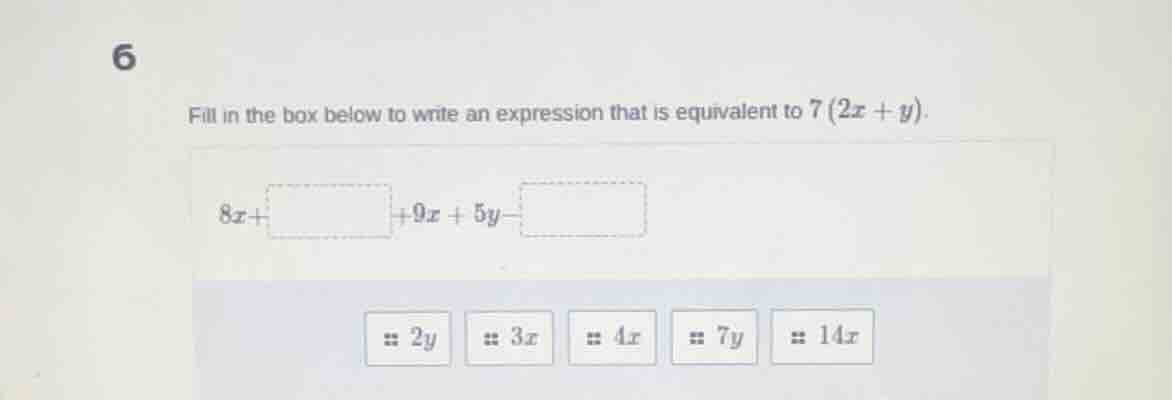
fill in the box below to write an expression that is equivalent to ( 7(2x + y) ).
( 8x + square + 9x + 5y - square )
( 2y ) ( 3x ) ( 4x ) ( 7y ) ( 14x )
Step1: Simplify the original expression
First, expand \(7(2x + y)\) using the distributive property. The distributive property states that \(a(b + c)=ab+ac\). So, \(7(2x + y)=7\times2x+7\times y = 14x + 7y\).
Step2: Combine like terms in the given expression
The given expression is \(8x+\square+9x + 5y-\square\). Combine the \(x\)-terms: \(8x + 9x=17x\). Let the first box be \(A\) (in terms of \(x\) or \(y\)) and the second box be \(B\) (in terms of \(x\) or \(y\)). So the expression becomes \((17x+A)+(5y - B)=17x+A + 5y-B\). We want this to equal \(14x + 7y\).
Step3: Solve for the first box (A) and the second box (B)
Let's handle the \(x\)-terms first: \(17x+A=14x\)? No, wait, maybe we made a mistake. Wait, actually, the expression is \(8x+\square+9x + 5y-\square\). Let's re - group: \((8x + 9x)+\square+(5y-\square)=17x+\square + 5y-\square\). We need \(17x+\square+5y - \square=14x + 7y\).
Let's consider the \(x\)-terms: Let the first square be a term with \(x\) (let's say \(ax\)) and the second square be a term with \(x\) (let's say \(bx\)) or \(y\). Wait, maybe a better approach: Let's assume the first box is a \(y\)-term and the second box is an \(x\)-term or vice - versa.
Wait, let's rewrite the target expression \(14x + 7y\) as \((8x+9x)+(5y + 2y)-(3x)\). Wait, \(8x + 9x=17x\), \(5y+2y = 7y\), and \(17x-3x = 14x\). Let's check:
\(8x + 2y+9x + 5y-3x=(8x + 9x-3x)+(2y + 5y)=14x+7y\), which matches \(7(2x + y)=14x + 7y\).
Let's verify:
First, expand \(7(2x + y)\): \(7\times2x+7\times y=14x + 7y\).
Now, compute \(8x + 2y+9x + 5y-3x\):
- Combine \(x\)-terms: \(8x+9x - 3x=(8 + 9-3)x=14x\)
- Combine \(y\)-terms: \(2y + 5y = 7y\)
So the first box should be \(2y\) and the second box should be \(3x\).

Snap & solve any problem in the app
Get step-by-step solutions on Sovi AI
Photo-based solutions with guided steps
Explore more problems and detailed explanations
First box: \(2y\), Second box: \(3x\)