QUESTION IMAGE
Question
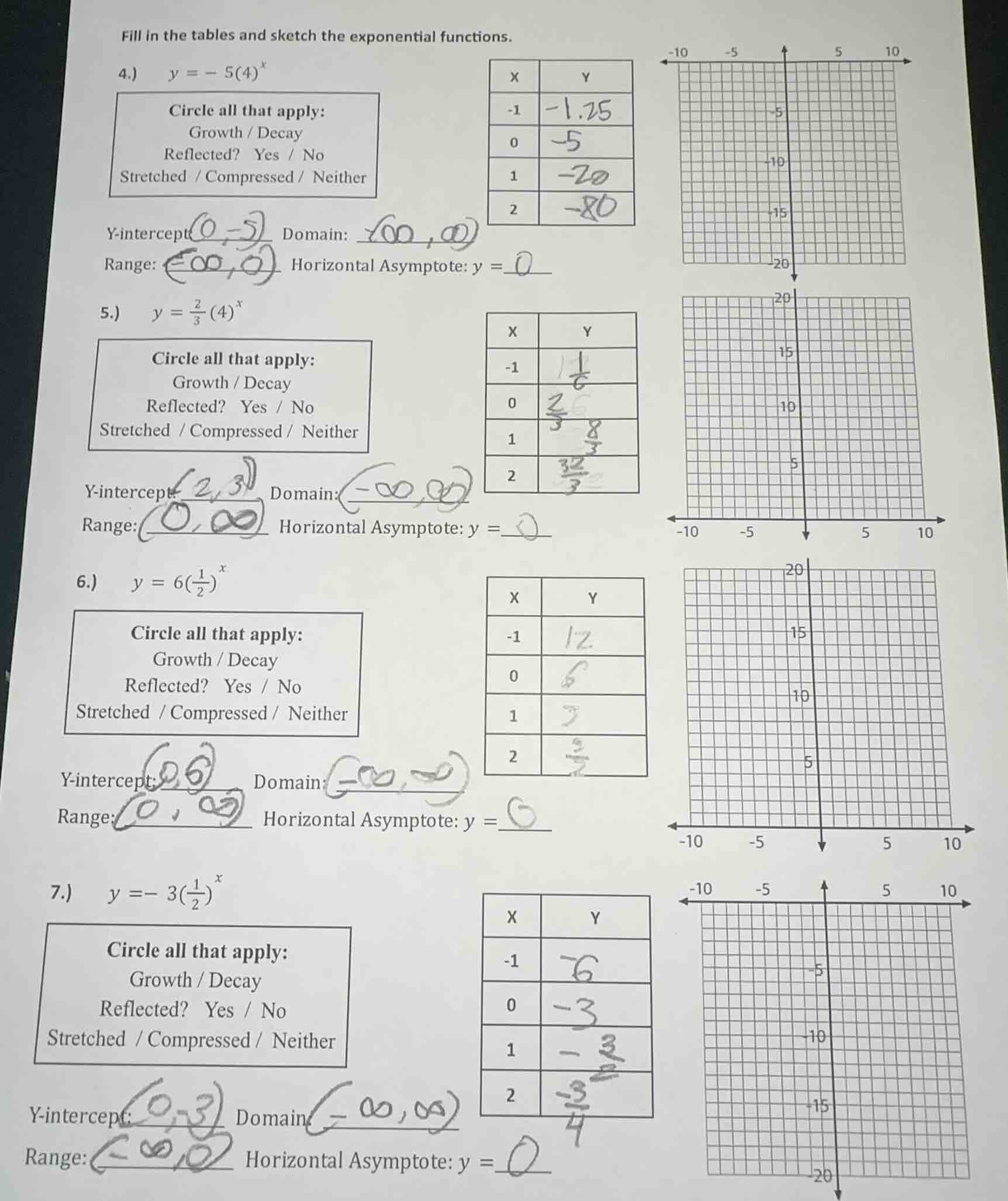
fill in the tables and sketch the exponential functions.
4.) \\( y = - 5(4)^{x} \\)
circle all that apply:
growth / decay
reflected? yes / no
stretched / compressed / neither
y - intercept: \\( \underline{\quad} \\) domain: \\( \underline{\quad} \\)
range: \\( \underline{\quad} \\) horizontal asymptote: \\( y = \underline{\quad} \\)
\\(\
\\)
5.) \\( y = \frac{2}{3}(4)^{x} \\)
circle all that apply:
growth / decay
reflected? yes / no
stretched / compressed / neither
y - intercept: \\( \underline{\quad} \\) domain: \\( \underline{\quad} \\)
range: \\( \underline{\quad} \\) horizontal asymptote: \\( y = \underline{\quad} \\)
\\(\
\\)
6.) \\( y = 6(\frac{1}{2})^{x} \\)
circle all that apply:
growth / decay
reflected? yes / no
stretched / compressed / neither
y - intercept: \\( \underline{\quad} \\) domain: \\( \underline{\quad} \\)
range: \\( \underline{\quad} \\) horizontal asymptote: \\( y = \underline{\quad} \\)
\\(\
\\)
7.) \\( y = - 3(\frac{1}{2})^{x} \\)
circle all that apply:
growth / decay
reflected? yes / no
stretched / compressed / neither
y - intercept: \\( \underline{\quad} \\) domain: \\( \underline{\quad} \\)
range: \\( \underline{\quad} \\) horizontal asymptote: \\( y = \underline{\quad} \\)
\\(\
\\)
Problem 4: \( y = -5(4)^x \)
Step 1: Determine Growth/Decay, Reflection, Stretch/Compression
- Growth/Decay: The base \( 4 > 1 \), but there's a negative sign. However, for growth/decay, we look at the base. Since \( 4 > 1 \), if it were positive, it would be growth, but the negative reflects it. But the "Growth/Decay" is about the magnitude. Wait, actually, the standard exponential function is \( y = ab^x \). If \( b > 1 \), it's growth; if \( 0 < b < 1 \), it's decay. Here \( b = 4 > 1 \), but the negative sign reflects over the x - axis. But for the "Growth/Decay" classification, since \( b>1 \), the underlying function (without reflection) is growth, but with reflection, the magnitude still increases as \( x \) increases (since \( 4^x \) increases, and we multiply by - 5, so \( |y| \) increases). But actually, the correct way: if \( b > 1 \), it's growth (even with reflection, the function is growing in magnitude, but reflected). Wait, no, the "Growth" means the function values (in absolute value) increase as \( x \) increases. So since \( b = 4>1 \), it's Growth? Wait, no, let's check the table. When \( x=-1 \), \( y=-5(4)^{-1}=-5\times\frac{1}{4}=-1.25 \); \( x = 0 \), \( y=-5 \); \( x = 1 \), \( y=-20 \); \( x = 2 \), \( y=-80 \). As \( x \) increases, \( y \) (which is negative) becomes more negative, so the magnitude increases. So it's Growth? Wait, no, decay is when the magnitude decreases. Wait, maybe I was wrong. Let's recall: for \( y = ab^x \), if \( b>1 \), it's exponential growth (the function increases as \( x \) increases when \( a>0 \)); if \( a < 0 \), it's a reflection, but the "growth/decay" is about the base. So since \( b = 4>1 \), it's Growth.
- Reflected?: The original exponential function \( y = 5(4)^x \) is above the x - axis. Our function is \( y=-5(4)^x \), which is below the x - axis, so it's reflected over the x - axis. So Yes.
- Stretched/Compressed/Neither: The coefficient \( |a| = 5>1 \), so it's stretched vertically.
Step 2: Y - intercept
The y - intercept is when \( x = 0 \). Substitute \( x = 0 \) into \( y=-5(4)^x \), we get \( y=-5(4)^0=-5\times1=-5 \). So the y - intercept is \( (0, - 5) \).
Step 3: Domain
For any exponential function \( y = ab^x \), the domain is all real numbers, \( (-\infty,\infty) \).
Step 4: Range
As \( x
ightarrow\infty \), \( 4^x
ightarrow\infty \), so \( y=-5(4)^x
ightarrow-\infty \). As \( x
ightarrow-\infty \), \( 4^x
ightarrow0 \), so \( y=-5(4)^x
ightarrow0 \). So the range is \( (-\infty,0) \).
Step 5: Horizontal Asymptote
For exponential functions \( y = ab^x + k \), the horizontal asymptote is \( y = k \). In our case, \( k = 0 \), so the horizontal asymptote is \( y = 0 \).
Problem 5: \( y=\frac{2}{3}(4)^x \)
Step 1: Determine Growth/Decay, Reflection, Stretch/Compression
- Growth/Decay: Since \( b = 4>1 \), the function is a growth function (because as \( x \) increases, \( 4^x \) increases, and we multiply by \( \frac{2}{3}>0 \), so \( y \) increases).
- Reflected?: The coefficient \( a=\frac{2}{3}>0 \), so there is no reflection over the x - axis. So No.
- Stretched/Compressed/Neither: The coefficient \( |a|=\frac{2}{3}<1 \), so it's compressed vertically.
Step 2: Y - intercept
Substitute \( x = 0 \) into \( y=\frac{2}{3}(4)^x \), we get \( y=\frac{2}{3}(4)^0=\frac{2}{3}\times1=\frac{2}{3} \). So the y - intercept is \( (0,\frac{2}{3}) \).
Step 3: Domain
For any exponential function, the domain is all real numbers, \( (-\infty,\infty) \).
Step 4: Range
As \( x
ightarrow\inft…

Snap & solve any problem in the app
Get step-by-step solutions on Sovi AI
Photo-based solutions with guided steps
Explore more problems and detailed explanations
Problem 4: \( y = -5(4)^x \)
Step 1: Determine Growth/Decay, Reflection, Stretch/Compression
- Growth/Decay: The base \( 4 > 1 \), but there's a negative sign. However, for growth/decay, we look at the base. Since \( 4 > 1 \), if it were positive, it would be growth, but the negative reflects it. But the "Growth/Decay" is about the magnitude. Wait, actually, the standard exponential function is \( y = ab^x \). If \( b > 1 \), it's growth; if \( 0 < b < 1 \), it's decay. Here \( b = 4 > 1 \), but the negative sign reflects over the x - axis. But for the "Growth/Decay" classification, since \( b>1 \), the underlying function (without reflection) is growth, but with reflection, the magnitude still increases as \( x \) increases (since \( 4^x \) increases, and we multiply by - 5, so \( |y| \) increases). But actually, the correct way: if \( b > 1 \), it's growth (even with reflection, the function is growing in magnitude, but reflected). Wait, no, the "Growth" means the function values (in absolute value) increase as \( x \) increases. So since \( b = 4>1 \), it's Growth? Wait, no, let's check the table. When \( x=-1 \), \( y=-5(4)^{-1}=-5\times\frac{1}{4}=-1.25 \); \( x = 0 \), \( y=-5 \); \( x = 1 \), \( y=-20 \); \( x = 2 \), \( y=-80 \). As \( x \) increases, \( y \) (which is negative) becomes more negative, so the magnitude increases. So it's Growth? Wait, no, decay is when the magnitude decreases. Wait, maybe I was wrong. Let's recall: for \( y = ab^x \), if \( b>1 \), it's exponential growth (the function increases as \( x \) increases when \( a>0 \)); if \( a < 0 \), it's a reflection, but the "growth/decay" is about the base. So since \( b = 4>1 \), it's Growth.
- Reflected?: The original exponential function \( y = 5(4)^x \) is above the x - axis. Our function is \( y=-5(4)^x \), which is below the x - axis, so it's reflected over the x - axis. So Yes.
- Stretched/Compressed/Neither: The coefficient \( |a| = 5>1 \), so it's stretched vertically.
Step 2: Y - intercept
The y - intercept is when \( x = 0 \). Substitute \( x = 0 \) into \( y=-5(4)^x \), we get \( y=-5(4)^0=-5\times1=-5 \). So the y - intercept is \( (0, - 5) \).
Step 3: Domain
For any exponential function \( y = ab^x \), the domain is all real numbers, \( (-\infty,\infty) \).
Step 4: Range
As \( x
ightarrow\infty \), \( 4^x
ightarrow\infty \), so \( y=-5(4)^x
ightarrow-\infty \). As \( x
ightarrow-\infty \), \( 4^x
ightarrow0 \), so \( y=-5(4)^x
ightarrow0 \). So the range is \( (-\infty,0) \).
Step 5: Horizontal Asymptote
For exponential functions \( y = ab^x + k \), the horizontal asymptote is \( y = k \). In our case, \( k = 0 \), so the horizontal asymptote is \( y = 0 \).
Problem 5: \( y=\frac{2}{3}(4)^x \)
Step 1: Determine Growth/Decay, Reflection, Stretch/Compression
- Growth/Decay: Since \( b = 4>1 \), the function is a growth function (because as \( x \) increases, \( 4^x \) increases, and we multiply by \( \frac{2}{3}>0 \), so \( y \) increases).
- Reflected?: The coefficient \( a=\frac{2}{3}>0 \), so there is no reflection over the x - axis. So No.
- Stretched/Compressed/Neither: The coefficient \( |a|=\frac{2}{3}<1 \), so it's compressed vertically.
Step 2: Y - intercept
Substitute \( x = 0 \) into \( y=\frac{2}{3}(4)^x \), we get \( y=\frac{2}{3}(4)^0=\frac{2}{3}\times1=\frac{2}{3} \). So the y - intercept is \( (0,\frac{2}{3}) \).
Step 3: Domain
For any exponential function, the domain is all real numbers, \( (-\infty,\infty) \).
Step 4: Range
As \( x
ightarrow\infty \), \( 4^x
ightarrow\infty \), so \( y=\frac{2}{3}(4)^x
ightarrow\infty \). As \( x
ightarrow-\infty \), \( 4^x
ightarrow0 \), so \( y=\frac{2}{3}(4)^x
ightarrow0 \). Since \( a=\frac{2}{3}>0 \), the range is \( (0,\infty) \).
Step 5: Horizontal Asymptote
For \( y = ab^x \), the horizontal asymptote is \( y = 0 \).
Problem 6: \( y = 6(\frac{1}{2})^x \)
Step 1: Determine Growth/Decay, Reflection, Stretch/Compression
- Growth/Decay: Since \( 0 < b=\frac{1}{2}<1 \), the function is a decay function (as \( x \) increases, \( (\frac{1}{2})^x \) decreases, and we multiply by \( 6>0 \), so \( y \) decreases).
- Reflected?: The coefficient \( a = 6>0 \), so there is no reflection over the x - axis. So No.
- Stretched/Compressed/Neither: The coefficient \( |a| = 6>1 \), so it's stretched vertically.
Step 2: Y - intercept
Substitute \( x = 0 \) into \( y = 6(\frac{1}{2})^x \), we get \( y = 6(\frac{1}{2})^0=6\times1 = 6 \). So the y - intercept is \( (0,6) \).
Step 3: Domain
The domain of an exponential function is all real numbers, \( (-\infty,\infty) \).
Step 4: Range
As \( x
ightarrow\infty \), \( (\frac{1}{2})^x
ightarrow0 \), so \( y = 6(\frac{1}{2})^x
ightarrow0 \). As \( x
ightarrow-\infty \), \( (\frac{1}{2})^x
ightarrow\infty \), so \( y = 6(\frac{1}{2})^x
ightarrow\infty \). Since \( a = 6>0 \), the range is \( (0,\infty) \).
Step 5: Horizontal Asymptote
For \( y = ab^x \), the horizontal asymptote is \( y = 0 \).
Problem 7: \( y=-3(\frac{1}{2})^x \)
Step 1: Determine Growth/Decay, Reflection, Stretch/Compression
- Growth/Decay: Since \( 0 < b=\frac{1}{2}<1 \), the underlying function \( y = 3(\frac{1}{2})^x \) is a decay function (as \( x \) increases, \( (\frac{1}{2})^x \) decreases). But with the negative sign, we reflect it over the x - axis. However, for the "Growth/Decay" classification, since \( b=\frac{1}{2}<1 \), the function (in terms of magnitude) is decay? Wait, let's check the table. When \( x=-1 \), \( y=-3(\frac{1}{2})^{-1}=-3\times2=-6 \); \( x = 0 \), \( y=-3 \); \( x = 1 \), \( y=-3\times\frac{1}{2}=-\frac{3}{2} \); \( x = 2 \), \( y=-3\times\frac{1}{4}=-\frac{3}{4} \). As \( x \) increases, \( y \) (which is negative) becomes less negative (approaches 0). So the magnitude of \( y \) decreases as \( x \) increases. So it's Decay (because the magnitude of \( y \) decreases as \( x \) increases, which is characteristic of decay when \( 0 < b < 1 \)).
- Reflected?: The coefficient \( a=-3<0 \), so it's reflected over the x - axis. So Yes.
- Stretched/Compressed/Neither: The coefficient \( |a| = 3>1 \), so it's stretched vertically.
Step 2: Y - intercept
Substitute \( x = 0 \) into \( y=-3(\frac{1}{2})^x \), we get \( y=-3(\frac{1}{2})^0=-3\times1=-3 \). So the y - intercept is \( (0, - 3) \).
Step 3: Domain
The domain of an exponential function is all real numbers, \( (-\infty,\infty) \).
Step 4: Range
As \( x
ightarrow\infty \), \( (\frac{1}{2})^x
ightarrow0 \), so \( y=-3(\frac{1}{2})^x
ightarrow0 \). As \( x
ightarrow-\infty \), \( (\frac{1}{2})^x
ightarrow\infty \), so \( y=-3(\frac{1}{2})^x
ightarrow-\infty \). So the range is \( (-\infty,0) \).
Step 5: Horizontal Asymptote
For \( y = ab^x \), the horizontal asymptote is \( y = 0 \).
Table Filling (Verification)
Problem 4 Table:
- \( x=-1 \): \( y=-5(4)^{-1}=-5\times\frac{1}{4}=-\frac{5}{4}=-1.25 \)
- \( x = 0 \): \( y=-5(4)^0=-5 \)
- \( x = 1 \): \( y=-5(4)^1=-20 \)
- \( x = 2 \): \( y=-5(4)^2=-5\times16=-80 \)
Problem 5 Table:
- \( x=-1 \): \( y=\frac{2}{3}(4)^{-1}=\frac{2}{3}\times\frac{1}{4}=\frac{1}{6} \)
- \( x = 0 \): \( y=\frac{2}{3}(4)^0=\frac{2}{3} \)
- \( x = 1 \): \( y=\frac{2}{3}(4)^1=\frac{8}{3} \)
- \( x = 2 \): \( y=\frac{2}{3}(4)^2=\frac{2}{3}\times16=\frac{32}{3} \)
Problem 6 Table:
- \( x=-1 \): \( y=6(\frac{1}{2})^{-1}=6\times2 = 12 \)
- \( x = 0 \): \( y=6(\frac{1}{2})^0=6 \)
- \( x = 1 \): \( y=6(\frac{1}{2})^1=3 \)
- \( x = 2 \): \( y=6(\frac{1}{2})^2=6\times\frac{1}{4}=\frac{3}{2} \)
Problem 7 Table:
- \( x=-1 \): \( y=-3(\frac{1}{2})^{-1}=-3\times2=-6 \)
- \( x = 0 \): \( y=-3(\frac{1}{2})^0=-3 \)
- \( x = 1 \): \( y=-3(\frac{1}{2})^1=-\frac{3}{2} \)
- \( x = 2 \): \( y=-3(\frac{1}{2})^2=-\frac{3}{4} \)
Sketching the Graphs
- For \( y=-5(4)^x \): Plot the points \((-1, - 1.25)\), \((0,-5)\), \((1,-20)\), \((2,-80)\). The graph is an exponential curve reflected over the x - axis, growing (in magnitude) as \( x \) increases, with horizontal asymptote \( y = 0 \), passing through \((0,-5)\).
- For \( y=\frac{2}{3}(4)^x \): Plot the points \((-1,\frac{1}{6})\), \((0,\frac{2}{3})\), \((1,\frac{8}{3})\), \((2,\frac{32}{3})\). The graph is an exponential growth curve, compressed vertically, with horizontal asymptote \( y = 0 \), passing through \((0,\frac{2}{3})\).
- For \( y = 6(\frac{1}{2})^x \): Plot the points \((-1,12)\), \((0,6)\), \((1,3)\), \((2,\frac{3}{2})\). The graph is an exponential decay curve, stretched vertically, with horizontal asymptote \( y = 0 \), passing through \((0,6)\).
- For \( y=-3(\frac{1}{2})^x \): Plot the points \((-1,-6)\), \((0,-3)\), \((1,-\frac{3}{2})\), \((2,-\frac{3}{4})\). The graph is an exponential curve reflected over the x - axis, decaying (in magnitude) as \( x \) increases, with horizontal asymptote \( y = 0 \), passing through \((0,-3)\).
Final Answers (Key Points)
Problem 4:
- Growth/Decay: Growth
- Reflected?: Yes
- Stretched/Compressed/Neither: Stretched
- Y - intercept: \((0, - 5)\)
- Domain: \((-\infty,\infty)\)
- Range: \((-\infty,0)\)
- Horizontal Asymptote: \( y = 0 \)
Problem 5:
- Growth/Decay: Growth
- Reflected?: No
- Stretched/Compressed/Neither: Compressed
- Y - intercept: \((0,\frac{2}{3})\)
- Domain: \((-\infty,\infty)\)
- Range: \((0,\infty)\)
- Horizontal Asymptote: \( y = 0 \)
Problem 6:
- Growth/Decay: Decay
- Reflected?: No
- Stretched/Compressed/Neither: Stretched
- Y - intercept: \((0,6)\)
- Domain: \((-\infty,\infty)\)
- Range: \((0,\infty)\)
- Horizontal Asymptote: \( y = 0 \)
Problem 7:
- Growth/Decay: Decay
- Reflected?: Yes
- Stretched/Compressed/Neither: Stretched
- Y - intercept: \((0, - 3)\)
- Domain: \((-\infty,\infty)\)
- Range: \((-\infty,0)\)
- Horizontal Asymptote: \( y = 0 \)