QUESTION IMAGE
Question
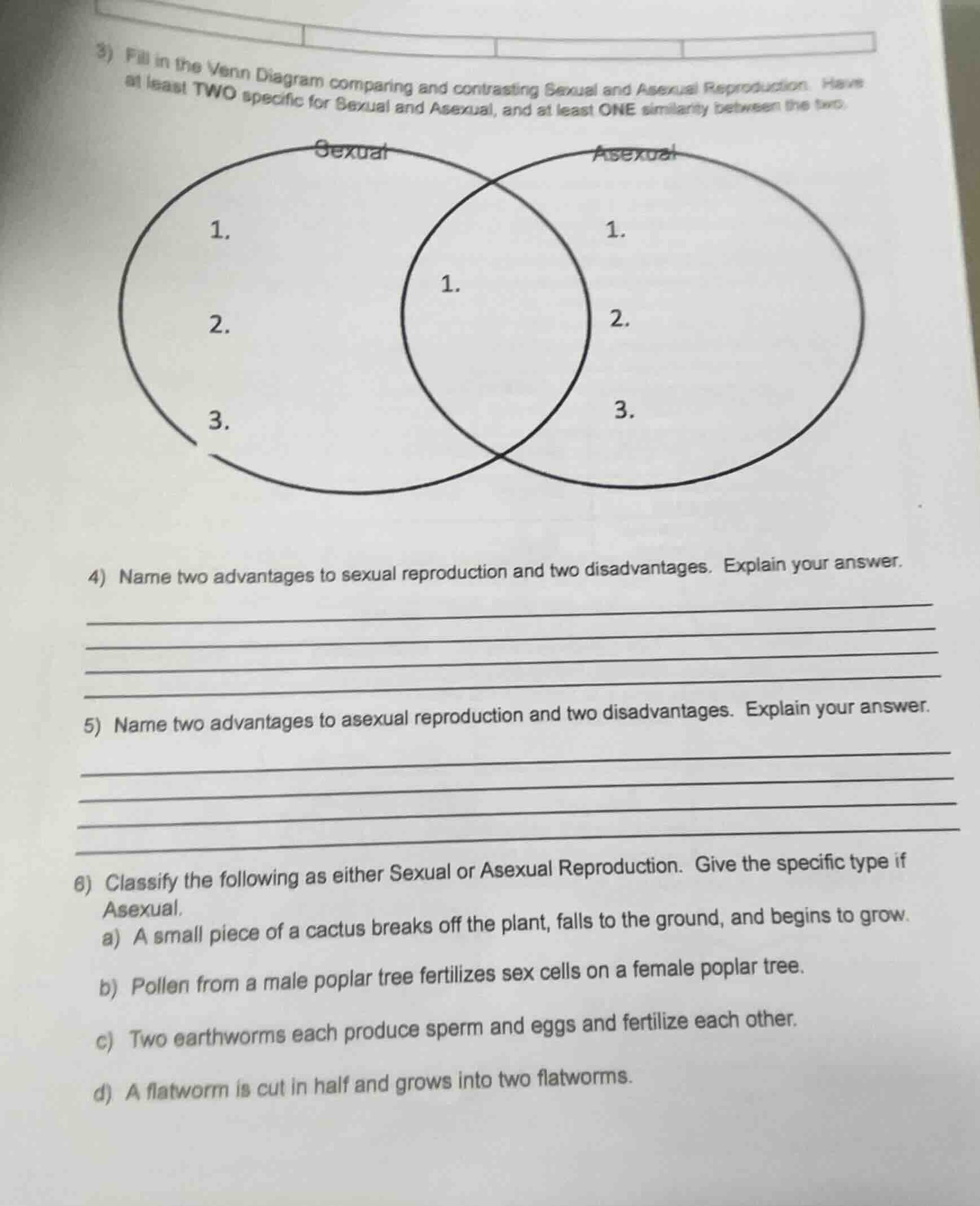
- fill in the venn diagram comparing and contrasting sexual and asexual reproduction. have at least two specific for sexual and asexual, and at least one similarity between the two.4) name two advantages to sexual reproduction and two disadvantages. explain your answer.5) name two advantages to asexual reproduction and two disadvantages. explain your answer.6) classify the following as either sexual or asexual reproduction. give the specific type if asexual.a) a small piece of a cactus breaks off the plant, falls to the ground, and begins to grow.b) pollen from a male poplar tree fertilizes sex cells on a female poplar tree.c) two earthworms each produce sperm and eggs and fertilize each other.d) a flatworm is cut in half and grows into two flatworms.
(Question 3):
Step1: Fill Sexual-only traits
- Requires two distinct parents (male + female)
- Produces genetically unique offspring
- Involves gamete (sex cell) fusion (fertilization)
Step2: Fill Asexual-only traits
- Requires only one parent organism
- Offspring are genetically identical clones
- No gamete production or fertilization
Step3: Fill shared similarity
- Core goal: produce new individuals to sustain the species
(Question 4):
Step1: List advantages of sexual reproduction
- Genetic diversity: Creates unique offspring via gene mixing, which helps populations adapt to environmental changes and resist diseases.
- Reduced harmful trait inheritance: Harmful recessive genes are less likely to be expressed when paired with a dominant healthy gene from a different parent.
Step2: List disadvantages of sexual reproduction
- Energy cost: Requires finding and courting a mate, which uses significant time and resources.
- Low reproductive rate: Fewer offspring are produced per reproductive event compared to asexual reproduction, and offspring take longer to develop.
(Question 5):
Step1: List advantages of asexual reproduction
- Rapid reproduction: No need to find a mate, so populations can grow quickly to exploit favorable environments.
- Energy efficiency: Saves energy that would be spent on mating behavior, gamete production, or caring for a mate.
Step2: List disadvantages of asexual reproduction
- No genetic diversity: All offspring are identical clones, so the population is vulnerable to the same diseases and environmental changes (no adaptive variation).
- Accumulation of harmful mutations: Harmful genetic mutations are passed directly to all offspring, with no way to dilute them via genetic mixing.
(Question 6):
Step1: Classify each case
a) Asexual reproduction (Fragmentation): The new cactus grows from a broken piece of the parent.
b) Sexual reproduction: Pollen (male gamete) fertilizes a female gamete from a separate parent tree.
c) Sexual reproduction: Two distinct parents exchange gametes (sperm and eggs) to fertilize each other.
d) Asexual reproduction (Binary fission/Regeneration): The flatworm splits and each fragment regrows into a full, genetically identical organism.

Snap & solve any problem in the app
Get step-by-step solutions on Sovi AI
Photo-based solutions with guided steps
Explore more problems and detailed explanations
Question 3 (Venn Diagram)
- Sexual only:
- Requires two distinct parents
- Produces genetically unique offspring
- Involves gamete fusion (fertilization)
- Asexual only:
- Requires only one parent
- Offspring are genetic clones
- No gamete production/fertilization
- Similarity:
- Produces new individuals to sustain the species
Question 4
Advantages:
- Genetic diversity: Boosts population adaptability to environmental changes and disease.
- Reduces harmful trait expression: Recessive harmful genes are often masked by healthy dominant genes from a second parent.
Disadvantages:
- High energy cost: Requires time and resources to find and court a mate.
- Low reproductive output: Fewer offspring are produced per event, with longer development times.
Question 5
Advantages:
- Rapid population growth: No mate needed, so offspring are produced quickly.
- Energy efficiency: Saves resources that would be used for mating or gamete production.
Disadvantages:
- No genetic diversity: Cloned offspring are all vulnerable to the same threats.
- Harmful mutation accumulation: Mutations are passed directly to all offspring with no genetic mixing to dilute them.
Question 6
a) Asexual Reproduction (Fragmentation)
b) Sexual Reproduction
c) Sexual Reproduction
d) Asexual Reproduction (Regeneration)