QUESTION IMAGE
Question
final questions: john adams
- what years (date) was adams in office?
- how many terms did he serve?
- what was his political party?
- who was his vice president?
- during the xyz affair, how did france offend the american diplomats?
- what do you think we proved when we demanded better treatment from france?
- what was alien act?
- why did john adams have this act passed?
- what was the sedition act?
- why did john adams have this act passed?
- which amendment does the sedition act violate?
- what effect did the alien and sedition acts have on the federalist party?
- based on the fact that adams only served one term as president, what assumption can you make about how the public felt about adams, the alien and sedition acts, and the job he did as president?
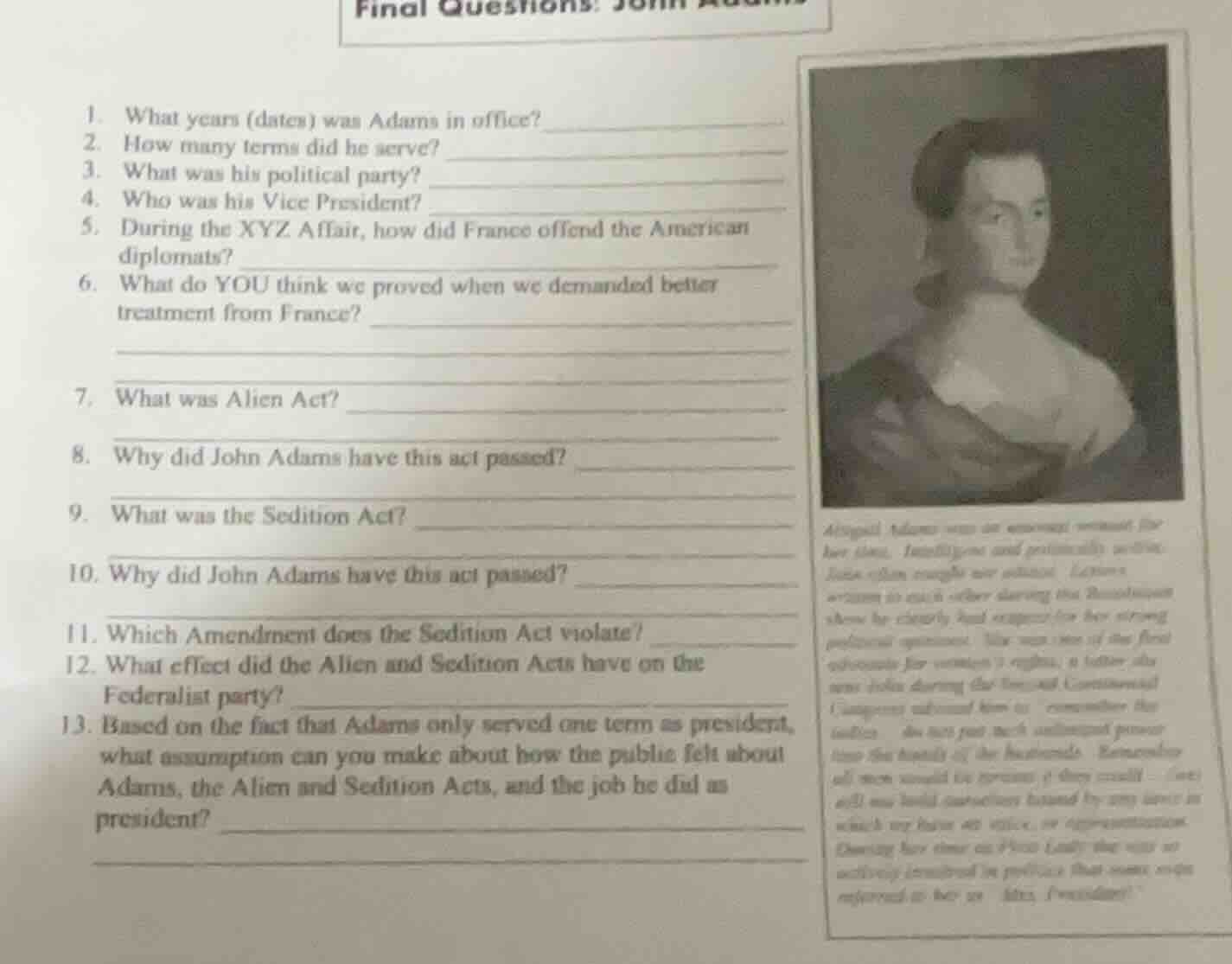
abigail adams was an amazing woman for her time. intelligent and politically active, john often sought her advice. letters written to each other during the revolution show he clearly had respect for her strong political opinions. she was one of the first advocates for women’s rights, a letter she sent john during the second continental congress advised him to “remember the ladies, do not put such unlimited power into the hands of the husbands. remember all men would be tyrants if they could... (she) will not hold ourselves bound by any laws in which we have no voice, or representation. during her time as first lady she was so actively involved in politics that some even referred to her as “mrs. president!”
- John Adams served as the 2nd U.S. President.
- U.S. presidents serve 4-year terms; Adams served one full term.
- Adams was part of the early Federalist political faction.
- Thomas Jefferson was Adams' running mate and vice president.
- French agents demanded bribes before negotiations.
- The U.S. showed it would not accept diplomatic extortion.
- The Alien Act allowed deportation of foreign nationals deemed dangerous, and extended citizenship requirements.
- Adams feared foreign influence amid tensions with France.
- The Sedition Act criminalized criticism of the government/officials.
- Adams aimed to suppress opposition during national tensions.
- The 1st Amendment protects free speech and press, which the Sedition Act violated.
- The acts sparked public backlash, weakening Federalist support.
- Adams' single term suggests public dissatisfaction with his policies and presidency.

Snap & solve any problem in the app
Get step-by-step solutions on Sovi AI
Photo-based solutions with guided steps
Explore more problems and detailed explanations
- 1797 – 1801
- 1 term
- Federalist Party
- Thomas Jefferson
- French agents (referred to as X, Y, Z) demanded bribes and a loan from American diplomats before agreeing to negotiate.
- The U.S. proved it would not submit to diplomatic extortion and valued its national dignity over easy compromise.
- A law that allowed the president to deport any non-citizen (alien) deemed a threat to national security, and increased the residency requirement for U.S. citizenship from 5 to 14 years.
- He feared foreign influence and potential sabotage amid rising tensions with France.
- A law that made it a crime to publish "false, scandalous, and malicious writing" against the U.S. government, Congress, or the president.
- To suppress political opposition and criticism during a time of heightened national tension.
- The 1st Amendment (which protects freedom of speech and freedom of the press).
- The acts caused widespread public anger, eroded support for the Federalist Party, and helped lead to their defeat in the 1800 election.
- It is reasonable to assume the majority of the public was dissatisfied with John Adams, opposed the unpopular Alien and Sedition Acts, and disapproved of his overall performance as president, leading to his failure to win re-election.