QUESTION IMAGE
Question
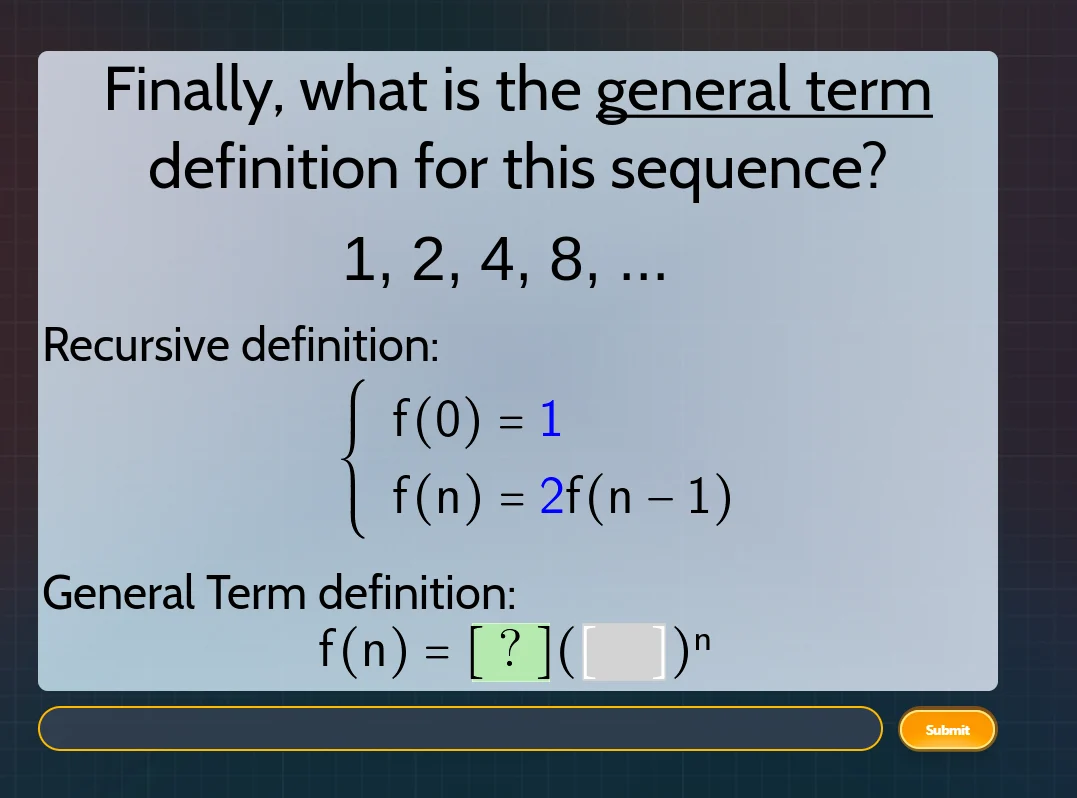
finally, what is the general term definition for this sequence?
1, 2, 4, 8, ...
recursive definition:
\
general term definition:
$f(n) = ?(\quad)^n$
Step1: Identify the sequence type
The sequence \(1, 2, 4, 8, \dots\) is a geometric sequence. In a geometric sequence, each term is obtained by multiplying the previous term by a common ratio \(r\). Here, the common ratio \(r = \frac{2}{1}=\frac{4}{2}=\frac{8}{4}=2\).
Step2: Recall the formula for the general term of a geometric sequence
The general term of a geometric sequence with first term \(a\) (when \(n = 0\)) and common ratio \(r\) is given by \(f(n)=a\times r^{n}\).
Step3: Determine the values of \(a\) and \(r\)
From the recursive definition, when \(n = 0\), \(f(0)=1\), so the first term \(a = 1\). The common ratio \(r = 2\) (as we found in Step 1).
Step4: Substitute \(a\) and \(r\) into the formula
Substituting \(a = 1\) and \(r = 2\) into the formula \(f(n)=a\times r^{n}\), we get \(f(n)=1\times(2)^{n}\), which simplifies to \(f(n)=1\times(2)^{n}\) or \(f(n) = 2^{n}\) (since \(1\times x=x\) for any \(x\)).

Snap & solve any problem in the app
Get step-by-step solutions on Sovi AI
Photo-based solutions with guided steps
Explore more problems and detailed explanations
The first box (the coefficient) is \(1\) and the second box (the base of the exponent) is \(2\), so \(f(n)=\boldsymbol{1}\times(\boldsymbol{2})^{n}\)