QUESTION IMAGE
Question
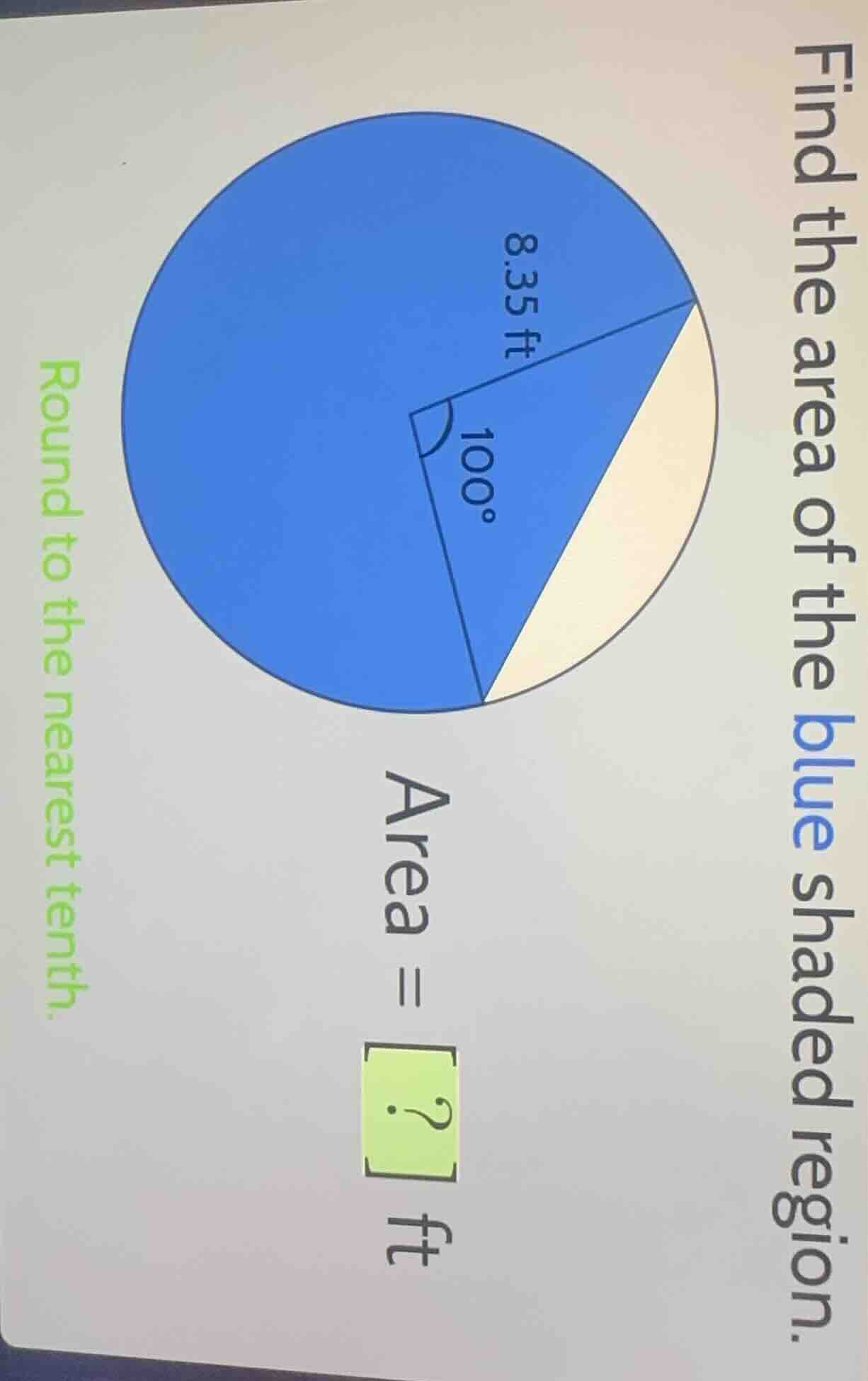
find the area of the blue shaded region. round to the nearest tenth. 8.35 ft 100° area =? ft
Step1: Find the area of the whole circle
The formula for the area of a circle is \( A = \pi r^2 \), where \( r = 8.35 \) ft.
\( A_{circle} = \pi \times (8.35)^2 \approx 3.1416 \times 70.0225 \approx 219.9 \) (approximate value for later use, but we'll do it more accurately in the next step with the sector formula).
Step2: Find the central angle of the blue region
A full circle is \( 360^\circ \). The non - blue (white) region has a central angle of \( 100^\circ \)? Wait, no, looking at the diagram, the blue region: Wait, actually, the central angle of the non - blue sector is \( 100^\circ \)? Wait, no, the triangle - like sector (the blue small sector and the white) – Wait, no, the radius is 8.35 ft. The blue region: The central angle of the blue region is \( 360 - 100=260^\circ \)? Wait, no, maybe I misread. Wait, the diagram shows a sector with angle \( 100^\circ \), but the blue region is the rest? Wait, no, let's re - examine. The formula for the area of a sector is \( A_{sector}=\frac{\theta}{360}\times\pi r^2 \), where \( \theta \) is the central angle of the sector.
Wait, maybe the blue region is a sector with central angle \( 360 - 100 = 260^\circ \)? Wait, no, let's check again. The radius \( r = 8.35 \) ft. Let's assume that the blue region is a sector with central angle \( \theta=360 - 100 = 260^\circ \)? Wait, no, maybe the angle given is the angle of the non - blue sector. Let's confirm: The formula for the area of a sector is \( A=\frac{\theta}{360}\times\pi r^2 \).
If the non - blue sector has angle \( 100^\circ \), then the blue sector has angle \( \theta = 360 - 100=260^\circ \).
So, \( A_{blue}=\frac{260}{360}\times\pi\times(8.35)^2 \)
First, calculate \( (8.35)^2 = 8.35\times8.35 = 69.7225 \)
Then, \( \frac{260}{360}=\frac{13}{18}\approx0.7222 \)
Then, \( A_{blue}=\frac{13}{18}\times\pi\times69.7225 \)
\( \pi\approx3.1416 \), so \( \frac{13}{18}\times3.1416\times69.7225 \)
First, \( 3.1416\times69.7225\approx219.0 \) (more accurately, \( 3.1416\times69.7225 = 3.1416\times70 - 3.1416\times0.2775=219.912 - 0.872 = 219.04 \))
Then, \( \frac{13}{18}\times219.04\approx\frac{13\times219.04}{18}=\frac{2847.52}{18}\approx158.2 \) (Wait, no, let's do it more accurately)
\( \frac{260}{360}\times\pi\times(8.35)^2=\frac{260}{360}\times3.1416\times69.7225 \)
\( \frac{260}{360}=0.722222\cdots \)
\( 0.722222\times3.1416 = 2.268 \)
\( 2.268\times69.7225\approx2.268\times70 - 2.268\times0.2775 = 158.76-0.630 = 158.13 \)
Wait, let's use a more accurate calculation:
\( r = 8.35 \), so \( r^2=8.35\times8.35 = 70.0225 \)
\( \pi r^2=3.14159265\times70.0225\approx3.14159265\times70+3.14159265\times0.0225\approx219.9114855 + 0.0706858\approx219.9821713 \)
The central angle of the blue sector: If the white sector has angle \( 100^\circ \), then the blue sector has angle \( \theta = 360 - 100=260^\circ \)
So, \( A_{blue}=\frac{260}{360}\times219.9821713=\frac{13}{18}\times219.9821713\approx\frac{2859.768227}{18}\approx158.876 \approx 158.9 \) (rounded to the nearest tenth)
Wait, maybe I made a mistake in the angle. Wait, maybe the blue region is the sector with angle \( 360 - 100 = 260^\circ \), or maybe the angle given is the angle of the blue sector? Wait, no, the diagram shows a small sector with \( 100^\circ \), so the large sector (blue) has \( 360 - 100 = 260^\circ \)
Let's recalculate:
\( \theta = 260^\circ \), \( r = 8.35 \)
\( A=\frac{260}{360}\times\pi\times(8.35)^2 \)
\( (8.35)^2 = 70.0225 \)
\( \frac{260}{360}=\frac{13}{18}\approx0.7222 \)
\( \pi\times70.0225\approx219.98 \)
\( 0.7222\times219.98…

Snap & solve any problem in the app
Get step-by-step solutions on Sovi AI
Photo-based solutions with guided steps
Explore more problems and detailed explanations
\( 158.9 \) (ft²)