QUESTION IMAGE
Question
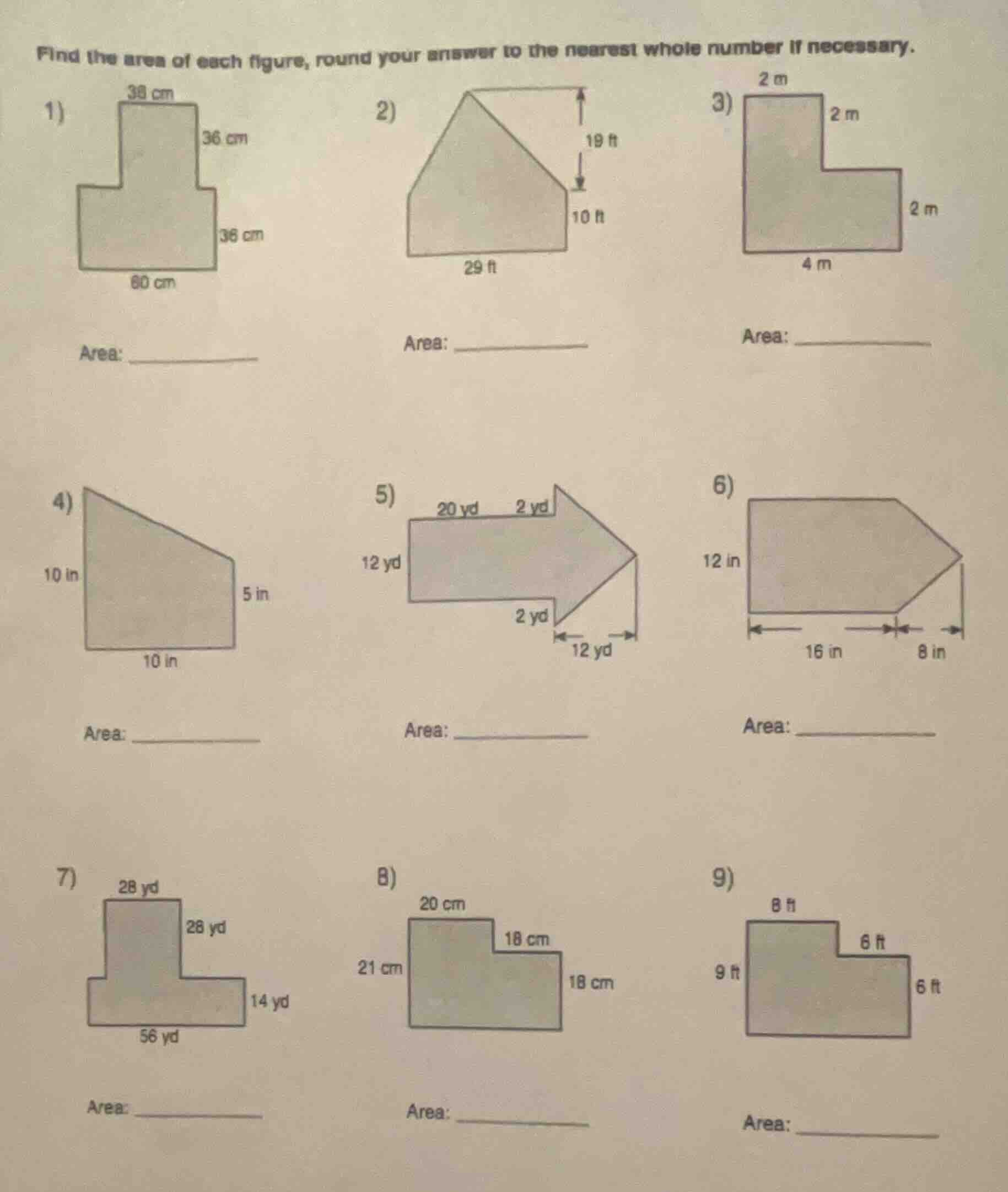
find the area of each figure, round your answer to the nearest whole number if necessary.
1)
area:
2)
area:
3)
area:
4)
area:
5)
area:
6)
area:
7)
area:
8)
area:
9)
area:
1) Figure 1: Split into two rectangles
Step1: Calculate area of top rectangle
$A_1 = 38 \times 36 = 1368 \, \text{cm}^2$
Step2: Calculate area of bottom rectangle
$A_2 = 80 \times 36 = 2880 \, \text{cm}^2$
Step3: Sum the two areas
$A_{\text{total}} = 1368 + 2880 = 4248 \, \text{cm}^2$
---
2) Figure 2: Split into rectangle + triangle
Step1: Area of lower rectangle
$A_1 = 29 \times 10 = 290 \, \text{ft}^2$
Step2: Area of upper triangle
Height of triangle: $19 - 10 = 9 \, \text{ft}$
$A_2 = \frac{1}{2} \times 29 \times 9 = 130.5 \, \text{ft}^2$
Step3: Sum the two areas
$A_{\text{total}} = 290 + 130.5 = 420.5 \approx 421 \, \text{ft}^2$
---
3) Figure 3: Split into two squares
Step1: Area of top square
$A_1 = 2 \times 2 = 4 \, \text{m}^2$
Step2: Area of bottom rectangle
Width of bottom: $4 - 2 = 2 \, \text{m}$
$A_2 = 4 \times 2 = 8 \, \text{m}^2$
Step3: Sum the two areas
$A_{\text{total}} = 4 + 8 = 12 \, \text{m}^2$
---
4) Figure 4: Trapezoid area formula
Step1: Apply trapezoid area formula
$A = \frac{1}{2} \times (a + b) \times h$ where $a=10, b=5, h=10$
$A = \frac{1}{2} \times (10 + 5) \times 10 = 75 \, \text{in}^2$
---
5) Figure 5: Split into rectangle + triangle
Step1: Area of left rectangle
$A_1 = (20 + 2) \times 12 = 264 \, \text{yd}^2$
Step2: Area of right triangle
Base/height of triangle: $12 - 2 - 2 = 8 \, \text{yd}$
$A_2 = \frac{1}{2} \times 12 \times 8 = 48 \, \text{yd}^2$
Step3: Sum the two areas
$A_{\text{total}} = 264 + 48 = 312 \, \text{yd}^2$
---
6) Figure 6: Split into rectangle + triangle
Step1: Area of left rectangle
$A_1 = 16 \times 12 = 192 \, \text{in}^2$
Step2: Area of right triangle
$A_2 = \frac{1}{2} \times 12 \times 8 = 48 \, \text{in}^2$
Step3: Sum the two areas
$A_{\text{total}} = 192 + 48 = 240 \, \text{in}^2$
---
7) Figure 7: Split into two rectangles
Step1: Area of top rectangle
$A_1 = 28 \times 28 = 784 \, \text{yd}^2$
Step2: Area of bottom rectangle
$A_2 = 56 \times 14 = 784 \, \text{yd}^2$
Step3: Sum the two areas
$A_{\text{total}} = 784 + 784 = 1568 \, \text{yd}^2$
---
8) Figure 8: Split into two rectangles
Step1: Area of top rectangle
Width of top: $20 \, \text{cm}$, height: $21 - 18 = 3 \, \text{cm}$
$A_1 = 20 \times 3 = 60 \, \text{cm}^2$
Step2: Area of bottom rectangle
$A_2 = 20 \times 18 = 360 \, \text{cm}^2$
Step3: Sum the two areas
$A_{\text{total}} = 60 + 360 = 420 \, \text{cm}^2$
---
9) Figure 9: Split into two rectangles
Step1: Area of top rectangle
Width of top: $8 \, \text{ft}$, height: $9 - 6 = 3 \, \text{ft}$
$A_1 = 8 \times 3 = 24 \, \text{ft}^2$
Step2: Area of bottom rectangle
Width of bottom: $8 + 6 = 14 \, \text{ft}$
$A_2 = 14 \times 6 = 84 \, \text{ft}^2$
Step3: Sum the two areas
$A_{\text{total}} = 24 + 84 = 108 \, \text{ft}^2$

Snap & solve any problem in the app
Get step-by-step solutions on Sovi AI
Photo-based solutions with guided steps
Explore more problems and detailed explanations
- $\boldsymbol{4248 \, \text{cm}^2}$
- $\boldsymbol{421 \, \text{ft}^2}$
- $\boldsymbol{12 \, \text{m}^2}$
- $\boldsymbol{75 \, \text{in}^2}$
- $\boldsymbol{312 \, \text{yd}^2}$
- $\boldsymbol{240 \, \text{in}^2}$
- $\boldsymbol{1568 \, \text{yd}^2}$
- $\boldsymbol{420 \, \text{cm}^2}$
- $\boldsymbol{108 \, \text{ft}^2}$