QUESTION IMAGE
Question
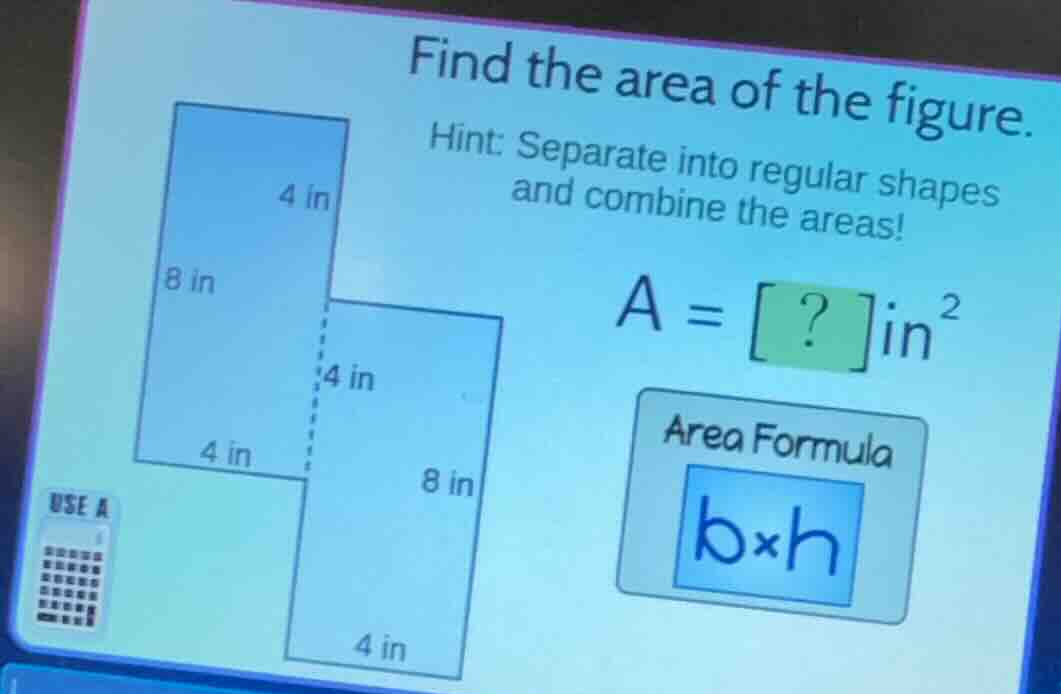
find the area of the figure. hint: separate into regular shapes and combine the areas! a = ? in² area formula b×h 4 in 8 in 4 in 4 in 8 in 4 in use a
Step1: Analyze the figure's parts
The figure can be split into two rectangles. Each rectangle has dimensions \(4\) in (base) and \(8\) in (height), but we need to check for overlaps? Wait, no, looking at the diagram, actually, maybe each rectangle is \(4\times8\), but let's see: Wait, the first rectangle is \(4\) in (width) and \(8\) in (height). The second rectangle: but wait, the overlapping part? Wait, no, the hint says separate into regular shapes. Wait, maybe the figure is two rectangles, but let's check the dimensions. Wait, the first rectangle: width \(4\) in, height \(8\) in. The second rectangle: width \(4\) in, height \(8\) in? But wait, is there an overlap? Wait, no, maybe the figure is two rectangles, each with area \(4\times8\), but wait, no, let's look again. Wait, the first rectangle: \(4\) in (base) and \(8\) in (height). The second rectangle: also \(4\) in (base) and \(8\) in (height)? Wait, but maybe the total area is the sum of two rectangles, but we have to check if there's an overlapping square? Wait, the dashed line is \(4\) in, so maybe the overlapping part is a \(4\times4\) square? Wait, no, let's think again.
Wait, the formula for the area of a rectangle is \(b\times h\) (base times height). Let's consider the figure: it's like two rectangles, each with length \(8\) in and width \(4\) in, but they overlap at a \(4\times4\) square. Wait, no, maybe the figure is composed of two rectangles, but we have to add their areas and subtract the overlapping area (since it's counted twice). Wait, the first rectangle: area \(4\times8 = 32\) in². The second rectangle: area \(4\times8 = 32\) in². But the overlapping area (the square where they intersect) is \(4\times4 = 16\) in². So total area would be \(32 + 32 - 16 = 48\) in²? Wait, no, that doesn't seem right. Wait, maybe I'm overcomplicating. Wait, the hint says "separate into regular shapes and combine the areas". Let's look at the diagram again. The first rectangle: vertical, \(4\) in (width) and \(8\) in (height). The second rectangle: horizontal? No, the second rectangle is also vertical? Wait, no, maybe the figure is two rectangles, each with dimensions \(4\) in (width) and \(8\) in (height), but they are placed such that they overlap at a \(4\) in by \(4\) in square. Wait, no, let's count the squares. Wait, maybe the figure is made of two rectangles, each with area \(4\times8\), but the overlapping part is a \(4\times4\) square. So total area = area of first rectangle + area of second rectangle - area of overlap.
First rectangle area: \(4\times8 = 32\) in².
Second rectangle area: \(4\times8 = 32\) in².
Overlap area: \(4\times4 = 16\) in².
Total area: \(32 + 32 - 16 = 48\) in². Wait, but let's check again.
Wait, alternatively, maybe the figure is two rectangles, each with length \(8\) in and width \(4\) in, but arranged so that they form a shape where the total area is \( (4\times8) + (4\times8) - (4\times4) \). Let's calculate that: \(32 + 32 - 16 = 48\). So the area is \(48\) in².
Wait, but let's verify. Another way: the figure can be seen as a large rectangle minus the overlapping square? No, maybe not. Wait, let's think of the two rectangles. Each has area \(4\times8 = 32\). But where they overlap, the area is \(4\times4 = 16\), which is counted twice, so we subtract it once. So total area is \(32 + 32 - 16 = 48\).
Step1: Calculate area of first rectangle
The first rectangle has base \(b = 4\) in and height \(h = 8\) in. Using the formula \(A = b\times h\), the area is \(4\times8 = 32\) in².
Step2: Calculate area of second rectangle
The second…

Snap & solve any problem in the app
Get step-by-step solutions on Sovi AI
Photo-based solutions with guided steps
Explore more problems and detailed explanations
\(48\)