QUESTION IMAGE
Question
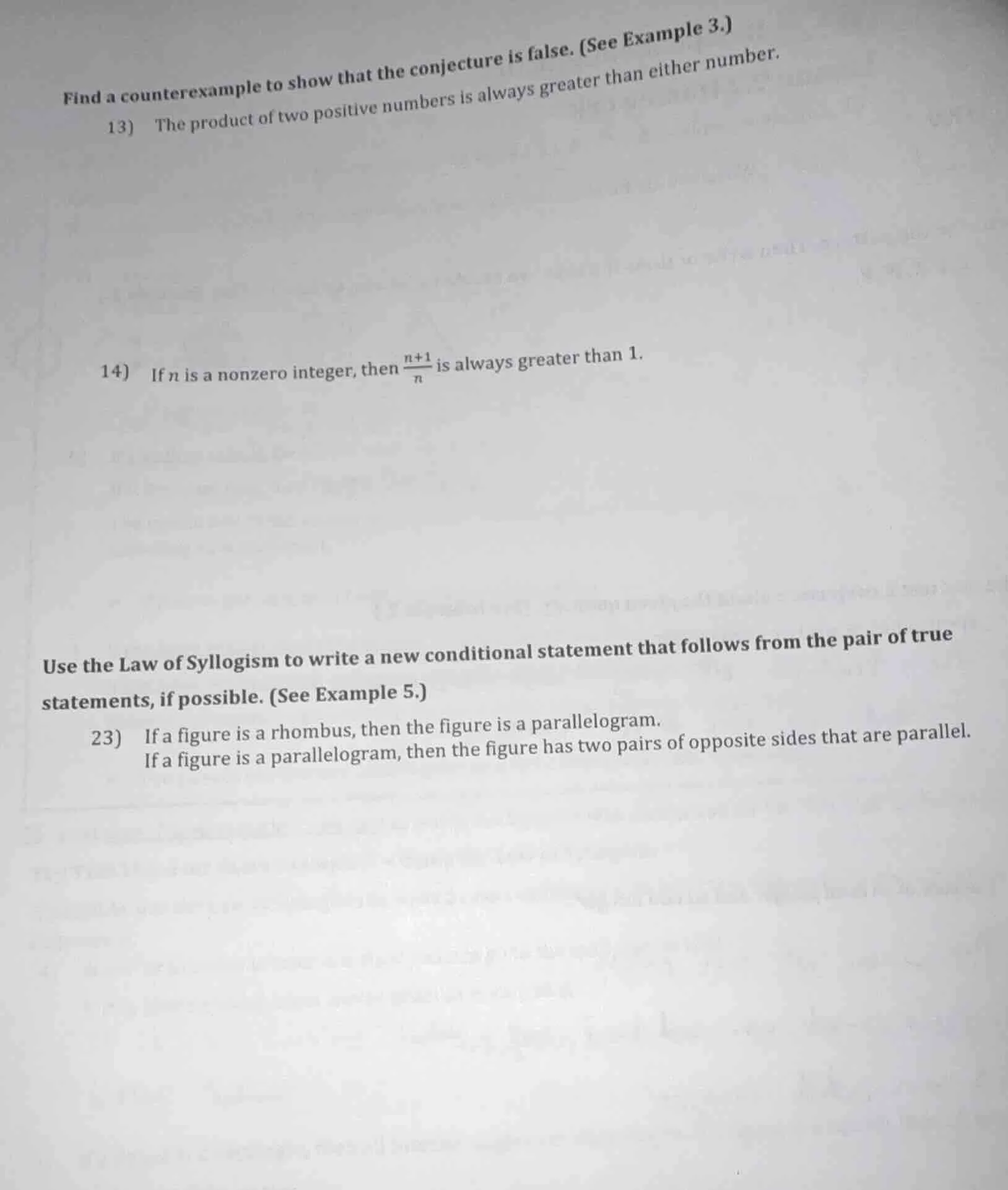
find a counterexample to show that the conjecture is false. (see example 3.)
- the product of two positive numbers is always greater than either number.
- if ( n ) is a nonzero integer, then ( \frac{n + 1}{n} ) is always greater than 1.
use the law of syllogism to write a new conditional statement that follows from the pair of true statements, if possible. (see example 5.)
- if a figure is a rhombus, then the figure is a parallelogram.
if a figure is a parallelogram, then the figure has two pairs of opposite sides that are parallel.
(Problem 13):
Step1: Pick small positive numbers
Choose positive numbers less than 1, e.g., $\frac{1}{2}$ and $\frac{1}{3}$.
Step2: Calculate their product
$\frac{1}{2} \times \frac{1}{3} = \frac{1}{6}$
Step3: Compare product to originals
$\frac{1}{6} < \frac{1}{2}$ and $\frac{1}{6} < \frac{1}{3}$
(Problem 14):
Step1: Pick negative nonzero integer
Choose $n = -1$ (nonzero integer).
Step2: Substitute into the expression
$\frac{-1 + 1}{-1} = \frac{0}{-1} = 0$
Step3: Compare result to 1
$0 < 1$
(Problem 23):
Step1: Identify syllogism structure
Let $p$ = "a figure is a rhombus", $q$ = "a figure is a parallelogram", $r$ = "a figure has two pairs of opposite sides that are parallel". The given statements are $p
ightarrow q$ and $q
ightarrow r$.
Step2: Apply Law of Syllogism
Combine $p
ightarrow q$ and $q
ightarrow r$ to get $p
ightarrow r$.

Snap & solve any problem in the app
Get step-by-step solutions on Sovi AI
Photo-based solutions with guided steps
Explore more problems and detailed explanations
- For problem 13: A counterexample is $\frac{1}{2}$ and $\frac{1}{3}$; their product $\frac{1}{6}$ is less than both numbers.
- For problem 14: A counterexample is $n=-1$; $\frac{n+1}{n}=0$, which is less than 1.
- For problem 23: If a figure is a rhombus, then the figure has two pairs of opposite sides that are parallel.