QUESTION IMAGE
Question
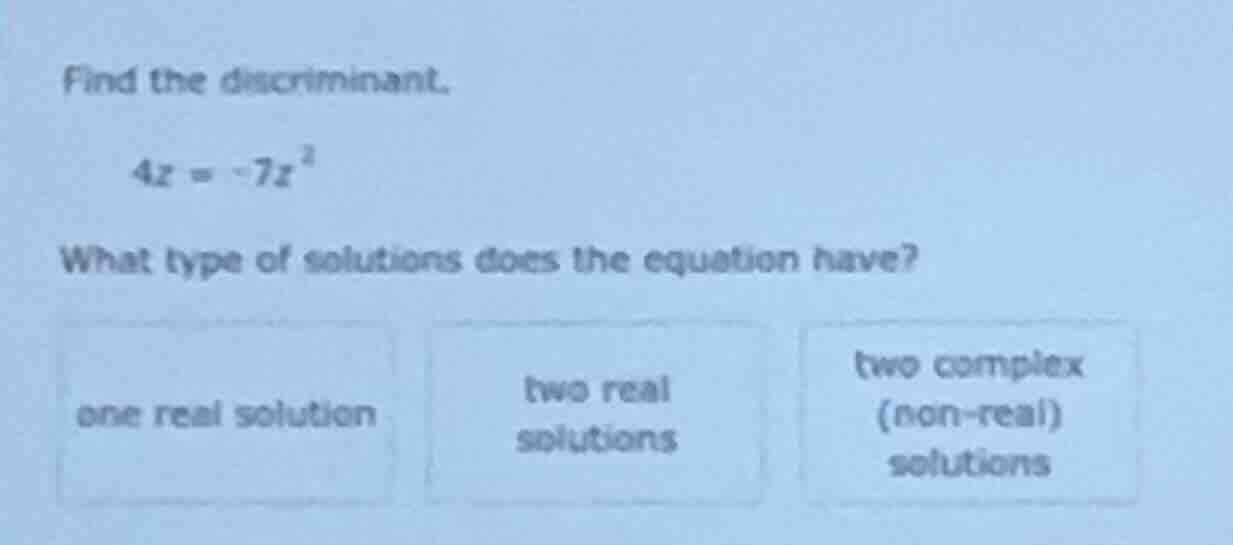
find the discriminant.
\\(4z = -7z^2\\)
what type of solutions does the equation have?
one real solution \t two real solutions \t two complex (non - real) solutions
Step1: Rewrite the equation in standard form
The standard form of a quadratic equation is \(ax^{2}+bx + c = 0\). Given the equation \(4z=-7z^{2}\), we can rewrite it as \(7z^{2}+4z = 0\). Here, \(a = 7\), \(b = 4\), and \(c = 0\).
Step2: Calculate the discriminant
The formula for the discriminant (\(D\)) of a quadratic equation \(ax^{2}+bx + c = 0\) is \(D=b^{2}-4ac\). Substituting \(a = 7\), \(b = 4\), and \(c = 0\) into the formula, we get:
\(D=(4)^{2}-4\times7\times0\)
\(D = 16-0\)
\(D=16\)
Step3: Determine the type of solutions
- If \(D>0\), the quadratic equation has two distinct real solutions.
- If \(D = 0\), the quadratic equation has one real solution (a repeated root).
- If \(D<0\), the quadratic equation has two complex (non - real) solutions.
Since \(D = 16>0\), the equation has two real solutions.

Snap & solve any problem in the app
Get step-by-step solutions on Sovi AI
Photo-based solutions with guided steps
Explore more problems and detailed explanations
The discriminant is \(16\). The equation has two real solutions.