QUESTION IMAGE
Question
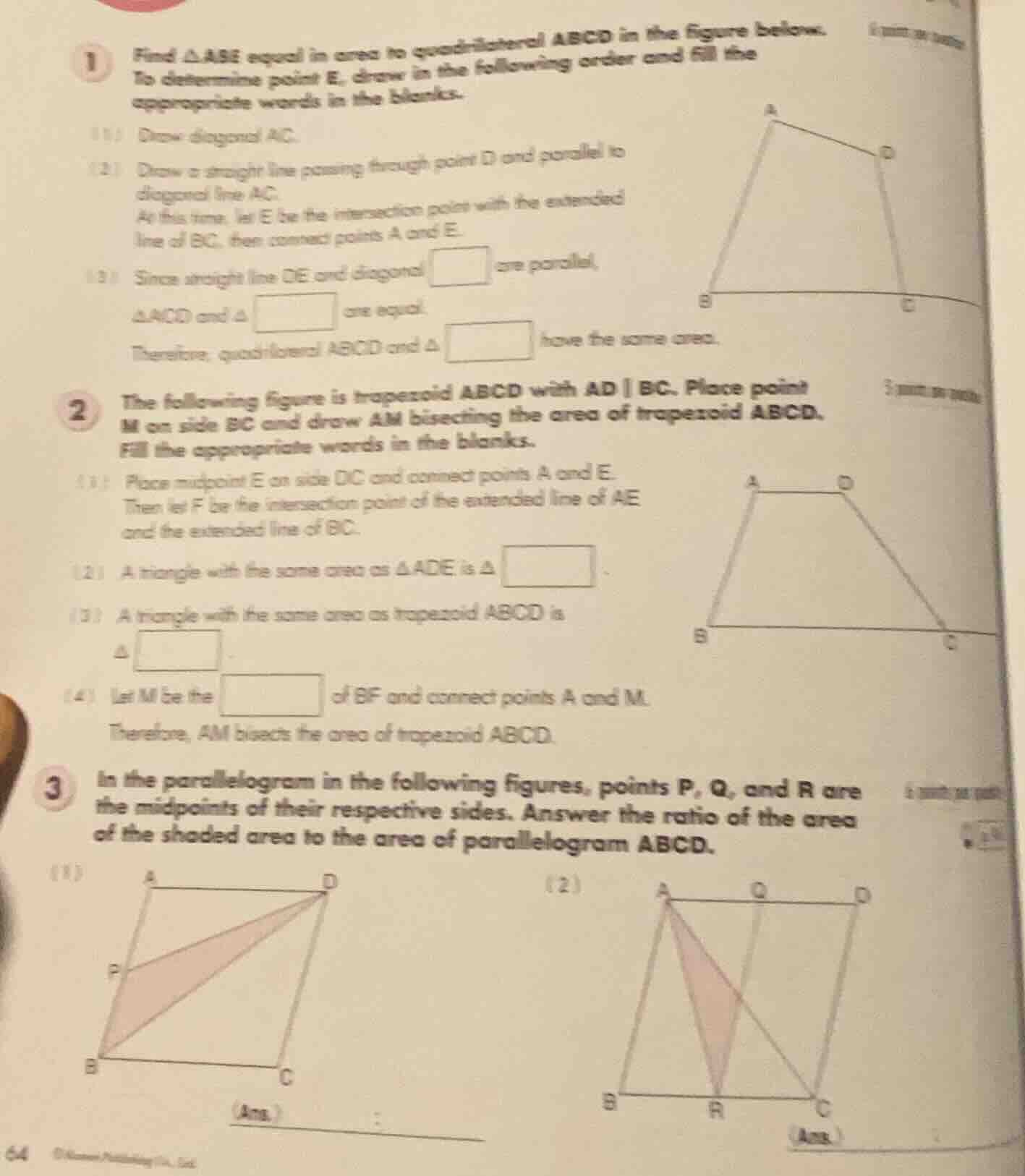
1 find $\triangle abe$ equal in area to quadrilateral $abcd$ in the figure below. to determine point $e$, draw in the following order and fill the appropriate words in the blanks. (1) draw diagonal $ac$. (2) draw a straight line passing through point $d$ and parallel to diagonal line $ac$. at this time, let $e$ be the intersection point with the extended line of $bc$, then connect points $a$ and $e$. (3) since straight line $de$ and diagonal $\square$ are parallel, $\triangle acd$ and $\triangle \square$ are equal. therefore, quadrilateral $abcd$ and $\triangle \square$ have the same area. 2 the following figure is trapezoid $abcd$ with $ad \parallel bc$. place point $m$ on side $bc$ and draw $am$ bisecting the area of trapezoid $abcd$. fill the appropriate words in the blanks. (1) place midpoint $e$ on side $dc$ and connect points $a$ and $e$. then let $f$ be the intersection point of the extended line of $ae$ and the extended line of $bc$. (2) a triangle with the same area as $\triangle ade$ is $\triangle \square$. (3) a triangle with the same area as trapezoid $abcd$ is $\triangle \square$. (4) let $m$ be the $\square$ of $bf$ and connect points $a$ and $m$. therefore, $am$ bisects the area of trapezoid $abcd$. 3 in the parallelogram in the following figures, points $p$, $q$, and $r$ are the midpoints of their respective sides. answer the ratio of the area of the shaded area to the area of parallelogram $abcd$. (1) (2) (ans.) : (ans.)
Problem 1
Step1: Analyze the parallel lines
From step (2), we know \( DE \parallel AC \). So the first blank should be \( AC \).
Step2: Triangles with equal area
Triangles with the same base and between the same parallel lines have equal area. Since \( DE \parallel AC \), \( \triangle ACD \) and \( \triangle ACE \) (because they share the base \( AC \) and are between \( AC \) and \( DE \)) have equal area. So the second blank is \( ACE \).
Step3: Area of quadrilateral and triangle
Quadrilateral \( ABCD \) area is \( \triangle ABC + \triangle ACD \). Since \( \triangle ACD=\triangle ACE \), then \( ABCD \) area is \( \triangle ABC+\triangle ACE=\triangle ABE \). So the third blank is \( ABE \).
Step1: Triangle with same area as \( \triangle ADE \)
Since \( AD \parallel BC \), \( \triangle ADE \) and \( \triangle CFE \) (vertical angles and parallel lines, so equal area). Wait, actually, \( E \) is the midpoint of \( DC \), \( AE \) extended meets \( BC \) extended at \( F \). \( \triangle ADE \) and \( \triangle FCE \) are congruent (ASA), so same area. So blank is \( FCE \).
Step2: Triangle with area of trapezoid
Trapezoid \( ABCD \) area is \( \triangle ABC + \triangle ADC \). But with \( F \), trapezoid area is equal to \( \triangle ABF \) (since \( \triangle ADE=\triangle FCE \), so \( ABCD \) area = \( ABF \) area). So blank is \( ABF \).
Step3: Midpoint of \( BF \)
To bisect the area of \( \triangle ABF \), we take the midpoint of \( BF \), so \( M \) is the midpoint.
Step1: Let area of parallelogram be \( S \)
Let \( AB = a \), height \( h \), so \( S = ah \). \( P \) is midpoint of \( AB \), so \( BP=\frac{a}{2} \).
Step2: Area of shaded triangle
Area of \( \triangle BPD \): base \( BP=\frac{a}{2} \), height \( h \) (same as parallelogram). Area \(=\frac{1}{2}\times\frac{a}{2}\times h=\frac{1}{4}ah \)? Wait, no, wait. Wait, in parallelogram \( ABCD \), \( P \) is midpoint of \( AB \), \( D \) is vertex. The area of \( \triangle BPD \): actually, \( \triangle ABD \) area is \( \frac{1}{2}S \). \( P \) is midpoint, so \( \triangle BPD \) area is \( \frac{1}{2}\times\frac{1}{2}S=\frac{1}{4}S \)? Wait, no, maybe better: Let’s assume coordinates. Let \( A(0,0) \), \( B(b,0) \), \( D(0,h) \), \( C(b,h) \), \( P(\frac{b}{2},0) \). Area of \( \triangle BPD \): points \( B(b,0) \), \( P(\frac{b}{2},0) \), \( D(0,h) \). Area \(=\frac{1}{2}\times base\times height=\frac{1}{2}\times\frac{b}{2}\times h=\frac{1}{4}bh \). Parallelogram area is \( bh \). Wait, no, that's wrong. Wait, \( \triangle BPD \): base \( BP = \frac{b}{2} \), height from \( D \) to \( AB \) is \( h \). Wait, no, \( D \) is at \( (0,h) \), \( AB \) is x - axis. So area of \( \triangle BPD \) is \( \frac{1}{2}\times BP\times h=\frac{1}{2}\times\frac{b}{2}\times h=\frac{bh}{4} \)? But parallelogram area is \( bh \). Wait, no, maybe I messed up. Wait, \( P \) is midpoint of \( AB \), \( BD \) is diagonal? No, \( P \) is on \( AB \), \( D \) is opposite. Wait, the shaded triangle is \( \triangle BPD \)? Wait, no, the figure: \( P \) on \( AB \), \( B \), \( P \), \( D \). Wait, actually, in parallelogram \( ABCD \), \( P \) is midpoint of \( AB \), so area of \( \triangle BPD \): \( AB \) is base, \( D \) is top. The area of \( \triangle ABD \) is \( \frac{1}{2} \) of parallelogram. \( P \) is midpoint, so \( \triangle BPD \) is \( \frac{1}{2} \) of \( \triangle ABD \), so \( \frac{1}{4} \) of parallelogram? Wait, no, \( \triangle ABD \) area is \( \frac{1}{2} \times AB \times height \). \( \triangle BPD \) has base \( BP = \frac{AB}{2} \), same height, so area \( \frac{1}{2} \times \frac{AB}{2} \times height=\frac{1}{4} \times AB \times height=\frac{1}{4} \) of parallelogram. Wait, but maybe another way: Let parallelogram area be \( 4 \) units. Then \( \triangle BPD \) area is \( 1 \)? No, wait, maybe I made a mistake. Wait, the correct ratio: In parallelogram \( ABCD \), \( P \) is midpoint of \( AB \). The area of \( \triangle BPD \): \( AB \) length \( l \), height \( h \). Area of parallelogram \( lh \). Area of \( \triangle ABD \) is \( \frac{lh}{2} \). \( P \) is midpoint, so \( \triangle BPD \) area is \( \frac{1}{2} \times \frac{lh}{2}=\frac{lh}{4} \). So ratio is \( \frac{1}{4} \)? Wait, no, wait the figure: \( P \) is on \( AB \), \( D \) is on \( AD \)? No, \( ABCD \) is parallelogram, \( A - B - C - D - A \). \( P \) is midpoint of \( AB \), \( D \) is vertex. So \( \triangle BPD \): base \( BP \), height from \( D \) to \( AB \). So area \( \frac{1}{2} \times BP \times h \). \( BP=\frac{AB}{2} \), so \( \frac{1}{2} \times \frac{AB}{2} \times h=\frac{AB \times h}{4}=\frac{1}{4} \) of parallelogram area (since parallelogram area is \( AB \times h \)).
Step2: For the second figure (2)
Let \( AD = l \), height \( h \), parallelogram area \( lh \). \( Q \) is midpoint of \( AD \), \( R \) is on \( BC \). The shaded triangle: base \( QR \)? Wait, \( Q \) is midpoint, \( R \) is... Wait, \( AQ=\frac{l}{2} \), the shaded triangle has base \( \frac{l}{2} \) and height \( h \)? No, wait, the triangle is between \( A \), \( R \),…

Snap & solve any problem in the app
Get step-by-step solutions on Sovi AI
Photo-based solutions with guided steps
Explore more problems and detailed explanations
(3) \( AC \), \( ACE \), \( ABE \)