QUESTION IMAGE
Question
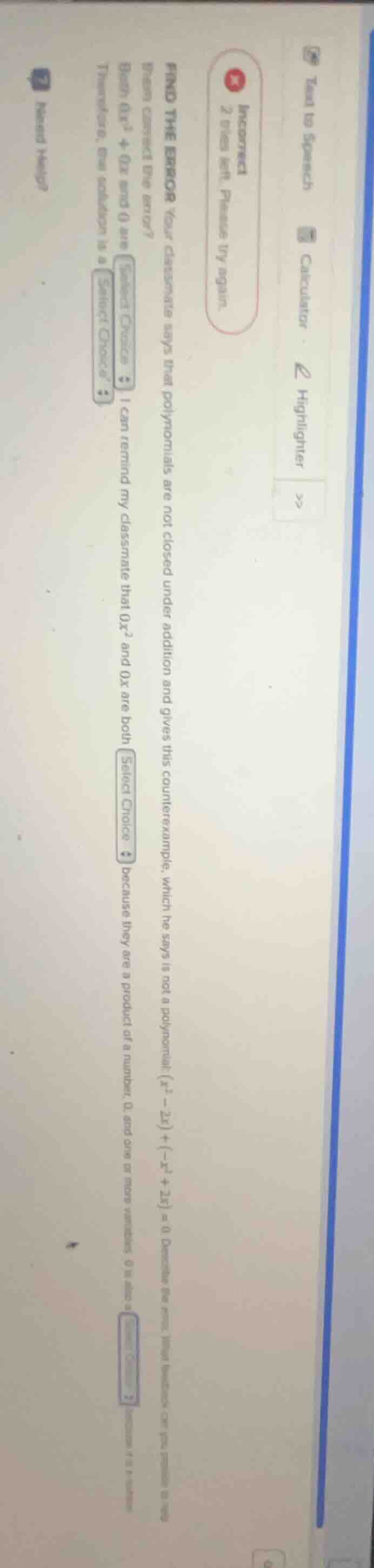
find the error. your classmate says that polynomials are not closed under addition and gives this counterexample: ((x^2 - 2x) + (-x^2 + 2x) = 0). describe the error. just because our answer is 0, does that mean its not a polynomial? i can remind my classmate that (0x^2) and (0x) are both... because they are a product of a number, 0, and one or more variables. 0 is also a polynomial because it can be written as (0x^2 + 0x + 0). therefore, the solution is a...
Step1: Recall polynomial closure under addition
Polynomials are closed under addition, meaning the sum of two polynomials is a polynomial. A polynomial is an expression of the form \(a_nx^n + \dots + a_1x + a_0\), where \(a_i\) are constants and \(n\) is a non - negative integer. The zero polynomial (e.g., \(0x^2+0x + 0\)) is a polynomial (it can be written in the polynomial form with all coefficients zero).
Step2: Analyze the classmate's error
The classmate claims that \((x^2 - 2x)+(-x^2 + 2x)=0\) is a counterexample to the closure of polynomials under addition. But the sum \(0\) (which can be written as \(0x^2+0x + 0\)) is a polynomial. The error is in thinking that \(0\) is not a polynomial. In fact, the zero polynomial is a valid polynomial (it has degree \(-\infty\) or is considered as a polynomial with all coefficients zero). Also, when we simplify \((x^2 - 2x)+(-x^2 + 2x)\), we combine like terms: \(x^2 - x^2-2x + 2x=(1 - 1)x^2+(-2 + 2)x=0x^2+0x = 0\), and \(0\) is a polynomial.

Snap & solve any problem in the app
Get step-by-step solutions on Sovi AI
Photo-based solutions with guided steps
Explore more problems and detailed explanations
The error is that the classmate incorrectly believes that \(0\) (the result of the addition of the two polynomials) is not a polynomial. In reality, the zero polynomial (which is what \(0\) is in polynomial form, \(0x^2 + 0x+0\)) is a valid polynomial, and polynomials are closed under addition because the sum of two polynomials is always a polynomial (in this case, the zero polynomial).