QUESTION IMAGE
Question
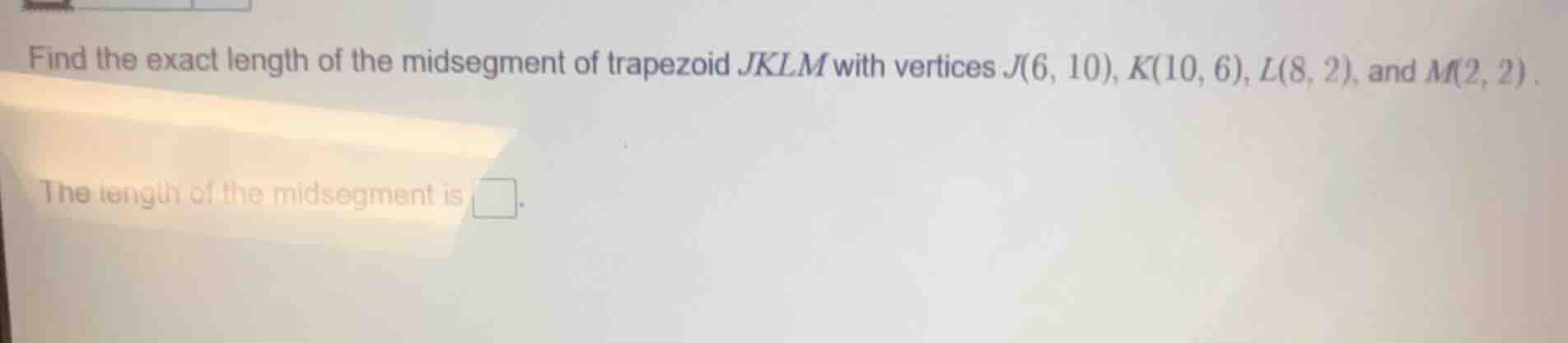
find the exact length of the midsegment of trapezoid jklm with vertices j(6, 10), k(10, 6), l(8, 2), and m(2, 2). the length of the midsegment is \square.
Step1: Identify the bases of the trapezoid
First, we need to determine which sides are parallel (the bases). Let's find the slopes of the sides.
The slope formula is $m = \frac{y_2 - y_1}{x_2 - x_1}$.
Slope of $JM$: $J(6,10)$, $M(2,2)$
$m_{JM} = \frac{2 - 10}{2 - 6} = \frac{-8}{-4} = 2$
Slope of $KL$: $K(10,6)$, $L(8,2)$
$m_{KL} = \frac{2 - 6}{8 - 10} = \frac{-4}{-2} = 2$
Slope of $JK$: $J(6,10)$, $K(10,6)$
$m_{JK} = \frac{6 - 10}{10 - 6} = \frac{-4}{4} = -1$
Slope of $ML$: $M(2,2)$, $L(8,2)$
$m_{ML} = \frac{2 - 2}{8 - 2} = \frac{0}{6} = 0$
Since the slopes of $JM$ and $KL$ are equal (both 2), $JM$ and $KL$ are parallel (the bases). Now we find the lengths of $JM$ and $KL$.
Step2: Calculate the length of $JM$
Using the distance formula $d = \sqrt{(x_2 - x_1)^2 + (y_2 - y_1)^2}$ for $J(6,10)$ and $M(2,2)$:
$d_{JM} = \sqrt{(2 - 6)^2 + (2 - 10)^2} = \sqrt{(-4)^2 + (-8)^2} = \sqrt{16 + 64} = \sqrt{80} = 4\sqrt{5}$
Step3: Calculate the length of $KL$
Using the distance formula for $K(10,6)$ and $L(8,2)$:
$d_{KL} = \sqrt{(8 - 10)^2 + (2 - 6)^2} = \sqrt{(-2)^2 + (-4)^2} = \sqrt{4 + 16} = \sqrt{20} = 2\sqrt{5}$
Step4: Find the length of the midsegment
The length of the midsegment of a trapezoid is the average of the lengths of the two bases. The formula is $m = \frac{d_1 + d_2}{2}$, where $d_1$ and $d_2$ are the lengths of the bases.
So, $m = \frac{4\sqrt{5} + 2\sqrt{5}}{2} = \frac{6\sqrt{5}}{2} = 3\sqrt{5}$
Wait, that seems incorrect. Wait, maybe I made a mistake in identifying the bases. Let's check the other sides. Wait, the slope of $ML$ is 0, so it's horizontal. Let's check the y-coordinates of $M(2,2)$ and $L(8,2)$: they have the same y-coordinate, so $ML$ is horizontal. Now check the slope of $JK$: -1, and slope of $JM$: 2, slope of $KL$: 2. Wait, maybe $ML$ and $JK$ are not the bases. Wait, let's re-examine the coordinates.
Points: $J(6,10)$, $K(10,6)$, $L(8,2)$, $M(2,2)$
Let's plot them mentally: $M(2,2)$ and $L(8,2)$ are on the horizontal line $y = 2$. $J(6,10)$ and $K(10,6)$: let's see the y-coordinates. Now, the midsegment of a trapezoid is parallel to the bases and its length is the average of the lengths of the two bases.
Wait, maybe the bases are $ML$ and $JK$? No, $ML$ is horizontal (slope 0), $JK$ has slope -1. Not parallel. Wait, $ML$ is from (2,2) to (8,2), length is $8 - 2 = 6$ (since y is constant). $JM$: from (6,10) to (2,2), length we calculated as $4\sqrt{5} \approx 8.94$. $KL$: from (10,6) to (8,2), length $2\sqrt{5} \approx 4.47$. $JK$: from (6,10) to (10,6), length $\sqrt{(10 - 6)^2 + (6 - 10)^2} = \sqrt{16 + 16} = \sqrt{32} = 4\sqrt{2} \approx 5.66$.
Wait, maybe I made a mistake in slope calculation. Let's recalculate slopes:
Slope of $ML$: $M(2,2)$, $L(8,2)$: $\frac{2 - 2}{8 - 2} = 0$, correct.
Slope of $JK$: $J(6,10)$, $K(10,6)$: $\frac{6 - 10}{10 - 6} = \frac{-4}{4} = -1$, correct.
Slope of $JM$: $J(6,10)$, $M(2,2)$: $\frac{2 - 10}{2 - 6} = \frac{-8}{-4} = 2$, correct.
Slope of $KL$: $K(10,6)$, $L(8,2)$: $\frac{2 - 6}{8 - 10} = \frac{-4}{-2} = 2$, correct.
So $JM$ and $KL$ are parallel (both slope 2), so they are the legs? No, legs are non-parallel. Wait, no: in a trapezoid, only one pair of sides is parallel (in some definitions, at least one pair). Wait, maybe this is a trapezoid with bases $ML$ and $JK$? No, they are not parallel. Wait, no, $ML$ is horizontal, let's check the other side: $J(6,10)$ and $K(10,6)$: not horizontal. Wait, $M(2,2)$ and $L(8,2)$: length 6 (since x from 2 to 8, y=2). $J(6,10)$ and $K(10,6)$: length $\sqrt{(10 - 6)^2 + (6 - 10)^2} = \sqrt{16 + 16} = \sqr…

Snap & solve any problem in the app
Get step-by-step solutions on Sovi AI
Photo-based solutions with guided steps
Explore more problems and detailed explanations
$3\sqrt{5}$