QUESTION IMAGE
Question
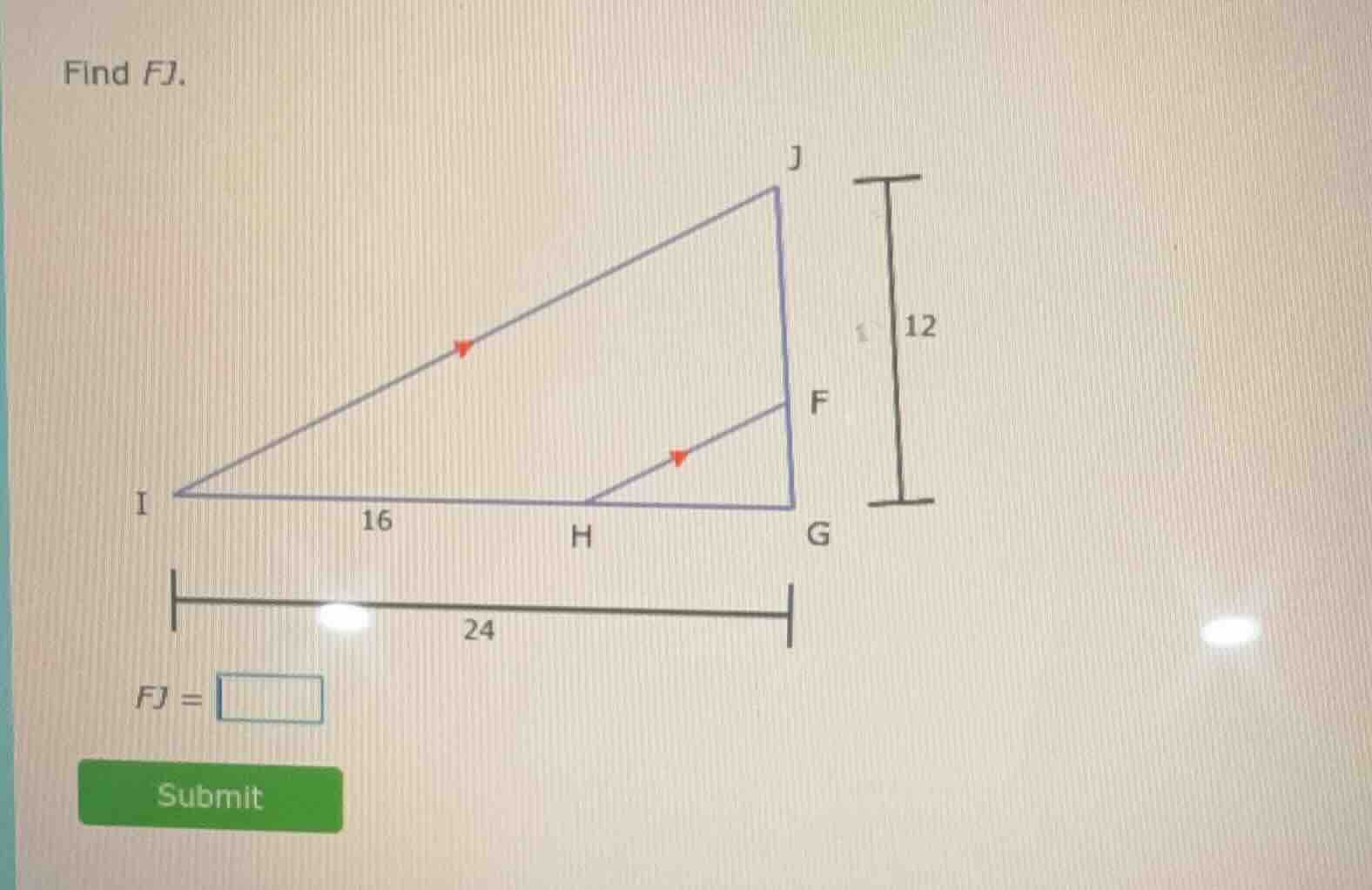
find fj.
fj = \boxed{}
submit
Step1: Identify Similar Triangles
The triangles \( \triangle IJG \) and \( \triangle IFH \) are similar (by the Basic Proportionality Theorem or AA similarity, as the lines \( IH \) and \( IF \) (wait, actually \( IH \) and \( HG \)? Wait, no, the midline? Wait, \( IH = 16 \), \( IG = 24 \), so the ratio of \( IH \) to \( IG \) is \( \frac{16}{24}=\frac{2}{3} \). Wait, actually, the segment \( FH \) is parallel to \( IJ \)? Wait, no, the arrows indicate that \( FH \) is parallel to \( IJ \)? Wait, no, the triangle: \( I \) to \( H \) to \( G \), and \( F \) is on \( JG \), \( H \) is on \( IG \), and \( FH \) is parallel to \( IJ \). So by the Basic Proportionality Theorem (Thales' theorem), \( \frac{IH}{IG}=\frac{JF}{JG} \)? Wait, no, \( IH = 16 \), \( IG = 24 \), so \( \frac{IH}{IG}=\frac{16}{24}=\frac{2}{3} \). Then, since \( FH \parallel IJ \), the triangles \( \triangle FHG \) and \( \triangle IJG \) are similar? Wait, no, \( H \) is on \( IG \), \( F \) is on \( JG \), and \( FH \parallel IJ \), so \( \triangle IFH \sim \triangle IJG \)? Wait, maybe better to use the ratio of segments. The length of \( JG \) is 12. Let \( FJ = x \), then \( FG = 12 - x \). Wait, no, \( IH = 16 \), \( HG = IG - IH = 24 - 16 = 8 \). Wait, \( IH = 16 \), \( HG = 8 \), so \( IH:HG = 2:1 \). Then, since \( FH \parallel IJ \), by the converse of Thales' theorem, \( \frac{IH}{HG}=\frac{JF}{FG} \). Wait, \( IH = 16 \), \( HG = 8 \), so \( \frac{16}{8} = 2 \), so \( \frac{JF}{FG} = 2 \), so \( JF = 2 \times FG \). But \( JF + FG = JG = 12 \), so \( 2 \times FG + FG = 12 \), \( 3 \times FG = 12 \), \( FG = 4 \), so \( JF = 8 \)? Wait, no, maybe I mixed up. Wait, \( IH = 16 \), \( IG = 24 \), so \( \frac{IH}{IG}=\frac{16}{24}=\frac{2}{3} \). Then, since \( FH \parallel IJ \), the ratio of \( JF \) to \( JG \) should be \( \frac{IH}{IG} \)? Wait, no, the smaller triangle \( \triangle FHG \) has base \( HG = 8 \), and the larger triangle \( \triangle IJG \) has base \( IG = 24 \). Wait, no, \( H \) is on \( IG \), so \( IH = 16 \), \( HG = 8 \), so \( IH:HG = 2:1 \). Then, the height of the smaller triangle (from \( F \) to \( HG \)) and the height of the larger triangle (from \( J \) to \( IG \)) should be in the same ratio. Wait, the total height \( JG = 12 \). Let \( FG = y \), then \( JF = 12 - y \). Then, since \( \triangle FHG \sim \triangle IJG \) (by AA similarity, as \( \angle G \) is common and \( \angle FHG = \angle IJG \) because \( FH \parallel IJ \)), the ratio of similarity is \( \frac{HG}{IG}=\frac{8}{24}=\frac{1}{3} \). Wait, no, \( HG = 8 \), \( IG = 24 \), so ratio \( 1:3 \), so \( FG = \frac{1}{3} JG = \frac{1}{3} \times 12 = 4 \), so \( JF = JG - FG = 12 - 4 = 8 \). Wait, that makes sense. Alternatively, using the ratio of \( IH \) to \( IG \): \( \frac{IH}{IG}=\frac{16}{24}=\frac{2}{3} \), so the ratio of \( JF \) to \( JG \) is \( \frac{2}{3} \)? Wait, no, that would be if \( H \) is the midpoint, but no. Wait, maybe the correct approach is: since \( FH \) is parallel to \( IJ \), by the Basic Proportionality Theorem, \( \frac{IH}{HG}=\frac{JF}{FG} \). \( IH = 16 \), \( HG = 24 - 16 = 8 \), so \( \frac{16}{8} = 2 \), so \( \frac{JF}{FG} = 2 \), so \( JF = 2 \times FG \). And \( JF + FG = 12 \), so \( 2FG + FG = 12 \), \( 3FG = 12 \), \( FG = 4 \), so \( JF = 8 \).
Step2: Calculate FJ
We have \( IH = 16 \), \( IG = 24 \), so \( HG = IG - IH = 24 - 16 = 8 \). The ratio \( \frac{IH}{HG} = \frac{16}{8} = 2 \). By the Basic Proportionality Theorem (Thales' theorem), since \( FH \parallel IJ \), \( \frac{JF}{FG} = \frac{IH}{HG} = 2 \…

Snap & solve any problem in the app
Get step-by-step solutions on Sovi AI
Photo-based solutions with guided steps
Explore more problems and detailed explanations
\( \boxed{8} \)