QUESTION IMAGE
Question
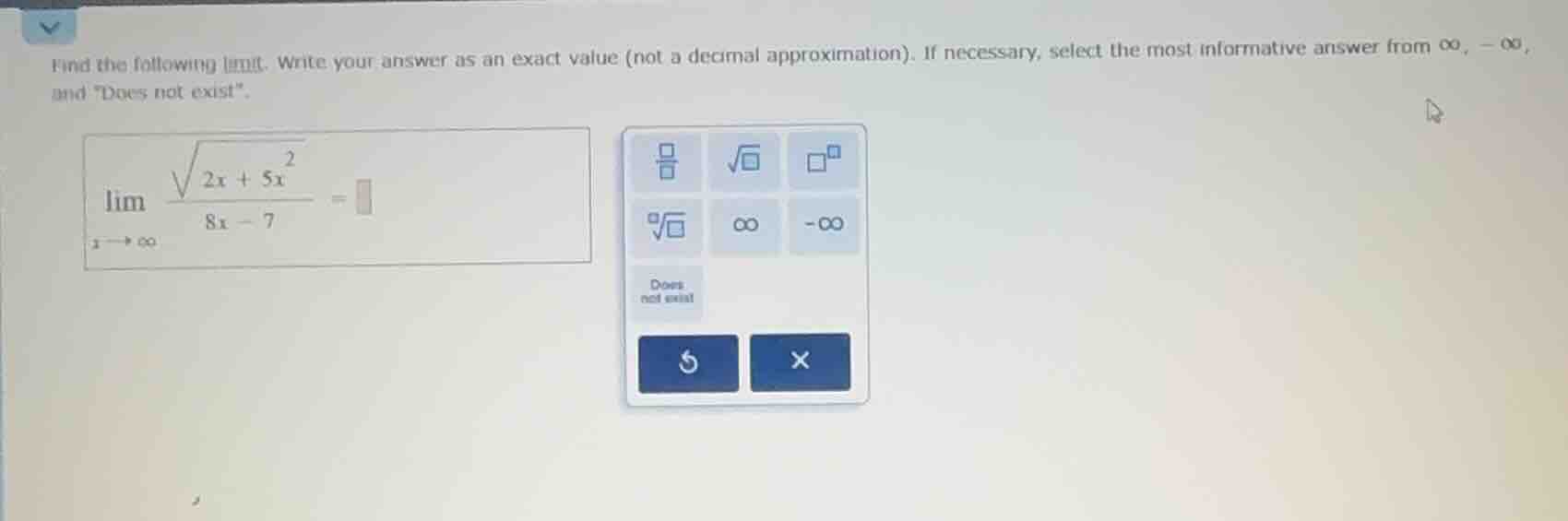
find the following limit. write your answer as an exact value (not a decimal approximation). if necessary, select the most informative answer from $\infty$, $-\infty$, and \does not exist\. $\lim\limits_{x \to -\infty} \frac{\sqrt{2x + 5x^2}}{8x - 7} = $
Step1: Simplify the square root
For large \( x \), the dominant term inside the square root \( \sqrt{2x + 5x^2} \) is \( 5x^2 \) (since the degree of \( 5x^2 \) is higher than that of \( 2x \)). So, \( \sqrt{2x + 5x^2} \approx \sqrt{5x^2}=|x|\sqrt{5} \). As \( x \to \infty \), \( |x| = x \), so this becomes \( x\sqrt{5} \).
Step2: Analyze the denominator
The denominator is \( 8x - 7 \). For large \( x \), the dominant term is \( 8x \), so \( 8x - 7 \approx 8x \) as \( x \to \infty \).
Step3: Find the limit
Now, we can rewrite the limit as:
\[
\lim_{x \to \infty} \frac{\sqrt{5}x}{8x}
\]
The \( x \) terms cancel out (since \( x
eq 0 \) when \( x \to \infty \)), and we are left with \( \frac{\sqrt{5}}{8} \)? Wait, no, wait. Wait, the original expression inside the square root is \( 2x + 5x^2 \), so when we take the square root, it's \( \sqrt{x^2(5 + \frac{2}{x})}=|x|\sqrt{5 + \frac{2}{x}} \). As \( x \to \infty \), \( \frac{2}{x} \to 0 \), so \( \sqrt{5 + \frac{2}{x}} \to \sqrt{5} \), and \( |x| = x \) for \( x \to \infty \). So the numerator is \( x\sqrt{5 + \frac{2}{x}} \approx x\sqrt{5} \) for large \( x \). The denominator is \( 8x - 7 \approx 8x \). So the limit is \( \lim_{x \to \infty} \frac{x\sqrt{5}}{8x}=\frac{\sqrt{5}}{8} \)? Wait, no, that can't be right. Wait, no, wait, the original function is \( \frac{\sqrt{2x + 5x^2}}{8x - 7} \). Let's factor out \( x^2 \) inside the square root: \( \sqrt{x^2(5 + \frac{2}{x})}=|x|\sqrt{5 + \frac{2}{x}} \). Since \( x \to \infty \), \( |x| = x \), so this is \( x\sqrt{5 + \frac{2}{x}} \). Then the denominator is \( 8x - 7 = x(8 - \frac{7}{x}) \). So now, the limit becomes:
\[
\lim_{x \to \infty} \frac{x\sqrt{5 + \frac{2}{x}}}{x(8 - \frac{7}{x})}
\]
We can cancel the \( x \) terms (since \( x
eq 0 \) as \( x \to \infty \)):
\[
\lim_{x \to \infty} \frac{\sqrt{5 + \frac{2}{x}}}{8 - \frac{7}{x}}
\]
Now, as \( x \to \infty \), \( \frac{2}{x} \to 0 \) and \( \frac{7}{x} \to 0 \), so we substitute these in:
\[
\frac{\sqrt{5 + 0}}{8 - 0}=\frac{\sqrt{5}}{8}
\]
Wait, but that seems small. Wait, no, wait, maybe I made a mistake. Wait, the original expression is \( \sqrt{2x + 5x^2} \). Let's check the degree. The numerator: the expression inside the square root is \( 5x^2 + 2x \), which is degree 2, so the square root is degree 1 (since square root of degree 2 is degree 1). The denominator is degree 1 (since \( 8x - 7 \) is degree 1). So when we take the limit of a degree 1 over degree 1, the limit is the ratio of the leading coefficients. The leading coefficient of the numerator (inside the square root, then square root) is: the leading term inside the square root is \( 5x^2 \), so square root is \( \sqrt{5}x \), so leading coefficient is \( \sqrt{5} \). The leading coefficient of the denominator is \( 8 \). So the limit is \( \frac{\sqrt{5}}{8} \). Wait, but let's test with \( x = 1000 \). Numerator: \( \sqrt{21000 + 5(1000)^2}=\sqrt{2000 + 5000000}=\sqrt{5002000}\approx 2236.5 \). Denominator: \( 8*1000 - 7 = 7993 \). Then \( 2236.5 / 7993 \approx 0.2798 \). \( \sqrt{5}/8 \approx 2.236/8 \approx 0.2795 \), which matches. So that's correct.
Wait, but wait, the problem is \( \lim_{x \to \infty} \frac{\sqrt{2x + 5x^2}}{8x - 7} \). Let's do it more formally.
Factor out \( x^2 \) from the numerator:
\( \sqrt{2x + 5x^2} = \sqrt{x^2(5 + \frac{2}{x})} = |x|\sqrt{5 + \frac{2}{x}} \)
Since \( x \to \infty \), \( |x| = x \), so:
\( \sqrt{2x + 5x^2} = x\sqrt{5 + \frac{2}{x}} \)
Now, the denominator is \( 8x - 7 = x(8 - \frac{7}{x}) \)
So the expression becomes:
\( \frac{x\sqrt{5 + \frac{…

Snap & solve any problem in the app
Get step-by-step solutions on Sovi AI
Photo-based solutions with guided steps
Explore more problems and detailed explanations
\( \dfrac{\sqrt{5}}{8} \)