QUESTION IMAGE
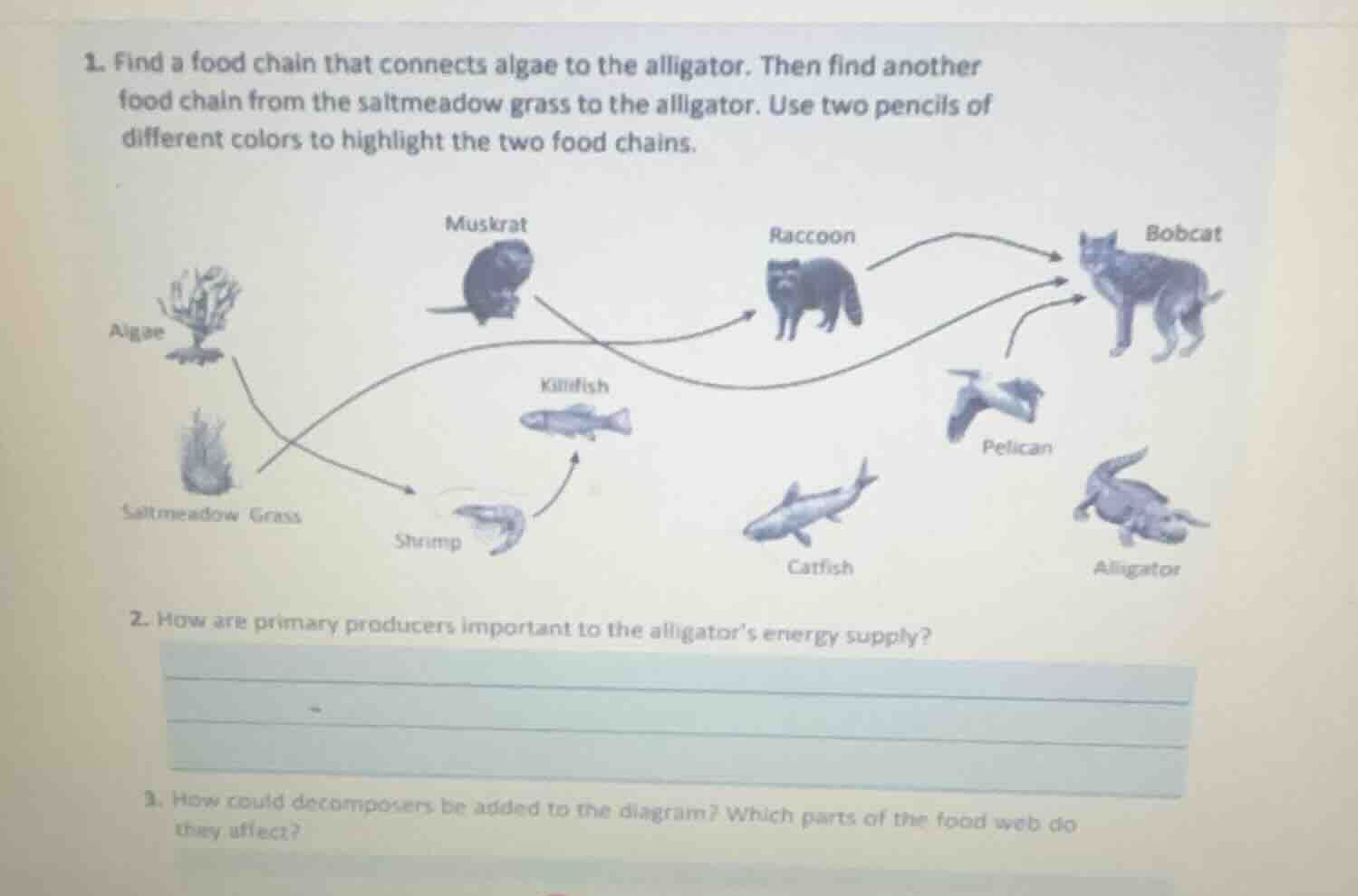
Question
- find a food chain that connects algae to the alligator. then find another food chain from the saltmeadow grass to the alligator. use two pencils of different colors to highlight the two food chains.
- how are primary producers important to the alligators energy supply?
- how could decomposers be added to the diagram? which parts of the food web do they affect?
Step1: Identify algae-alligator chain
Algae → Shrimp → Killifish → Catfish → Alligator
Step2: Identify grass-alligator chain
Saltmeadow Grass → Muskrat → Raccoon → Bobcat → Alligator
Step3: Explain producer energy role
Primary producers (algae, grass) capture sunlight to make food via photosynthesis, forming the base of the food web. All energy for the alligator’s prey (and thus the alligator) originates from these producers, as energy flows up the food chains.
Step4: Explain decomposers' addition/impact
Decomposers (e.g., fungi, bacteria) would be added by drawing arrows from all dead organisms (all plants/animals in the web) to decomposers, and arrows from decomposers back to the producers. They break down dead matter, recycling nutrients into the environment that producers use to grow, supporting the entire food web.

Snap & solve any problem in the app
Get step-by-step solutions on Sovi AI
Photo-based solutions with guided steps
Explore more problems and detailed explanations
- Food chain 1 (algae to alligator): Algae → Shrimp → Killifish → Catfish → Alligator
Food chain 2 (saltmeadow grass to alligator): Saltmeadow Grass → Muskrat → Raccoon → Bobcat → Alligator
- Primary producers are the base of the food web; they convert sunlight into chemical energy via photosynthesis, which flows up through the food chains to provide all the energy the alligator obtains from its prey.
- Decomposers can be added by drawing connections from every dead organism in the food web to decomposers, and then from decomposers to the primary producers (algae, saltmeadow grass). They affect all parts of the food web by breaking down dead organic matter, recycling nutrients that producers need to grow, which in turn supports all other trophic levels.