QUESTION IMAGE
Question
find ij.
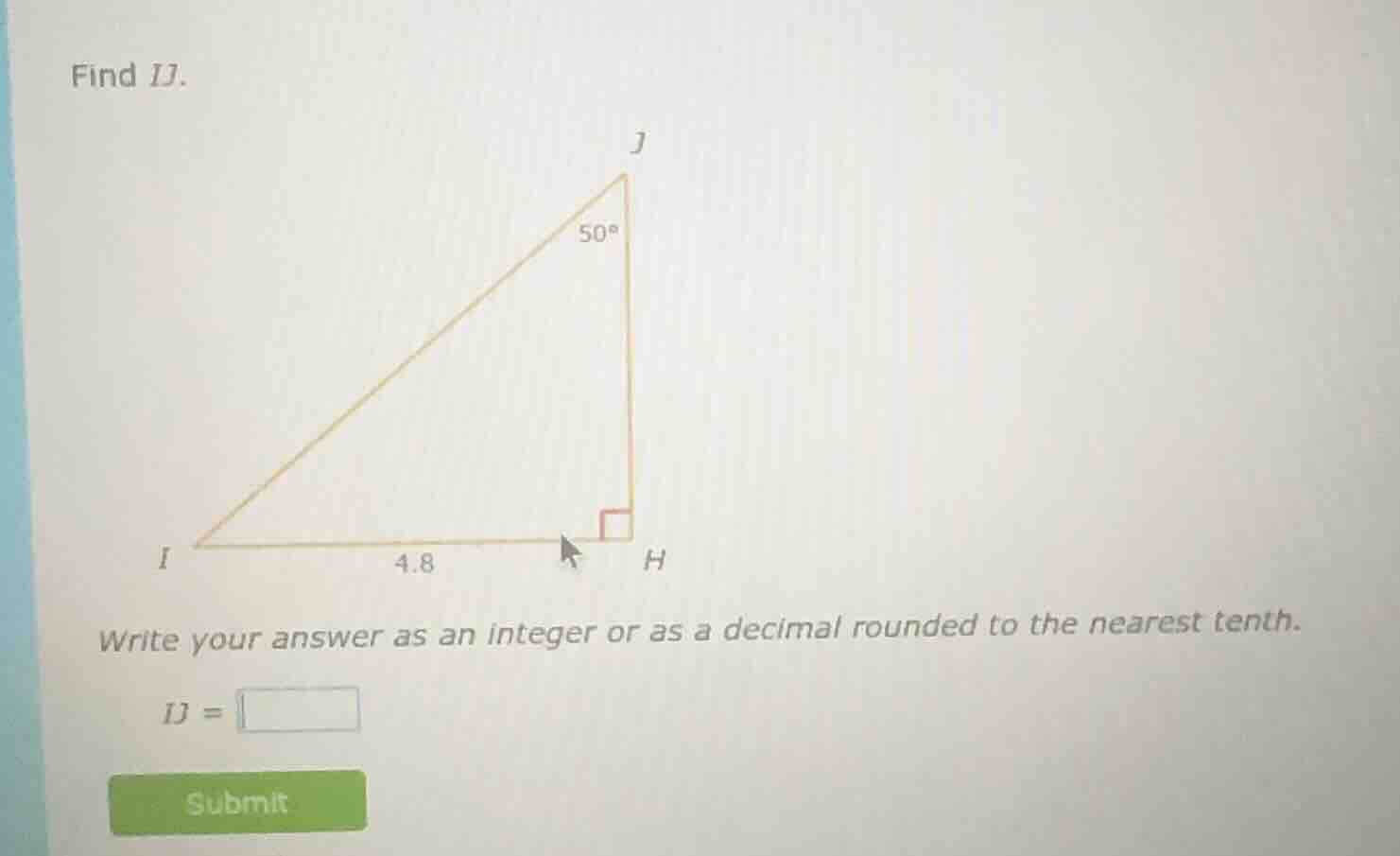
triangle with right angle at h, ih = 4.8, angle at j is 50 degrees.
write your answer as an integer or as a decimal rounded to the nearest tenth.
ij =
submit
Step1: Identify the trigonometric ratio
In right triangle \( \triangle IHJ \), \( \angle H = 90^\circ \), \( \angle J = 50^\circ \), and \( IH = 4.8 \). We need to find \( IJ \), the hypotenuse. We can use the sine function, but wait, actually, \( IH \) is the opposite side to \( \angle J \), and \( IJ \) is the hypotenuse. Wait, no: \( \sin(\theta)=\frac{\text{opposite}}{\text{hypotenuse}} \), so \( \sin(50^\circ)=\frac{IH}{IJ} \), so \( IJ = \frac{IH}{\sin(50^\circ)} \)? Wait, no, wait: \( \angle J = 50^\circ \), so the side opposite to \( \angle J \) is \( IH = 4.8 \), and the hypotenuse is \( IJ \). So \( \sin(50^\circ)=\frac{IH}{IJ} \), so \( IJ = \frac{IH}{\sin(50^\circ)} \). Wait, or maybe cosine? Wait, no, let's check the angles. Wait, \( \angle I + \angle J + \angle H = 180^\circ \), so \( \angle I = 40^\circ \). Alternatively, maybe using cosine for \( \angle I \). Wait, maybe I made a mistake. Wait, \( IH \) is adjacent to \( \angle I \), and opposite to \( \angle J \). Let's re-express: in \( \triangle IHJ \), right-angled at \( H \), \( IH = 4.8 \) (adjacent to \( \angle I \), opposite to \( \angle J \)), \( HJ \) is adjacent to \( \angle J \), opposite to \( \angle I \), and \( IJ \) is hypotenuse. So to find \( IJ \), we can use \( \sin(\angle J) = \frac{IH}{IJ} \), so \( IJ = \frac{IH}{\sin(\angle J)} \). Wait, \( \angle J = 50^\circ \), \( IH = 4.8 \), so \( IJ = \frac{4.8}{\sin(50^\circ)} \). Let's calculate \( \sin(50^\circ) \approx 0.7660 \). Then \( IJ \approx \frac{4.8}{0.7660} \approx 6.3 \). Wait, or maybe using \( \cos(\angle I) \), since \( \angle I = 40^\circ \), and \( IH \) is adjacent to \( \angle I \), so \( \cos(40^\circ)=\frac{IH}{IJ} \), so \( IJ = \frac{IH}{\cos(40^\circ)} \). Wait, \( \cos(40^\circ) \approx 0.7660 \), same as \( \sin(50^\circ) \), since \( \sin(\theta)=\cos(90^\circ - \theta) \). So either way, \( IJ = \frac{4.8}{\sin(50^\circ)} \approx \frac{4.8}{0.7660} \approx 6.3 \). Wait, let's check with calculator. \( \sin(50^\circ) \approx 0.7660 \), so \( 4.8 / 0.7660 \approx 6.266 \), which rounds to 6.3.
Wait, maybe I mixed up opposite and adjacent. Let's clarify: angle at J is 50 degrees, so the sides:
- Opposite to J: IH = 4.8
- Adjacent to J: HJ
- Hypotenuse: IJ
So \( \sin(J) = \frac{\text{opposite}}{\text{hypotenuse}} = \frac{IH}{IJ} \)
Therefore, \( IJ = \frac{IH}{\sin(J)} = \frac{4.8}{\sin(50^\circ)} \)
Calculating \( \sin(50^\circ) \approx 0.7660 \)
So \( IJ \approx \frac{4.8}{0.7660} \approx 6.3 \)
Step2: Calculate the value
Using a calculator, \( \sin(50^\circ) \approx 0.7660 \)
\( IJ = \frac{4.8}{0.7660} \approx 6.3 \) (rounded to the nearest tenth)

Snap & solve any problem in the app
Get step-by-step solutions on Sovi AI
Photo-based solutions with guided steps
Explore more problems and detailed explanations
\( IJ \approx \boxed{6.3} \)