QUESTION IMAGE
Question
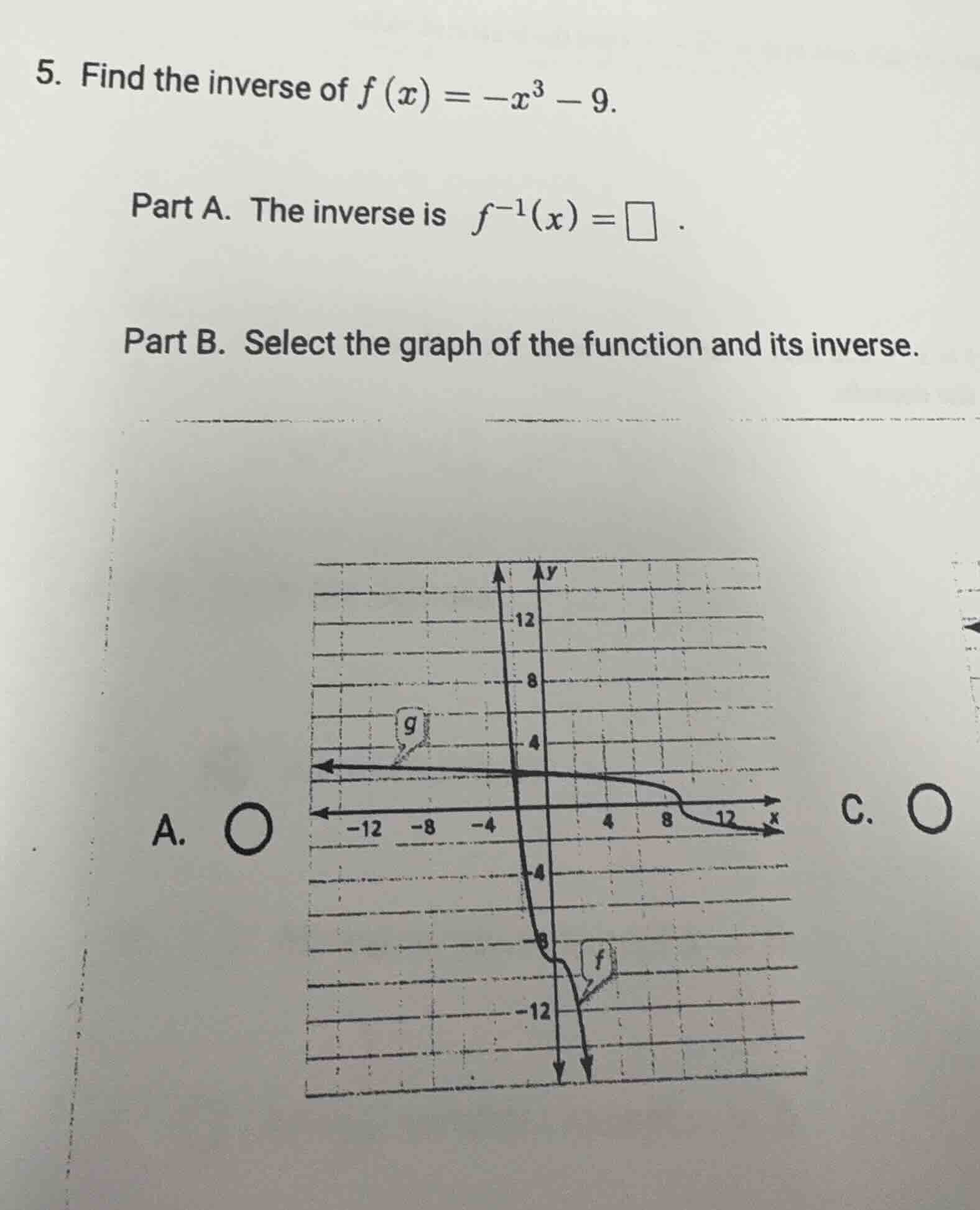
- find the inverse of $f(x) = -x^3 - 9$. part a. the inverse is $f^{-1}(x) = \square$. part b. select the graph of the function and its inverse. a. $\bigcirc$ graph with axes and curves labeled g and f c. $\bigcirc$
Part A
Step1: Replace \( f(x) \) with \( y \)
We start with the function \( f(x)=-x^{3}-9 \). Replace \( f(x) \) with \( y \), so we have \( y = -x^{3}-9 \).
Step2: Swap \( x \) and \( y \)
To find the inverse, we swap the roles of \( x \) and \( y \). This gives us \( x=-y^{3}-9 \).
Step3: Solve for \( y \)
First, we add 9 to both sides of the equation: \( x + 9=-y^{3} \). Then, we multiply both sides by - 1 to get \( - (x + 9)=y^{3} \), which can be rewritten as \( y^{3}=-x - 9 \). Finally, we take the cube root of both sides. The cube root of \( y^{3} \) is \( y \), and the cube root of \( -x - 9 \) is \( \sqrt[3]{-x - 9} \), which can also be written as \( -\sqrt[3]{x + 9} \) (since \( \sqrt[3]{-a}=-\sqrt[3]{a} \)). So \( y = \sqrt[3]{-x - 9}=-\sqrt[3]{x + 9} \).
Step4: Replace \( y \) with \( f^{-1}(x) \)
We replace \( y \) with \( f^{-1}(x) \) to get the inverse function. So \( f^{-1}(x)=-\sqrt[3]{x + 9} \) or \( f^{-1}(x)=\sqrt[3]{-x - 9} \)

Snap & solve any problem in the app
Get step-by-step solutions on Sovi AI
Photo-based solutions with guided steps
Explore more problems and detailed explanations
\( f^{-1}(x)=-\sqrt[3]{x + 9} \) (or \( f^{-1}(x)=\sqrt[3]{-x - 9} \))
Part B
To determine the graph of the function \( f(x)=-x^{3}-9 \) and its inverse \( f^{-1}(x)=-\sqrt[3]{x + 9} \), we use the property that the graph of a function and its inverse are symmetric about the line \( y = x \).
The function \( f(x)=-x^{3}-9 \) is a cubic function with a negative leading coefficient for the cubic term, so it is a decreasing function (as \( x \) increases, \( f(x) \) decreases). The inverse function \( f^{-1}(x) \) should also be a decreasing function (since the original function is one - to - one and decreasing) and its graph should be the reflection of the graph of \( f(x) \) over the line \( y=x \).
Looking at the given graph options (even though some are partially shown), the graph of \( f(x)=-x^{3}-9 \) will have a shape where as \( x\to+\infty \), \( f(x)\to-\infty \) and as \( x\to-\infty \), \( f(x)\to+\infty \). The inverse function, being the reflection over \( y = x \), will have a corresponding symmetric shape. If we assume the graph labeled \( f \) is the graph of \( f(x)=-x^{3}-9 \) and the graph labeled \( g \) (or other labels) is the graph of \( f^{-1}(x) \), the correct graph should show two curves that are symmetric with respect to the line \( y=x \).
Since we can't see all the options clearly, but based on the property of inverse functions (symmetry about \( y = x \)) and the nature of cubic functions:
The function \( f(x)=-x^{3}-9 \) has a \( y \) - intercept at \( (0,-9) \) (when \( x = 0 \), \( f(0)=-0 - 9=-9 \)). The inverse function \( f^{-1}(x) \) will have an \( x \) - intercept at \( (-9,0) \) (when \( x=-9 \), \( f^{-1}(-9)=-\sqrt[3]{-9 + 9}=0 \)).
If we consider the given graph with \( f \) and \( g \), the graph of \( f(x) \) (the cubic function) and its inverse should be symmetric about \( y = x \). So the correct graph is the one where the two curves (of \( f \) and \( f^{-1} \)) are mirror images across the line \( y=x \).
If we assume the first graph (with \( f \) and \( g \)) is the candidate, and based on the shape of cubic functions and their inverses, the correct graph is the one that shows the symmetry. However, since the options are not fully visible, but from the given partial graph, if the graph of \( f(x) \) is the one with the curve going from the second quadrant (as \( x\to-\infty \), \( f(x)\to+\infty \)) to the fourth quadrant (as \( x\to+\infty \), \( f(x)\to-\infty \)) and the other curve (the inverse) is its reflection over \( y = x \), then the correct option (among the given ones) should be the one where the two graphs are symmetric about \( y=x \).
But since we need to give an answer based on the partial information, and considering the standard graph of \( y=-x^{3}-9 \) and its inverse \( y =-\sqrt[3]{x + 9} \), the correct graph is the one that shows the two curves symmetric about \( y = x \). If we take the graph with \( f \) and \( g \) as the relevant one, and assuming the labels are correct, the answer would be the option (e.g., if the option with \( f \) and \( g \) is option A) A. But due to the limited visibility of the options, we can say that the correct graph is the one where the function and its inverse are symmetric about the line \( y = x \).
(Note: If more details of the options were provided, we could be more precise. But based on the property of inverse functions, the graph should show symmetry about \( y=x \))