QUESTION IMAGE
Question
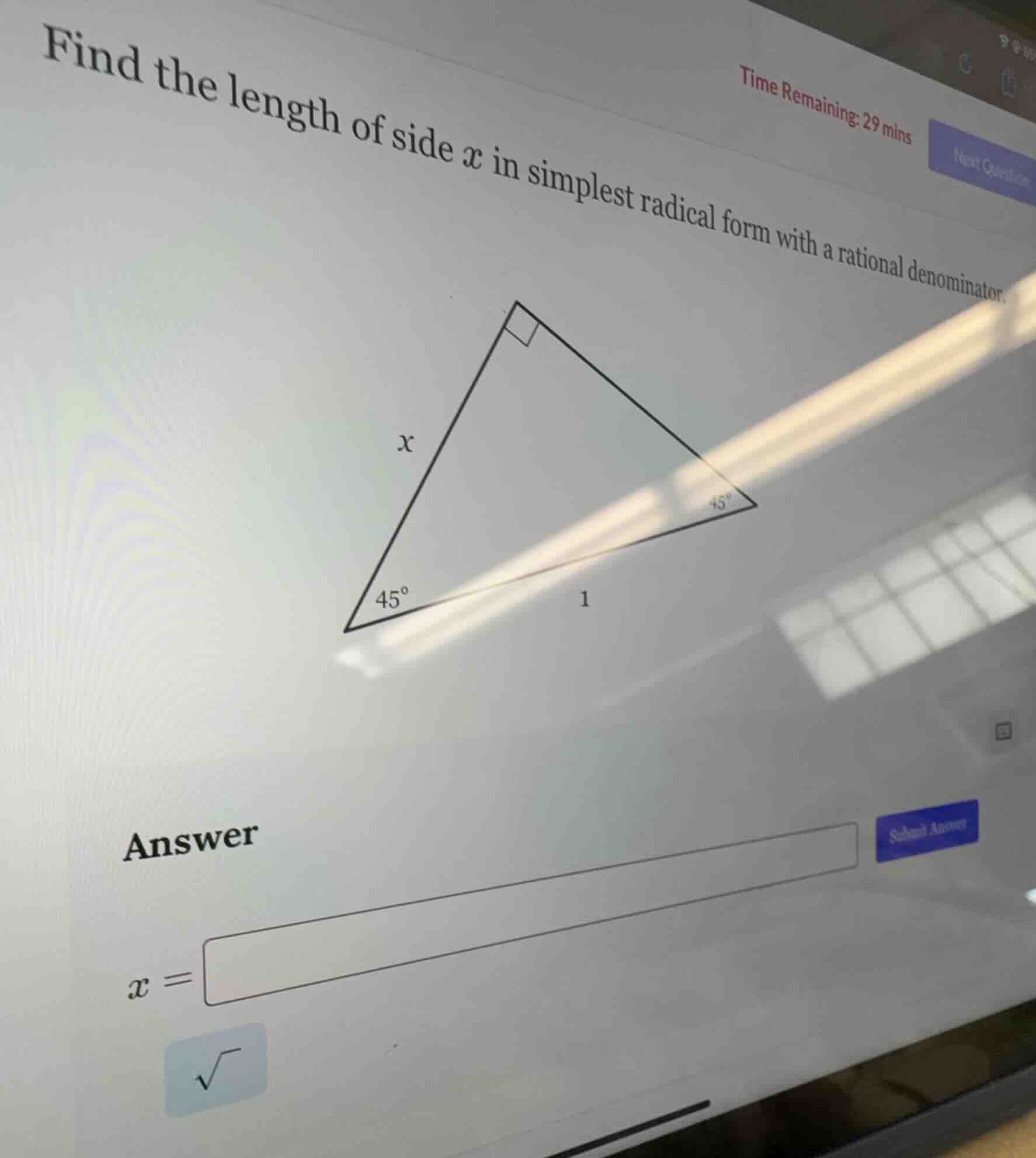
find the length of side ( x ) in simplest radical form with a rational denominator.
answer
( x = )
Step1: Identify triangle type
The triangle is a right - isosceles triangle (two angles are \(45^{\circ}\), so the two legs are equal, and the hypotenuse can be found using the Pythagorean theorem or the properties of \(45 - 45-90\) triangles. In a \(45 - 45-90\) triangle, the ratio of the legs to the hypotenuse is \(1:1:\sqrt{2}\). Here, the hypotenuse is given as \(1\), and we want to find the length of a leg \(x\).
Let the length of each leg be \(x\). By the Pythagorean theorem, for a right triangle \(a^{2}+b^{2}=c^{2}\), where \(a = b=x\) and \(c = 1\) (the hypotenuse). So we have \(x^{2}+x^{2}=1^{2}\).
Step2: Solve for \(x\)
Simplify the left - hand side of the equation: \(2x^{2}=1\).
Divide both sides by \(2\): \(x^{2}=\frac{1}{2}\).
Take the square root of both sides: \(x=\sqrt{\frac{1}{2}}\).
Rationalize the denominator: \(x = \frac{\sqrt{1}}{\sqrt{2}}=\frac{1}{\sqrt{2}}=\frac{\sqrt{2}}{2}\) (since \(\frac{1}{\sqrt{2}}\times\frac{\sqrt{2}}{\sqrt{2}}=\frac{\sqrt{2}}{2}\)).

Snap & solve any problem in the app
Get step-by-step solutions on Sovi AI
Photo-based solutions with guided steps
Explore more problems and detailed explanations
\(\frac{\sqrt{2}}{2}\)