QUESTION IMAGE
Question
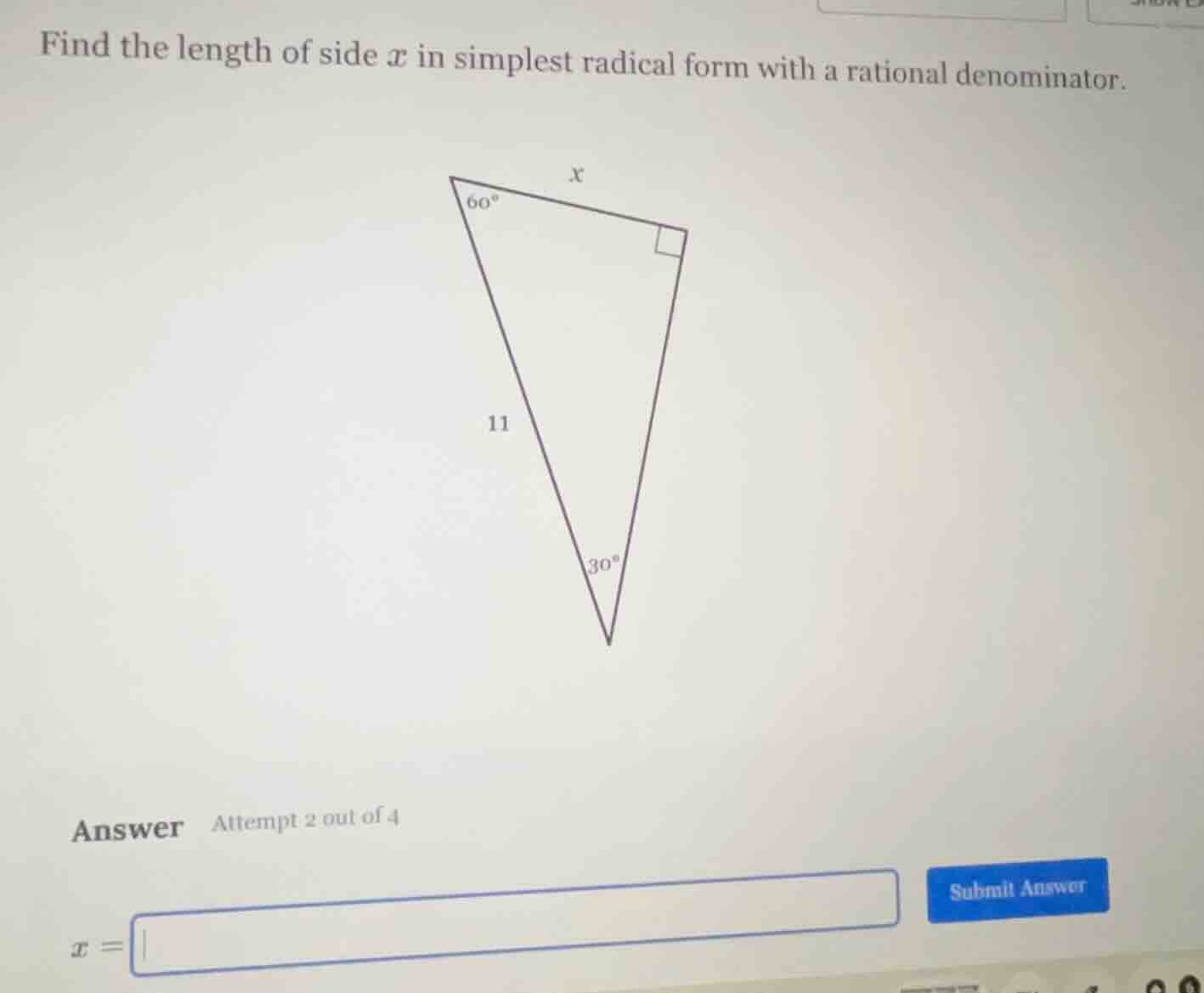
find the length of side ( x ) in simplest radical form with a rational denominator.
answer attempt 2 out of 4
( x = )
Step1: Identify triangle type
This is a 30 - 60 - 90 right triangle. In a 30 - 60 - 90 triangle, the sides are in the ratio \(1:\sqrt{3}:2\), where the side opposite \(30^{\circ}\) is the shortest, opposite \(60^{\circ}\) is \(\sqrt{3}\) times the shortest, and the hypotenuse is twice the shortest. Here, the hypotenuse is 11, and \(x\) is opposite the \(30^{\circ}\) angle? Wait, no, wait. Wait, the angles: one angle is \(60^{\circ}\), one is \(30^{\circ}\), and right angle. So the side opposite \(30^{\circ}\) is adjacent to \(60^{\circ}\), and vice - versa. Wait, let's label the triangle. Let the right - angled vertex be \(C\), the \(30^{\circ}\) vertex be \(A\), and \(60^{\circ}\) vertex be \(B\). Then hypotenuse \(AB = 11\), side \(x\) is \(BC\) (opposite \(30^{\circ}\)), and the other leg is opposite \(60^{\circ}\). In a 30 - 60 - 90 triangle, the side opposite \(30^{\circ}\) (let's call it \(a\)) is half the hypotenuse? Wait, no, wait: hypotenuse \(c = 2a\) (where \(a\) is opposite \(30^{\circ}\)), and the side opposite \(60^{\circ}\) (let's call it \(b\)) is \(a\sqrt{3}\). Wait, no, I think I mixed up. Let's use trigonometry. Let's take angle \(A = 30^{\circ}\), right angle at \(C\). Then \(\cos(A)=\frac{AC}{AB}\), \(\sin(A)=\frac{BC}{AB}\). Since \(A = 30^{\circ}\), \(\sin(30^{\circ})=\frac{x}{11}\) (because \(BC=x\) and \(AB = 11\) is the hypotenuse). We know that \(\sin(30^{\circ})=\frac{1}{2}\).
Step2: Solve for \(x\)
From \(\sin(30^{\circ})=\frac{x}{11}\), and \(\sin(30^{\circ})=\frac{1}{2}\), we have \(\frac{1}{2}=\frac{x}{11}\). Cross - multiplying gives \(x=\frac{11}{2}\)? Wait, no, that can't be. Wait, maybe I labeled the triangle wrong. Wait, the angle at the bottom is \(30^{\circ}\), the angle at the top is \(60^{\circ}\), right angle on the right. So the side \(x\) is adjacent to the \(60^{\circ}\) angle and opposite to the \(30^{\circ}\) angle. Wait, hypotenuse is 11. Let's use cosine of \(60^{\circ}\). \(\cos(60^{\circ})=\frac{x}{11}\), because \(\cos(\theta)=\frac{\text{adjacent}}{\text{hypotenuse}}\). And \(\cos(60^{\circ})=\frac{1}{2}\). So \(\frac{1}{2}=\frac{x}{11}\), then \(x = \frac{11}{2}\)? Wait, no, that seems too simple. Wait, no, maybe the hypotenuse is not 11. Wait, the side labeled 11 is the side opposite the \(60^{\circ}\) angle? Wait, let's re - examine the triangle. The side with length 11 is between the \(60^{\circ}\) and \(30^{\circ}\) angles, so it's the hypotenuse. Wait, in a right - triangle, the hypotenuse is opposite the right angle. So the side of length 11 is the hypotenuse. Then, if we want to find \(x\), which is adjacent to the \(60^{\circ}\) angle. So \(\cos(60^{\circ})=\frac{x}{11}\), \(\cos(60^{\circ}) = 0.5=\frac{1}{2}\), so \(x = 11\times\frac{1}{2}=\frac{11}{2}\). Wait, but that seems like the side opposite \(30^{\circ}\). Alternatively, using sine of \(30^{\circ}\): \(\sin(30^{\circ})=\frac{x}{11}\), and \(\sin(30^{\circ})=\frac{1}{2}\), so \(x=\frac{11}{2}\).
Wait, maybe I made a mistake in the trigonometric ratio. Let's recall: in a right - triangle, \(\sin(\theta)=\frac{\text{opposite}}{\text{hypotenuse}}\), \(\cos(\theta)=\frac{\text{adjacent}}{\text{hypotenuse}}\), \(\tan(\theta)=\frac{\text{opposite}}{\text{adjacent}}\). Let's define the angles: the angle of \(30^{\circ}\): opposite side is \(x\), hypotenuse is 11. So \(\sin(30^{\circ})=\frac{\text{opposite}}{\text{hypotenuse}}=\frac{x}{11}\). Since \(\sin(30^{\circ})=\frac{1}{2}\), then \(x = 11\times\frac{1}{2}=\frac{11}{2}\).

Snap & solve any problem in the app
Get step-by-step solutions on Sovi AI
Photo-based solutions with guided steps
Explore more problems and detailed explanations
\(\frac{11}{2}\)