QUESTION IMAGE
Question
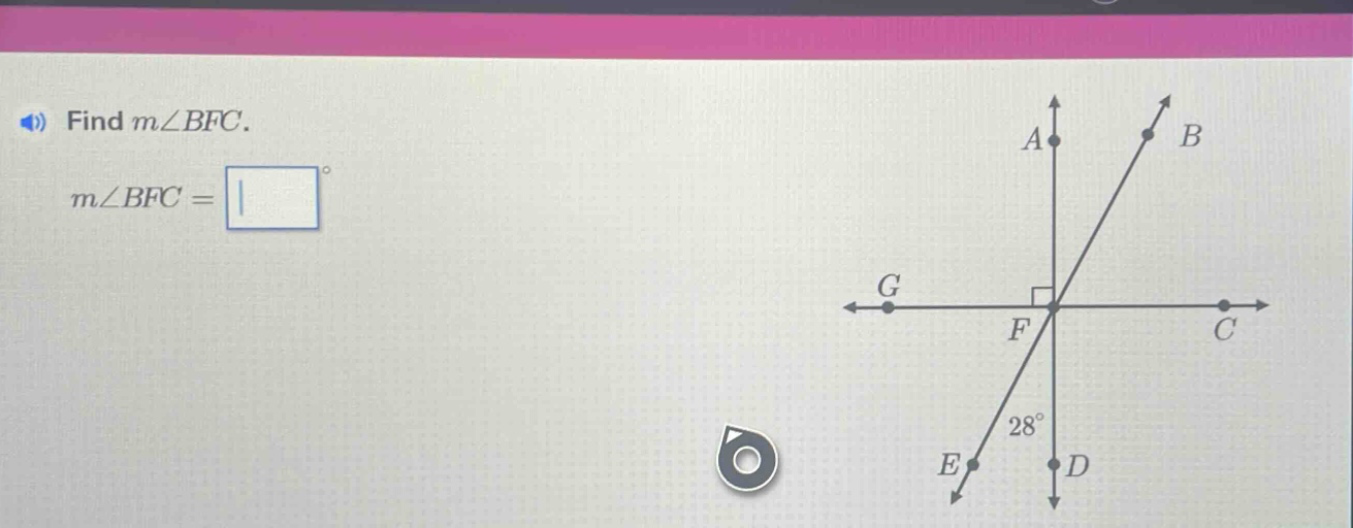
find ( mangle bfc ).( mangle bfc = square^circ )
Step1: Identify right angle and angle relation
Line \(AF\) is perpendicular to \(GC\), so \(\angle AFC = 90^\circ\). Also, \(\angle BFA\) and \(\angle EFD\) are vertical angles (or we can use the fact that \(\angle EFD = 28^\circ\) and \(\angle BFC\) relates to the right angle). Wait, actually, since \(AF\perp GC\) (right angle at \(F\) between \(AF\) and \(GC\)), and the angle between \(FD\) and \(EF\) is \(28^\circ\), the angle between \(BF\) and \(FC\) can be found by noting that \(\angle AFD = 90^\circ\) (since \(AF\perp FD\) as \(AF\) and \(GC\) are horizontal - vertical, so \(AF\) is vertical, \(GC\) is horizontal, \(FD\) is vertical down). Wait, maybe better: the angle between \(BF\) and \(AF\) should be equal to the angle between \(EF\) and \(FD\) because they are vertical angles? Wait, no. Let's see: \(AF\) is vertical up, \(FD\) is vertical down, so \(AFD\) is a straight line (180 degrees), but \(AF\perp GC\), so \(\angle AFC = 90^\circ\) (right angle). The angle between \(EF\) and \(FD\) is \(28^\circ\), so the angle between \(BF\) and \(AF\) is also \(28^\circ\) (vertical angles: \(\angle BFA\) and \(\angle EFD\) are vertical angles, so they are equal). Then, since \(\angle AFC = 90^\circ\), which is \(\angle BFA + \angle BFC\), so \(\angle BFC = 90^\circ - \angle BFA\). Since \(\angle BFA = 28^\circ\) (because \(\angle EFD = 28^\circ\) and they are vertical angles), then \(\angle BFC = 90 - 28 = 62^\circ\)? Wait, no, wait: maybe I got the angles reversed. Let's look at the diagram again: \(F\) is the intersection point. \(GC\) is horizontal (left \(G\), right \(C\)), \(AF\) is vertical up, \(FD\) is vertical down, \(EB\) is a line through \(F\), with \(E\) below, \(B\) above. The angle between \(EF\) and \(FD\) is \(28^\circ\) (so \(\angle EFD = 28^\circ\)). Then \(\angle BFA\) is equal to \(\angle EFD\) because they are vertical angles (opposite angles when two lines intersect). So \(\angle BFA = 28^\circ\). Now, \(\angle AFC\) is a right angle (90 degrees) because \(AF\) is perpendicular to \(GC\) (the little square at \(F\) between \(AF\) and \(GC\) indicates a right angle). So \(\angle AFC = \angle BFA + \angle BFC = 90^\circ\). Therefore, \(\angle BFC = 90^\circ - \angle BFA = 90 - 28 = 62^\circ\)? Wait, no, wait: if \(\angle EFD = 28^\circ\), then \(\angle BFA = 28^\circ\) (vertical angles). Then \(\angle BFC\) is adjacent to \(\angle BFA\) and together they make \(\angle AFC = 90^\circ\) (right angle). So \(\angle BFC = 90 - 28 = 62\)? Wait, no, maybe I have the angle direction wrong. Wait, maybe the angle between \(BF\) and \(FC\) is \(90 - 28 = 62\)? Wait, no, let's think again. The right angle is between \(AF\) and \(GC\) (so \(\angle AFC = 90^\circ\)). The line \(EB\) crosses \(AF\) and \(FD\). The angle between \(EF\) and \(FD\) is \(28^\circ\), so the angle between \(BF\) and \(AF\) is also \(28^\circ\) (vertical angles). Then, since \(\angle AFC = 90^\circ = \angle BFA + \angle BFC\), then \(\angle BFC = 90 - 28 = 62^\circ\). Wait, but maybe I mixed up the angles. Alternatively, the angle between \(BF\) and \(FD\) is \(90^\circ\) (since \(AF\) is vertical, \(FD\) is vertical, so \(BF\) makes an angle with \(FD\) of \(90 - 28 = 62\)? No, maybe the correct approach is: since \(AF\perp GC\), \(\angle AFC = 90^\circ\). The angle \(\angle BFA\) is equal to \(\angle EFD = 28^\circ\) (vertical angles). Therefore, \(\angle BFC = \angle AFC - \angle BFA = 90^\circ - 28^\circ = 62^\circ\).
Step2: Calculate the angle
So \(m\angle BFC = 90 - 28 = 62\) degrees.

Snap & solve any problem in the app
Get step-by-step solutions on Sovi AI
Photo-based solutions with guided steps
Explore more problems and detailed explanations
\(62\)