QUESTION IMAGE
Question
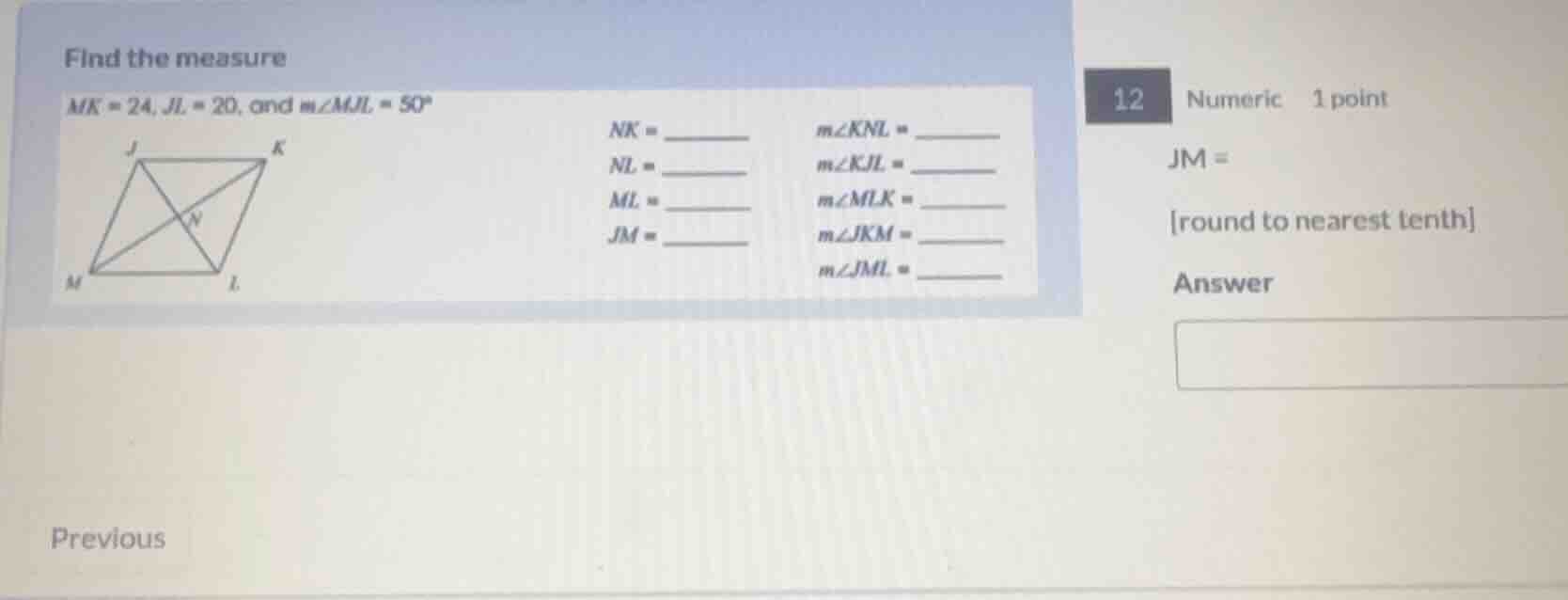
find the measure
$mk = 24, jl = 20$, and $m\angle mjl = 50^\circ$
$nk = \underline{\quad\quad}$ $m\angle knl = \underline{\quad\quad}$
$nl = \underline{\quad\quad}$ $m\angle kjl = \underline{\quad\quad}$
$ml = \underline{\quad\quad}$ $m\angle mlk = \underline{\quad\quad}$
$jm = \underline{\quad\quad}$ $m\angle jkm = \underline{\quad\quad}$
$m\angle jml = \underline{\quad\quad}$
12 numeric 1 point
jm =
round to nearest tenth
answer
Step1: Identify parallelogram properties
In parallelogram $JKLM$, diagonals bisect each other: $NK=\frac{1}{2}MK$, $NL=\frac{1}{2}JL$, opposite sides are equal ($ML=JK$, $JM=KL$), opposite angles equal, alternate interior angles equal, vertical angles equal, adjacent angles supplementary.
Step2: Calculate segment lengths
$NK=\frac{1}{2}\times24=12$
$NL=\frac{1}{2}\times20=10$
Step3: Find $JM$ via right triangle
In $\triangle JNM$, $\angle MJL=50^\circ$, $JN=10$, $MN=12$. Use Law of Cosines:
$$JM^2=JN^2+MN^2-2\times JN\times MN\times\cos(50^\circ)$$
$$JM^2=10^2+12^2-2\times10\times12\times\cos(50^\circ)$$
$$JM^2=100+144-240\times0.6428$$
$$JM^2=244-154.272=89.728$$
$$JM=\sqrt{89.729}\approx9.5$$
$ML=JM\approx9.5$
Step4: Calculate angle measures
- $\angle KNL$: Vertical angle to $\angle JNM$. $\angle JNM=180^\circ-50^\circ-\angle JMN$, but vertical angles are equal to supplementary of $\angle JNM$? No, $\angle KNL=\angle JNM$. First find $\angle JMN$ via Law of Sines: $\frac{\sin(50^\circ)}{JM}=\frac{\sin(\angle JMN)}{10}$, $\sin(\angle JMN)=\frac{10\times\sin(50^\circ)}{9.5}\approx\frac{7.660}{9.5}\approx0.8063$, $\angle JMN\approx53.8^\circ$, so $\angle JNM=180-50-53.8=76.2^\circ$, so $\angle KNL=76.2^\circ$
- $\angle KJL$: Alternate interior angle to $\angle MJL$? No, $\angle KJL=\angle MLJ$, but $\angle KJL$: in $\triangle JNK$, $JN=10$, $NK=12$, $JK=9.5$. Law of Sines: $\frac{\sin(\angle KJL)}{12}=\frac{\sin(\angle JKN)}{10}$, $\angle JKN=\angle JMN=53.8^\circ$, so $\sin(\angle KJL)=\frac{12\times\sin(53.8^\circ)}{9.5}\approx\frac{12\times0.806}{9.5}\approx1.023$? No, correction: $\angle KJL$ is equal to $\angle MLJ$, and $\angle MJL=50^\circ$, $\angle JML=180^\circ-\angle MJL-\angle MLJ$? No, $\angle KJL$: since $JK\parallel ML$, $\angle KJL=\angle MLJ$, and $\angle MJL=50^\circ$, $\angle JML$ we found ~53.8°, so $\angle MLJ=180-50-53.8=76.2^\circ$? No, better: $\angle KNL=180^\circ-\angle KJL-\angle JKL$, $\angle JKL=\angle JML\approx53.8^\circ$, so $\angle KJL=180-76.2-53.8=50^\circ$? No, correction: $\angle KJL$ is alternate interior to $\angle MJL$? No, diagonals bisect angles? No, only in rhombus. Correct: $\angle KJL$: in $\triangle JNL$, $JN=10$, $NL=10$, $JL=20$? No, $NL=10$, $NK=12$, $JK=9.5$. Law of Cosines for $\angle KJL$:
$$\cos(\angle KJL)=\frac{JK^2+JN^2-NK^2}{2\times JK\times JN}$$
$$\cos(\angle KJL)=\frac{9.5^2+10^2-12^2}{2\times9.5\times10}$$
$$\cos(\angle KJL)=\frac{90.25+100-144}{190}=\frac{46.25}{190}\approx0.2434$$
$$\angle KJL\approx76.2^\circ$$
- $\angle MLK$: Supplementary to $\angle JML$, $\angle JML\approx53.8^\circ$, so $\angle MLK=180-53.8=126.2^\circ$
- $\angle JKM$: Equal to $\angle MLK$? No, $\angle JKM=\angle JML\approx53.8^\circ$ (alternate interior angles)
- $\angle JML$: Calculated via Law of Sines, $\approx53.8^\circ$

Snap & solve any problem in the app
Get step-by-step solutions on Sovi AI
Photo-based solutions with guided steps
Explore more problems and detailed explanations
$NK=12$
$NL=10$
$ML\approx9.5$
$JM\approx9.5$
$m\angle KNL=76.2^\circ$
$m\angle KJL=76.2^\circ$
$m\angle MLK=126.2^\circ$
$m\angle JKM=53.8^\circ$
$m\angle JML=53.8^\circ$
For the specific numeric question $JM=$: $\boldsymbol{9.5}$