QUESTION IMAGE
Question
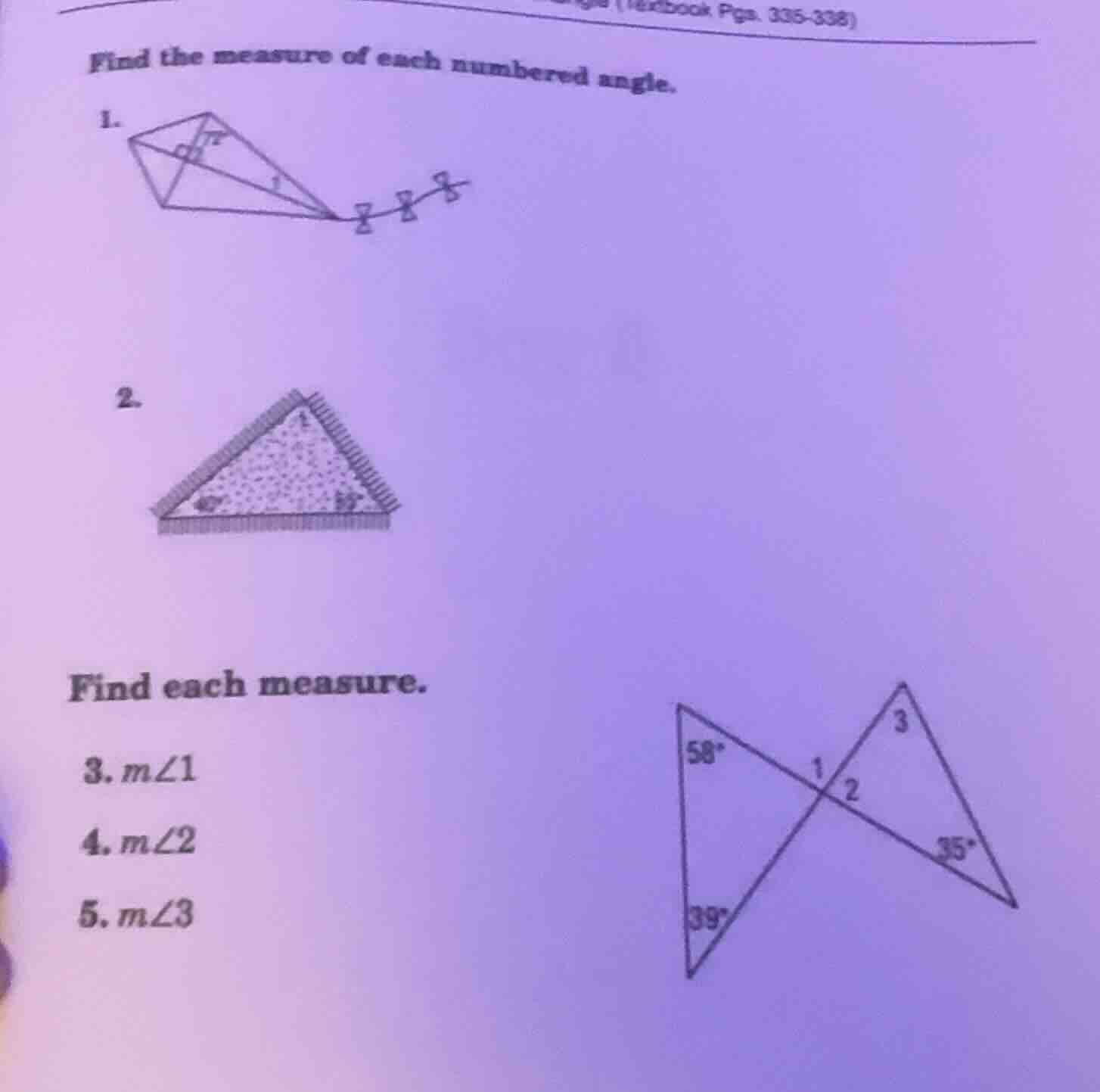
find the measure of each numbered angle.
1.
2.
find each measure.
- ( mangle 1 )
- ( mangle 2 )
- ( mangle 3 )
Problem 2:
Step1: Recall triangle angle sum
The sum of angles in a triangle is \(180^\circ\). Let the unknown angle be \(x\).
Step2: Calculate the unknown angle
Given two angles are \(45^\circ\) and \(65^\circ\), so \(x = 180^\circ - 45^\circ - 65^\circ\)
\(x = 180 - 110 = 70^\circ\)
Step1: Find the third angle in the left triangle
In a triangle, sum of angles is \(180^\circ\). Given angles \(58^\circ\) and \(39^\circ\), the third angle (let's call it \(A\)) is \(180 - 58 - 39 = 83^\circ\)
Step2: Find \(m\angle1\)
\(\angle1\) and angle \(A\) are supplementary (they form a linear pair), so \(m\angle1 = 180 - 83 = 97^\circ\)
Step1: Use vertical angles property
\(\angle1\) and \(\angle2\) are vertical angles? Wait, no, wait. Wait, actually, \(\angle1\) and \(\angle2\) are vertical angles? Wait, no, let's re - check. Wait, the angle adjacent to \(\angle1\) in the left triangle: Wait, no, actually, \(\angle1\) and \(\angle2\) are vertical angles? Wait, no, \(\angle1\) and \(\angle2\) are vertical angles? Wait, no, let's see. Wait, the two triangles are connected by intersecting lines. So \(\angle1\) and \(\angle2\) are vertical angles? Wait, no, vertical angles are equal. Wait, no, actually, \(\angle1\) and the angle opposite to it (which is \(\angle2\))? Wait, no, let's use the triangle angle sum. Wait, no, \(\angle1\) and \(\angle2\) are vertical angles, so they are equal? Wait, no, wait, in the left triangle, we found the angle adjacent to \(\angle1\) is \(83^\circ\), so \(\angle1 = 97^\circ\), and \(\angle2\) is equal to \(\angle1\) because they are vertical angles? Wait, no, wait, no. Wait, no, \(\angle1\) and \(\angle2\) are vertical angles? Wait, the two lines intersect, so \(\angle1\) and \(\angle2\) are vertical angles, so they are equal. Wait, but that can't be. Wait, no, I made a mistake earlier. Wait, let's re - do.
Wait, in the left triangle, angles are \(58^\circ\), \(39^\circ\), so the third angle is \(180-(58 + 39)=83^\circ\). Then, \(\angle1\) and this \(83^\circ\) angle form a linear pair, so \(\angle1 = 180 - 83=97^\circ\). Now, \(\angle1\) and \(\angle2\) are vertical angles? Wait, no, \(\angle1\) and \(\angle2\) are vertical angles, so \(m\angle2=m\angle1 = 97^\circ\)? Wait, no, that can't be. Wait, no, I think I messed up. Wait, the angle in the right triangle: let's look at the right triangle. The right triangle has an angle of \(35^\circ\) and we need to find \(\angle3\) later. Wait, no, \(\angle1\) and \(\angle2\) are vertical angles, so they are equal. So \(m\angle2 = 97^\circ\)? Wait, no, that seems wrong. Wait, no, let's use the linear pair. Wait, \(\angle1\) and the angle next to it (in the left triangle) are supplementary. Then, \(\angle2\) is equal to \(\angle1\) because they are vertical angles. So \(m\angle2=97^\circ\)

Snap & solve any problem in the app
Get step-by-step solutions on Sovi AI
Photo-based solutions with guided steps
Explore more problems and detailed explanations
The measure of the numbered angle (let's assume it's the top angle) is \(70^\circ\)