QUESTION IMAGE
Question
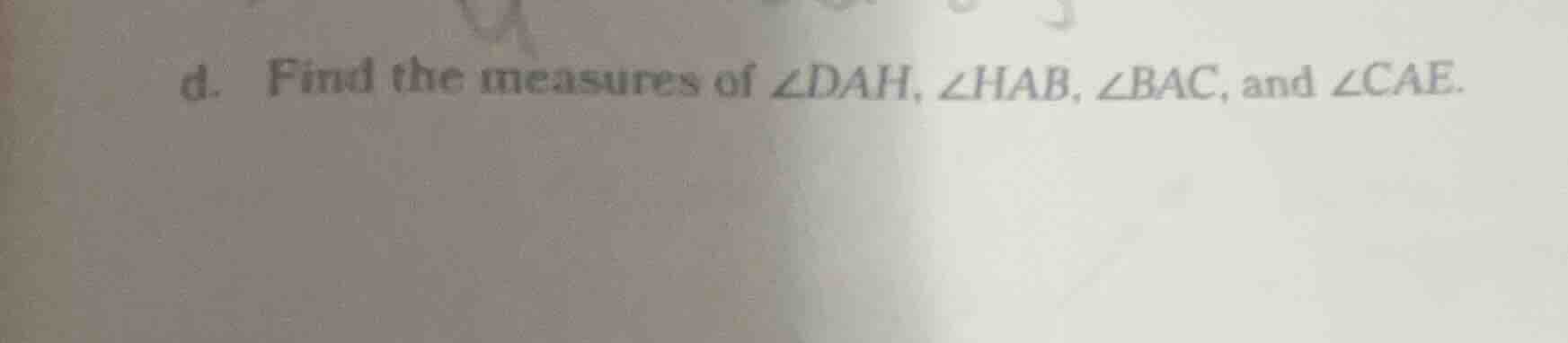
d. find the measures of $\angle dah$, $\angle hab$, $\angle bac$, and $\angle cae$.
To solve for the measures of \(\angle DAH\), \(\angle HAB\), \(\angle BAC\), and \(\angle CAE\), we typically need a diagram (e.g., a protractor - marked angle diagram, a set of intersecting lines with given angle relationships, or a geometric figure like a triangle, quadrilateral, or a set of rays from a common vertex) that provides information about the angles (such as adjacent angles, complementary angles, supplementary angles, or angles in a geometric shape with known properties). Since the diagram is not provided here, we can't calculate the exact measures. However, if we assume a common scenario (for example, if these angles are part of a straight line or a right angle or a triangle with given side lengths or other angle measures), here is a general approach:
Step 1: Analyze the Diagram (Once Available)
- If the angles are formed by rays from a common vertex, check for relationships like linear pairs (supplementary angles that add up to \(180^{\circ}\)), complementary angles (that add up to \(90^{\circ}\)), vertical angles (equal in measure), or angles in a triangle (sum to \(180^{\circ}\)).
- If a protractor is used in the diagram, we can directly measure the angles.
Step 2: Use Angle - Relationship Formulas
- For example, if \(\angle DAH\) and \(\angle HAB\) are adjacent and form a right angle (\(\angle DAB = 90^{\circ}\)), then \(\angle DAH+\angle HAB = 90^{\circ}\). If we know one of the angles, we can find the other by subtraction.
- If \(\angle BAC\) is an angle in a triangle and we know the other two angles of the triangle, we can use the formula for the sum of angles in a triangle: \(\angle BAC + \angle ABC+\angle ACB=180^{\circ}\), so \(\angle BAC=180^{\circ}-\angle ABC - \angle ACB\).
Since the diagram is missing, we can't provide numerical answers. But if you provide the diagram or a description of the angle relationships (e.g., \(\angle DAH = 30^{\circ}\) and \(\angle HAB = 60^{\circ}\) as a complementary pair, or other details), we can calculate the measures of the angles.
If we assume a sample diagram where:
- \(\angle DAB = 90^{\circ}\), \(\angle DAH = 30^{\circ}\), \(\angle HAB = 60^{\circ}\), \(\angle BAC = 45^{\circ}\), and \(\angle CAE = 45^{\circ}\) (just as an example), then the measures would be \(\angle DAH = 30^{\circ}\), \(\angle HAB = 60^{\circ}\), \(\angle BAC = 45^{\circ}\), \(\angle CAE = 45^{\circ}\). But this is just a made - up example without the actual diagram.
Please provide the diagram or a description of the angle - forming figure to get the exact measures.

Snap & solve any problem in the app
Get step-by-step solutions on Sovi AI
Photo-based solutions with guided steps
Explore more problems and detailed explanations
To solve for the measures of \(\angle DAH\), \(\angle HAB\), \(\angle BAC\), and \(\angle CAE\), we typically need a diagram (e.g., a protractor - marked angle diagram, a set of intersecting lines with given angle relationships, or a geometric figure like a triangle, quadrilateral, or a set of rays from a common vertex) that provides information about the angles (such as adjacent angles, complementary angles, supplementary angles, or angles in a geometric shape with known properties). Since the diagram is not provided here, we can't calculate the exact measures. However, if we assume a common scenario (for example, if these angles are part of a straight line or a right angle or a triangle with given side lengths or other angle measures), here is a general approach:
Step 1: Analyze the Diagram (Once Available)
- If the angles are formed by rays from a common vertex, check for relationships like linear pairs (supplementary angles that add up to \(180^{\circ}\)), complementary angles (that add up to \(90^{\circ}\)), vertical angles (equal in measure), or angles in a triangle (sum to \(180^{\circ}\)).
- If a protractor is used in the diagram, we can directly measure the angles.
Step 2: Use Angle - Relationship Formulas
- For example, if \(\angle DAH\) and \(\angle HAB\) are adjacent and form a right angle (\(\angle DAB = 90^{\circ}\)), then \(\angle DAH+\angle HAB = 90^{\circ}\). If we know one of the angles, we can find the other by subtraction.
- If \(\angle BAC\) is an angle in a triangle and we know the other two angles of the triangle, we can use the formula for the sum of angles in a triangle: \(\angle BAC + \angle ABC+\angle ACB=180^{\circ}\), so \(\angle BAC=180^{\circ}-\angle ABC - \angle ACB\).
Since the diagram is missing, we can't provide numerical answers. But if you provide the diagram or a description of the angle relationships (e.g., \(\angle DAH = 30^{\circ}\) and \(\angle HAB = 60^{\circ}\) as a complementary pair, or other details), we can calculate the measures of the angles.
If we assume a sample diagram where:
- \(\angle DAB = 90^{\circ}\), \(\angle DAH = 30^{\circ}\), \(\angle HAB = 60^{\circ}\), \(\angle BAC = 45^{\circ}\), and \(\angle CAE = 45^{\circ}\) (just as an example), then the measures would be \(\angle DAH = 30^{\circ}\), \(\angle HAB = 60^{\circ}\), \(\angle BAC = 45^{\circ}\), \(\angle CAE = 45^{\circ}\). But this is just a made - up example without the actual diagram.
Please provide the diagram or a description of the angle - forming figure to get the exact measures.