QUESTION IMAGE
Question
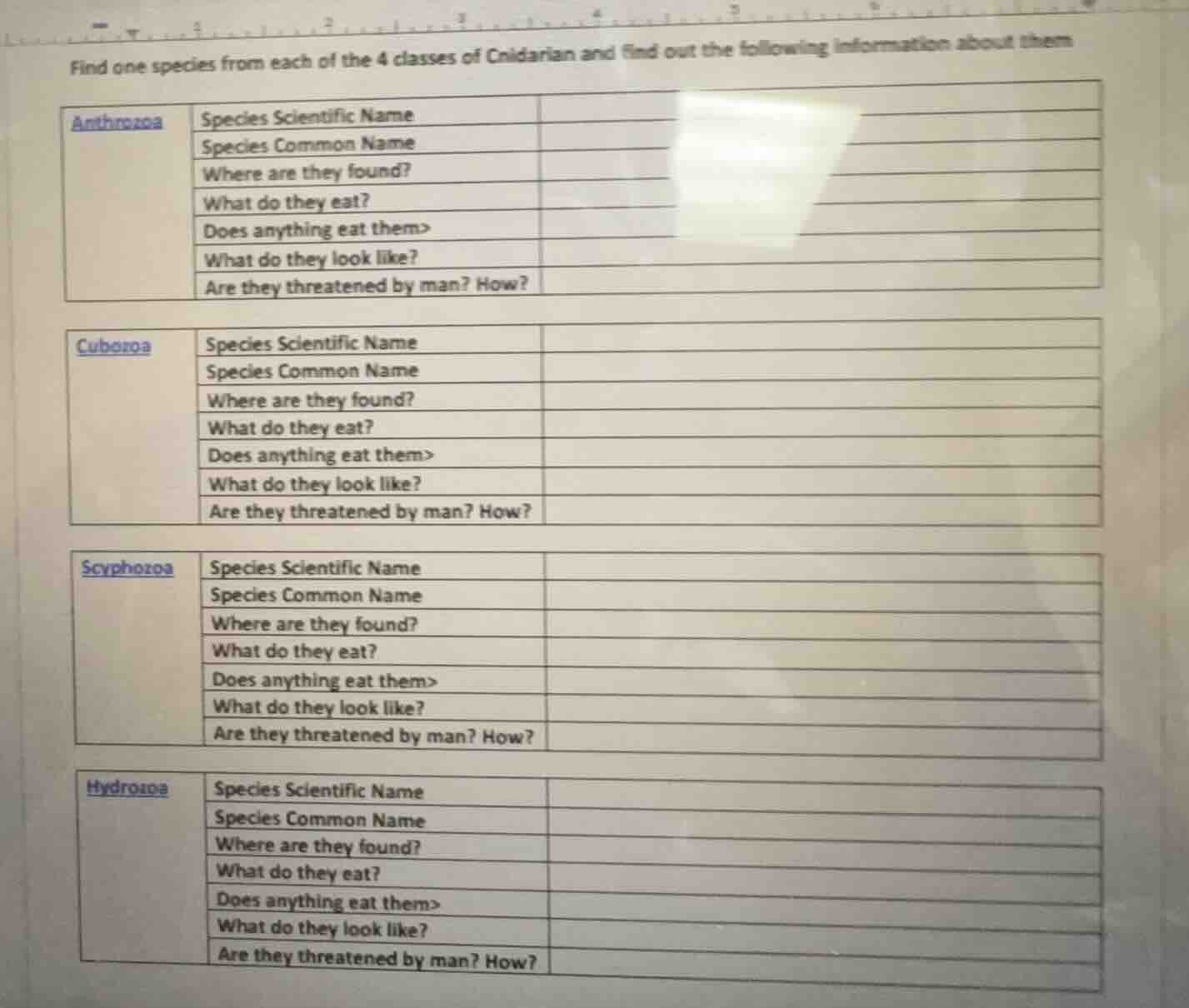
find one species from each of the 4 classes of cnidarian and find out the following information about them
anthrozoa
species scientific name
species common name
where are they found?
what do they eat?
does anything eat them?
what do they look like?
are they threatened by man? how?
cubozoa
species scientific name
species common name
where are they found?
what do they eat?
does anything eat them?
what do they look like?
are they threatened by man? how?
scyphozoa
species scientific name
species common name
where are they found?
what do they eat?
does anything eat them?
what do they look like?
are they threatened by man? how?
hydrozoa
species scientific name
species common name
where are they found?
what do they eat?
does anything eat them?
what do they look like?
are they threatened by man? how?
Anthozoa (e.g., Corallium rubrum - Red Coral)
| Category | Information |
|---|---|
| Species Common Name | Red Coral |
| Where are they found? | Mediterranean Sea, deep rocky reefs |
| What do they eat? | Plankton (captured via tentacles) |
| Does anything eat them? | Fish, echinoderms; also harvested by humans |
| What do they look like? | Branching, red/pink calcareous structures, colonial polyps |
| Are they threatened by man? How? | Yes, overharvesting for jewelry, habitat destruction (trawling) |
Cubozoa (e.g., Chironex fleckeri - Box Jellyfish)
| Category | Information |
|---|---|
| Species Common Name | Sea Wasp (Box Jellyfish) |
| Where are they found? | Northern Australia, Indo - Pacific warm coastal waters |
| What do they eat? | Small fish, shrimp, zooplankton (via stinging tentacles) |
| Does anything eat them? | Sea turtles (e.g., green turtles) |
| What do they look like? | Cube - shaped bell, long tentacles, transparent with pale blue hue |
| Are they threatened by man? How? | No major threat; human interactions are dangerous (stings) |
Scyphozoa (e.g., Aurelia aurita - Moon Jellyfish)
| Category | Information |
|---|---|
| Species Common Name | Moon Jellyfish |
| Where are they found? | Worldwide in warm - temperate oceans, coastal waters |
| What do they eat? | Plankton, small crustaceans (captured by mucus on bells) |
| Does anything eat them? | Sea turtles, large fish, birds (e.g., fulmars) |
| What do they look like? | Translucent, saucer - shaped bell with 4 purple gonad rings, short tentacles |
| Are they threatened by man? How? | No direct threat; affected by pollution (plastic, eutrophication) |
Hydrozoa (e.g., Obelia geniculata - Sea Fur)
| Category | Information |
|---|---|
| Species Common Name | Sea Fur |
| Where are they found? | North Atlantic, Pacific, coastal waters, attached to rocks/piers |
| What do they eat? | Pl…
of Selection:
- Anthozoa: Red Coral is a well - known anthozoan, with clear ecological and human - impact data.
- Cubozoa: Box Jellyfish (Sea Wasp) is a representative cubozoan, famous for its potent sting and unique morphology.
- Scyphozoa: Moon Jellyfish is a common scyphozoan, easy to observe and study in terms of diet, predators, and appearance.
- Hydrozoa: Sea Fur is a typical hydrozoan, showing colonial structure and coastal habitat traits.
These species were chosen for their representativeness within each Cnidarian class, with accessible information on all required categories.

Snap & solve any problem in the app
Get step-by-step solutions on Sovi AI
Photo-based solutions with guided steps
Explore more problems and detailed explanations
of Selection:
- Anthozoa: Red Coral is a well - known anthozoan, with clear ecological and human - impact data.
- Cubozoa: Box Jellyfish (Sea Wasp) is a representative cubozoan, famous for its potent sting and unique morphology.
- Scyphozoa: Moon Jellyfish is a common scyphozoan, easy to observe and study in terms of diet, predators, and appearance.
- Hydrozoa: Sea Fur is a typical hydrozoan, showing colonial structure and coastal habitat traits.
These species were chosen for their representativeness within each Cnidarian class, with accessible information on all required categories.