QUESTION IMAGE
Question
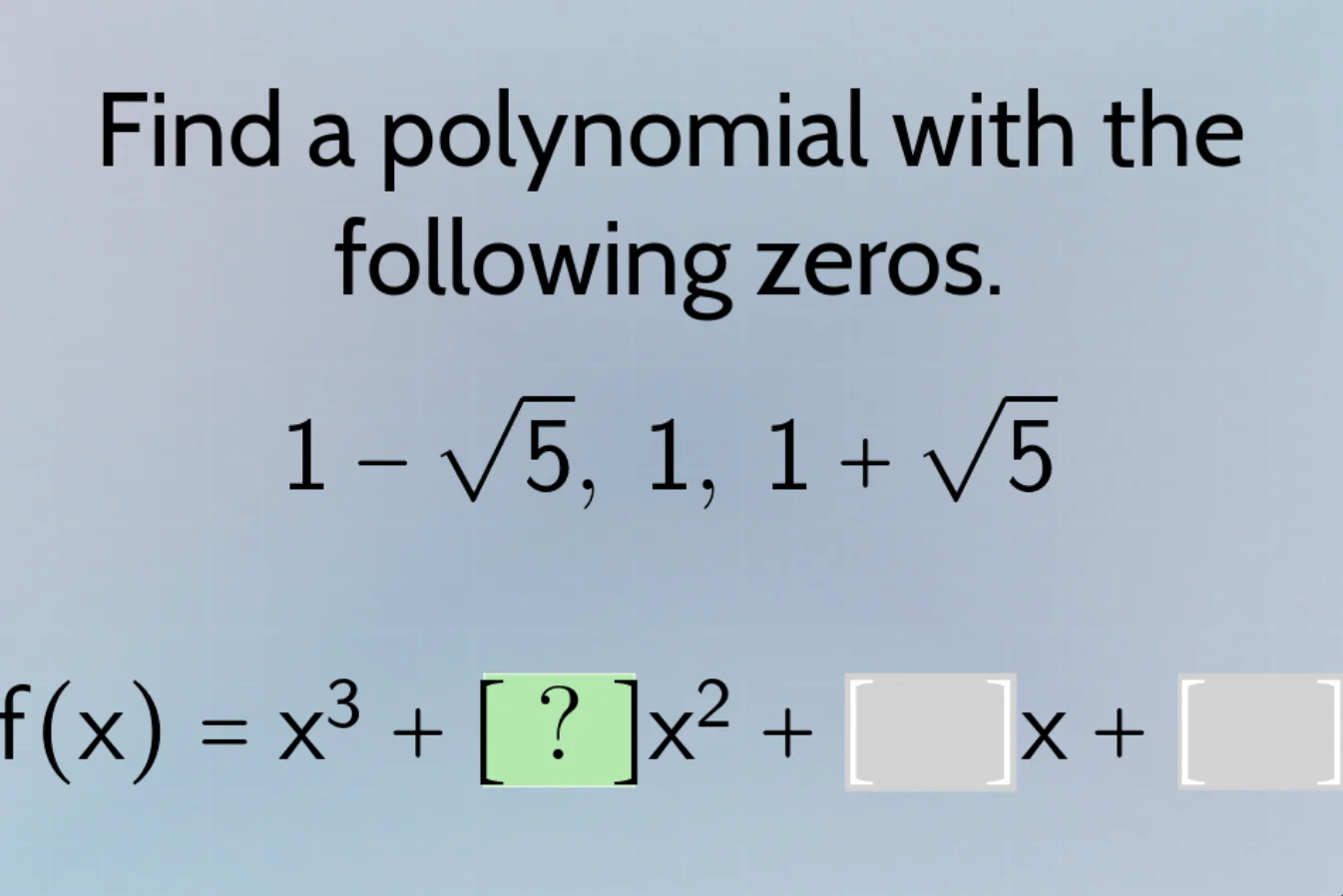
find a polynomial with the following zeros.
$1 - \sqrt{5}$, $1$, $1 + \sqrt{5}$
$f(x) = x^3 + ?x^2 + x + $
Step1: Recall the factor theorem
If \( r \) is a zero of a polynomial, then \( (x - r) \) is a factor. So the factors corresponding to the zeros \( 1 - \sqrt{5} \), \( 1 \), and \( 1 + \sqrt{5} \) are \( (x-(1 - \sqrt{5})) \), \( (x - 1) \), and \( (x-(1 + \sqrt{5})) \) respectively.
Step2: Multiply the first and the third factors
First, simplify \( (x-(1 - \sqrt{5}))(x-(1 + \sqrt{5})) \). Using the formula \( (a - b)(a + b)=a^{2}-b^{2} \), let \( a=(x - 1) \) and \( b = \sqrt{5} \). Then we have:
\[
\]
Step3: Multiply the result with the second factor
Now multiply \( (x^{2}-2x - 4) \) with \( (x - 1) \):
\[
\]

Snap & solve any problem in the app
Get step-by-step solutions on Sovi AI
Photo-based solutions with guided steps
Explore more problems and detailed explanations
For the coefficient of \( x^{2} \), the value is \(-3\). For the coefficient of \( x \), the value is \(-2\). For the constant term, the value is \(4\). So the polynomial is \( f(x)=x^{3}-3x^{2}-2x + 4 \), and the coefficients are \(-3\) (for \( x^{2} \)), \(-2\) (for \( x \)) and \(4\) (constant term). If we consider the form \( f(x)=x^{3}+ax^{2}+bx + c \), then \( a=-3 \), \( b = - 2 \), \( c = 4 \).