QUESTION IMAGE
Question
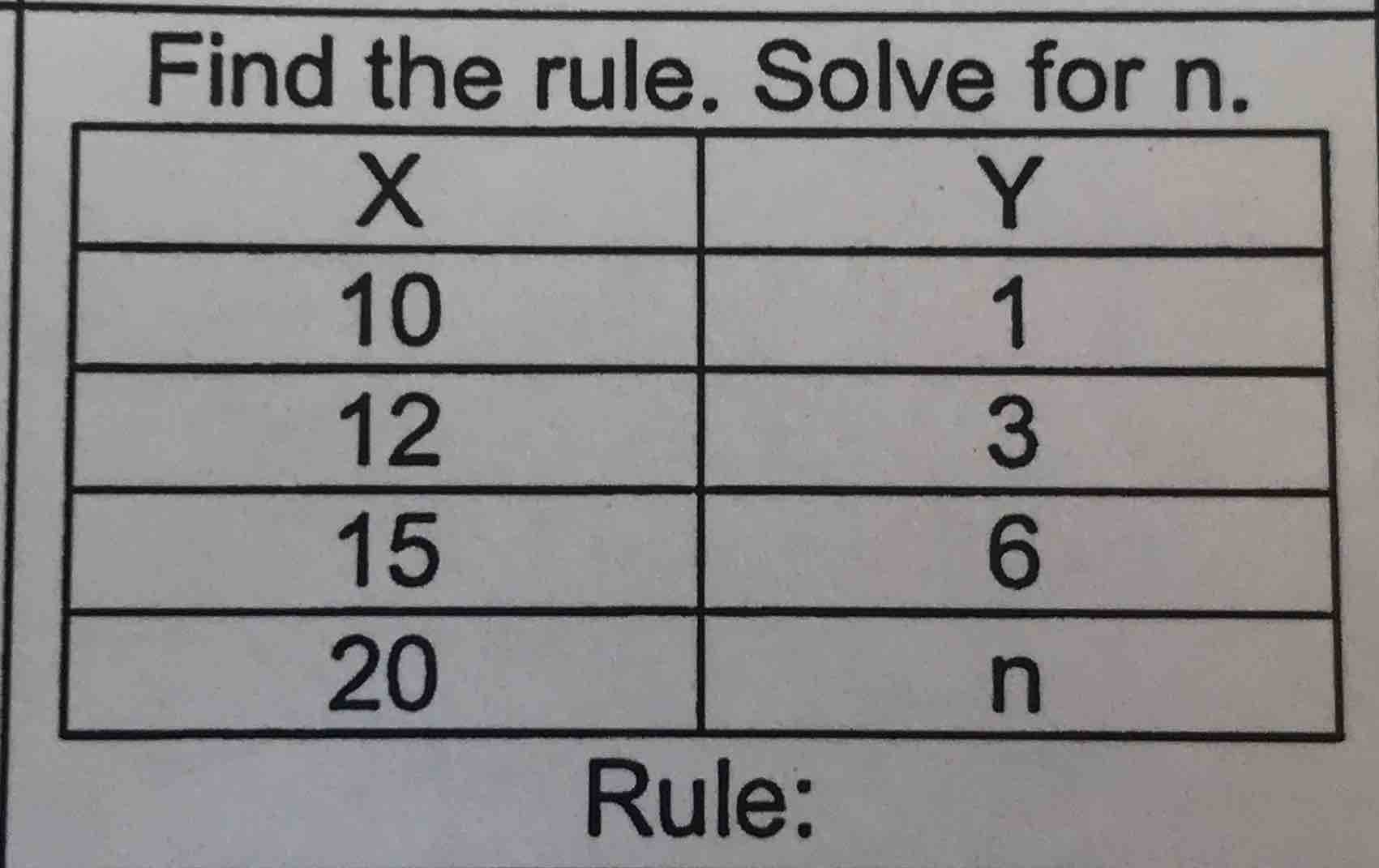
find the rule. solve for n.
x | y
10 | 1
12 | 3
15 | 6
20 | n
rule:
Step1: Analyze the differences in X and Y
First, find the differences between consecutive X values and consecutive Y values.
For X: \(12 - 10 = 2\), \(15 - 12 = 3\), \(20 - 15 = 5\)
For Y: \(3 - 1 = 2\), \(6 - 3 = 3\)
Step2: Identify the pattern
Notice that the difference in Y is the same as the difference in X minus 9? Wait, no, let's check the relationship between X and Y. Let's assume a quadratic or linear relationship. Let's try linear first. Let the rule be \(Y = aX + b\).
Using the first two points \((10,1)\) and \((12,3)\):
For \((10,1)\): \(1 = 10a + b\)
For \((12,3)\): \(3 = 12a + b\)
Subtract the first equation from the second: \(3 - 1 = 12a + b - (10a + b)\)
\(2 = 2a\) ⇒ \(a = 1\)
Then substitute \(a = 1\) into \(1 = 10a + b\): \(1 = 10(1) + b\) ⇒ \(b = 1 - 10 = -9\)
Check with the third point \((15,6)\): \(Y = 15 - 9 = 6\), which matches!
Step3: Solve for n
Now use the rule \(Y = X - 9\) for \(X = 20\):
\(n = 20 - 9 = 11\)

Snap & solve any problem in the app
Get step-by-step solutions on Sovi AI
Photo-based solutions with guided steps
Explore more problems and detailed explanations
The rule is \(Y = X - 9\) and \(n = 11\)