QUESTION IMAGE
Question
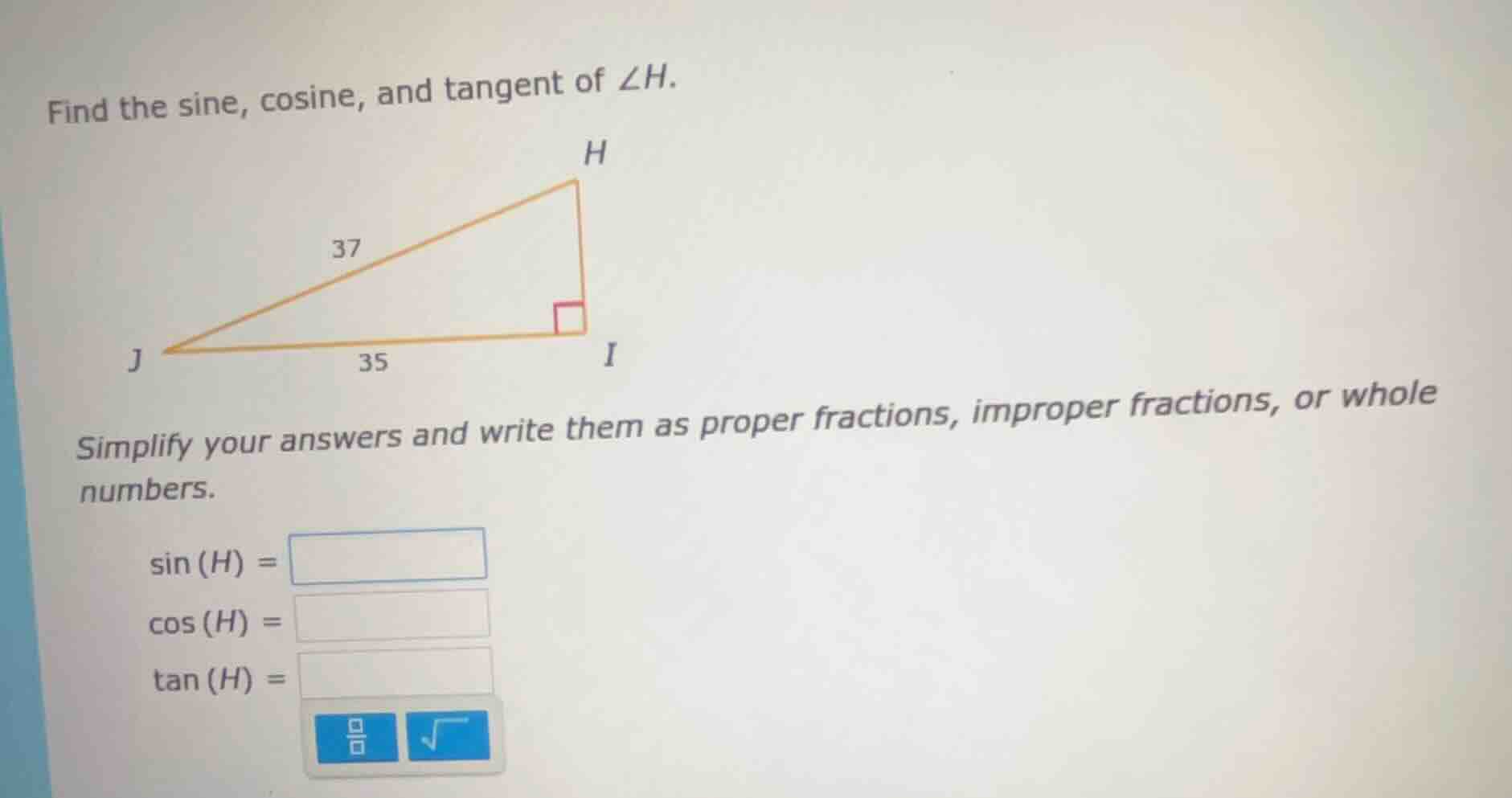
find the sine, cosine, and tangent of ∠h. simplify your answers and write them as proper fractions, improper fractions, or whole numbers. sin(h) = cos(h) = tan(h) =
Step1: Find the length of HI
In right triangle \( \triangle JIH \), by the Pythagorean theorem \( a^2 + b^2 = c^2 \), where \( c = 37 \) (hypotenuse), \( a = 35 \) (adjacent to \( \angle H \)), and \( b = HI \) (opposite to \( \angle H \)). So \( HI^2 + 35^2 = 37^2 \).
\( HI^2 = 37^2 - 35^2 = (37 - 35)(37 + 35) = 2\times72 = 144 \), so \( HI = 12 \).
Step2: Calculate \( \sin(H) \)
\( \sin(H) = \frac{\text{opposite}}{\text{hypotenuse}} = \frac{JI}{JH} = \frac{35}{37} \) (Wait, no: opposite to \( \angle H \) is \( JI \)? Wait, no: \( \angle H \) is at vertex H. So in \( \triangle JIH \), right-angled at I. So for \( \angle H \), the opposite side is \( JI = 35 \), adjacent is \( HI = 12 \), hypotenuse \( JH = 37 \). Wait, no: wait, \( \angle H \): the sides: opposite is \( JI \) (from H to J, opposite side is JI? Wait, no, in triangle, angle at H: the sides: the side opposite \( \angle H \) is \( JI \) (length 35), adjacent is \( HI \) (length 12), hypotenuse \( JH = 37 \). Wait, no, wait: in right triangle, angle at H: the sides: opposite side is the side not containing H, so \( JI \) (length 35), adjacent side is \( HI \) (length 12), hypotenuse \( JH = 37 \). So \( \sin(H) = \frac{\text{opposite}}{\text{hypotenuse}} = \frac{JI}{JH} = \frac{35}{37} \)? Wait, no, wait: no, I think I mixed up. Wait, angle at H: the sides: the side opposite \( \angle H \) is \( JI \) (from H, the opposite side is JI, which is 35), adjacent is \( HI \) (12), hypotenuse \( JH = 37 \). Wait, but let's recheck: in \( \triangle JIH \), right-angled at I. So vertices: J, I, H. Right angle at I. So sides: JI = 35 (horizontal), HI = 12 (vertical), JH = 37 (hypotenuse). So angle at H: the sides: opposite to H is JI (35), adjacent to H is HI (12), hypotenuse JH (37). So:
\( \sin(H) = \frac{\text{opposite}}{\text{hypotenuse}} = \frac{JI}{JH} = \frac{35}{37} \)? Wait, no, wait: no, opposite to angle H is the side that doesn't touch H. So angle H is at H, so the sides touching H are HI and JH. The side not touching H is JI. So yes, opposite is JI (35), adjacent is HI (12), hypotenuse JH (37). So:
\( \sin(H) = \frac{\text{opposite}}{\text{hypotenuse}} = \frac{35}{37} \)? Wait, no, wait, I think I made a mistake. Wait, no: in angle H, the opposite side is JI (length 35), adjacent is HI (length 12), hypotenuse JH (37). Wait, but let's recalculate:
Wait, \( \sin(\theta) = \frac{\text{opposite}}{\text{hypotenuse}} \), \( \cos(\theta) = \frac{\text{adjacent}}{\text{hypotenuse}} \), \( \tan(\theta) = \frac{\text{opposite}}{\text{adjacent}} \).
So for \( \angle H \):
- Opposite side: JI = 35 (since it's opposite to H, not connected to H)
- Adjacent side: HI = 12 (connected to H and the right angle)
- Hypotenuse: JH = 37 (longest side)
Wait, no, wait: in triangle, angle at H: the sides: the side opposite H is JI (length 35), adjacent is HI (length 12), hypotenuse JH (37). So:
\( \sin(H) = \frac{\text{opposite}}{\text{hypotenuse}} = \frac{35}{37} \)
\( \cos(H) = \frac{\text{adjacent}}{\text{hypotenuse}} = \frac{12}{37} \)
\( \tan(H) = \frac{\text{opposite}}{\text{adjacent}} = \frac{35}{12} \)
Wait, wait, no, wait: I think I mixed up opposite and adjacent. Wait, angle at H: the sides: the side opposite H is JI (35), adjacent is HI (12). Wait, no, let's label the triangle:
- Right angle at I: so \( \angle I = 90^\circ \)
- Sides:
- \( JI = 35 \) (horizontal, from J to I)
- \( HI = 12 \) (vertical, from H to I)
- \( JH = 37 \) (hypotenuse, from J to H)
So angle at H: \( \angle H \). The sides:
- Opposite to \( \angle H \): \( JI \) (since it's the side…

Snap & solve any problem in the app
Get step-by-step solutions on Sovi AI
Photo-based solutions with guided steps
Explore more problems and detailed explanations
\( \sin(H) = \frac{35}{37} \)
\( \cos(H) = \frac{12}{37} \)
\( \tan(H) = \frac{35}{12} \)