QUESTION IMAGE
Question
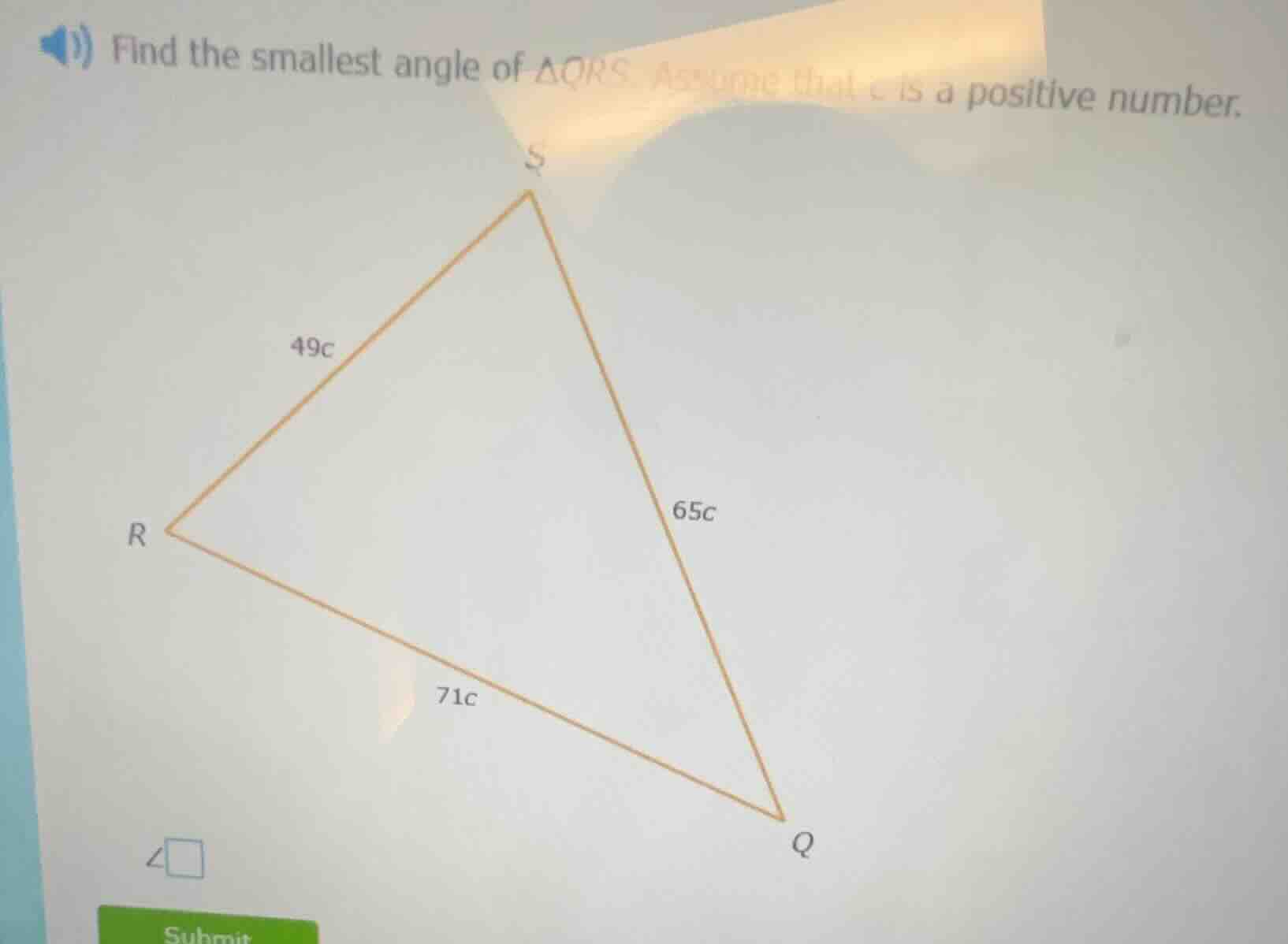
find the smallest angle of △qrs. assume that c is a positive number.
(the triangle △qrs has sides: rs = 49c, sq = 65c, rq = 71c)
Step1: Recall the triangle angle - side relationship
In a triangle, the smallest angle is opposite the shortest side. So first, we need to determine the shortest side among the sides \(49c\), \(65c\), and \(71c\). Since \(c>0\), we can compare the coefficients. We have \(49 < 65 < 71\), so the shortest side is \(49c\), and the angle opposite to \(49c\) is \(\angle Q\).
Step2: Use the triangle angle - sum property
The sum of the interior angles of a triangle is \(180^{\circ}\). Let the angles of \(\triangle QRS\) be \(\angle Q\), \(\angle R\), and \(\angle S\) opposite to sides \(RS = 65c\), \(QS=49c\), and \(QR = 71c\) respectively. Wait, no, let's correct the side - angle correspondence. Let's denote: side \(QR=71c\), side \(RS = 49c\), side \(QS=65c\). Then angle opposite \(QR\) (length \(71c\)) is \(\angle S\), angle opposite \(RS\) (length \(49c\)) is \(\angle Q\), and angle opposite \(QS\) (length \(65c\)) is \(\angle R\).
The sum of angles: \(\angle Q+\angle R+\angle S=180^{\circ}\). Let \(\angle Q = 49k\), \(\angle R=65k\), \(\angle S = 71k\) (since the angles are proportional to the lengths of their opposite sides in a triangle, by the Law of Sines \(\frac{a}{\sin A}=\frac{b}{\sin B}=\frac{c}{\sin C}\), and when \(c > 0\), the ratio of sides is the same as the ratio of sines of opposite angles. For a triangle, if we assume the angles are in the ratio of the opposite sides, we can let the angles be \(49k\), \(65k\), \(71k\)).
So \(49k + 65k+71k=180\)
Step3: Solve for \(k\)
Combine like terms: \((49 + 65+71)k=180\)
\(185k = 180\)? Wait, no, \(49 + 65+71=185\)? Wait, \(49+65 = 114\), \(114 + 71=185\). Then \(k=\frac{180}{185}=\frac{36}{37}\)? Wait, no, we made a mistake in side - angle correspondence.
Wait, the correct side - angle correspondence: In \(\triangle QRS\), vertices are \(Q\), \(R\), \(S\). So side \(QR\) is between \(Q\) and \(R\), side \(RS\) is between \(R\) and \(S\), side \(SQ\) is between \(S\) and \(Q\). So:
- Side \(RS\): length \(49c\), opposite angle \(\angle Q\)
- Side \(SQ\): length \(65c\), opposite angle \(\angle R\)
- Side \(QR\): length \(71c\), opposite angle \(\angle S\)
So the angles are: \(\angle Q\) (opposite \(RS = 49c\)), \(\angle R\) (opposite \(SQ = 65c\)), \(\angle S\) (opposite \(QR=71c\))
So the measures of the angles are proportional to the lengths of their opposite sides. So let \(\angle Q = 49x\), \(\angle R=65x\), \(\angle S = 71x\)
Then \(49x+65x + 71x=180\)
\((49 + 65+71)x=180\)
\(185x = 180\)
\(x=\frac{180}{185}=\frac{36}{37}\)
Now, the smallest angle is the one with the smallest coefficient, which is \(\angle Q\) with coefficient \(49\).
\(\angle Q=49x=49\times\frac{36}{37}=\frac{1764}{37}\approx47.68^{\circ}\)? Wait, no, we messed up. Wait, the Law of Sines says \(\frac{a}{\sin A}=\frac{b}{\sin B}=\frac{c}{\sin C}\). But when the triangle has sides \(a,b,c\) and opposite angles \(A,B,C\) respectively, the larger the side, the larger the opposite angle (since \(\sin\) is increasing in \([0,\frac{\pi}{2}]\) and for a triangle, all angles are less than \(180^{\circ}\)).
So the side lengths are: \(RS = 49c\), \(SQ=65c\), \(QR = 71c\). So the order of side lengths: \(RS
Now, using the angle - sum property: \(\angle Q+\angle R+\angle S = 180^{\circ}\). Let the angles be \(49k\), \(65k\), \(71k\) (since the sides are…

Snap & solve any problem in the app
Get step-by-step solutions on Sovi AI
Photo-based solutions with guided steps
Explore more problems and detailed explanations
The smallest angle of \(\triangle QRS\) is \(\frac{1764}{37}^{\circ}\) (or approximately \(47.7^{\circ}\))