QUESTION IMAGE
Question
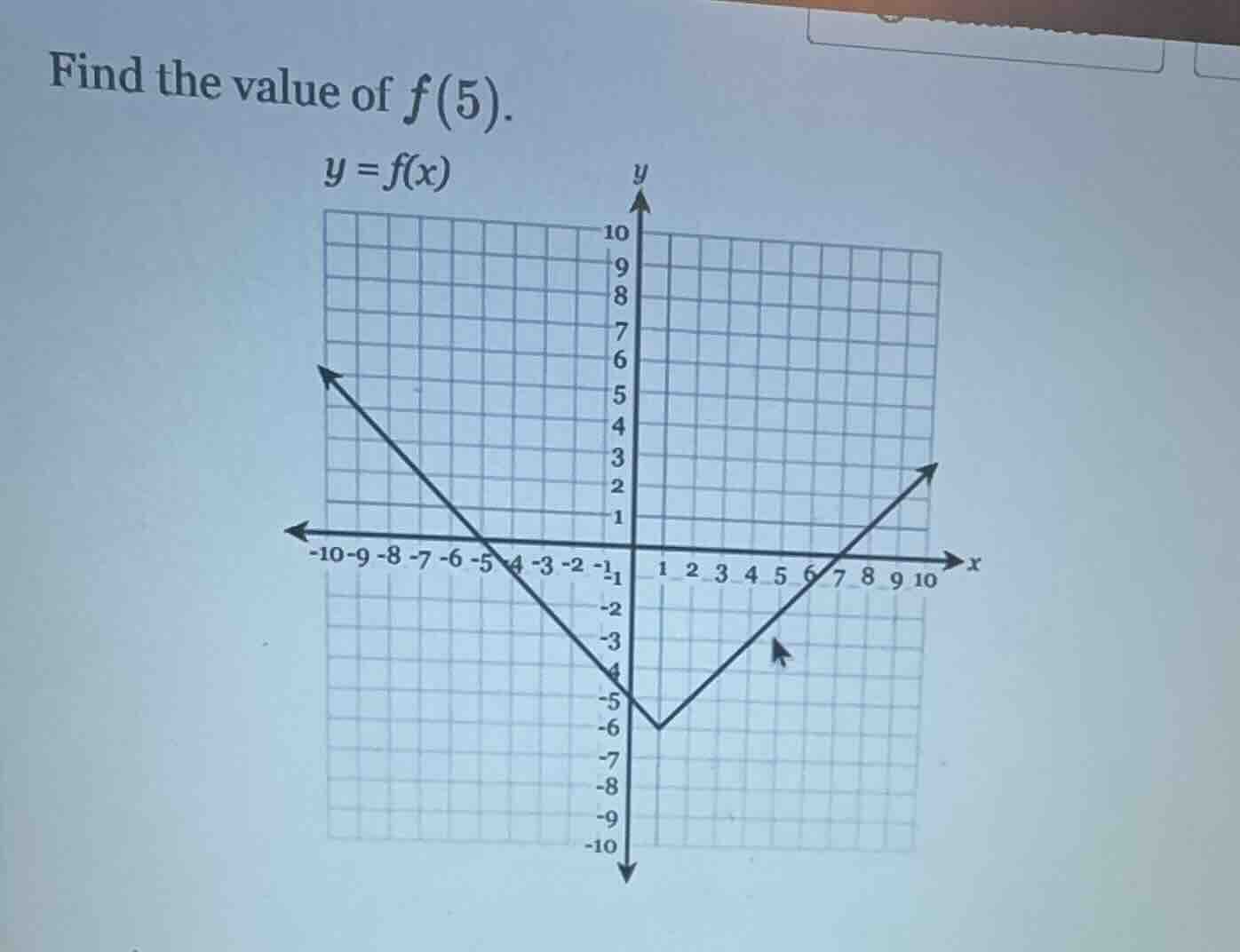
find the value of f(5). y = f(x)
Step1: Locate x = 5 on x - axis
Find the point on the x - axis where \(x = 5\).
Step2: Find corresponding y - value
From \(x = 5\), move vertically until intersecting the graph of \(y=f(x)\). The y - coordinate at this intersection point is the value of \(f(5)\). By looking at the graph, when \(x = 5\), the y - value is \(- 4\)? Wait, no, let's re - check. Wait, the right - hand part of the graph: let's find the equation of the right - hand line. The right - hand line passes through \((0,-6)\) and \((7,0)\). The slope \(m=\frac{0 - (-6)}{7-0}=\frac{6}{7}\)? Wait, no, wait the vertex is at \((0, - 6)\)? Wait, no, looking at the graph, the vertex is at \((0,-6)\)? Wait, no, when \(x = 0\), \(y=-6\). Then the right - hand line goes from \((0,-6)\) to \((7,0)\). Let's check the slope: \(m=\frac{0 - (-6)}{7 - 0}=\frac{6}{7}\). But when \(x = 5\), let's calculate \(y\). Using the point - slope form \(y - y_1=m(x - x_1)\), with \((x_1,y_1)=(0,-6)\) and \(m=\frac{6}{7}\), \(y=-6+\frac{6}{7}(x)\). When \(x = 5\), \(y=-6+\frac{30}{7}=\frac{-42 + 30}{7}=\frac{-12}{7}\)? Wait, that can't be. Wait, maybe I misread the graph. Wait, the grid: each square is 1 unit. Let's look at the right - hand segment. From the vertex (which is at \((0,-6)\)) to the x - intercept at \((7,0)\). Wait, when \(x = 5\), how many units from \(x = 0\) is \(x = 5\)? 5 units. The rise from \(x = 0\) to \(x = 7\) is 6 units (from \(y=-6\) to \(y = 0\)). So per unit x, the rise is \(\frac{6}{7}\) per x - unit. But maybe the graph is made of two lines: left line and right line. Wait, the left line: from \((-5,0)\) to \((0,-6)\). Slope \(m=\frac{-6-0}{0 - (-5)}=\frac{-6}{5}\). The right line: from \((0,-6)\) to \((7,0)\), slope \(m=\frac{0 - (-6)}{7-0}=\frac{6}{7}\). Wait, but when \(x = 5\), let's count the grid. Let's look at the graph again. The right - hand line: when \(x = 5\), let's go up from \(x = 5\) on the x - axis. The graph at \(x = 5\): looking at the grid, each square is 1. So from \(x = 0\) (y=-6) to \(x = 7\) (y = 0). So at \(x = 5\), the y - value: from \(x = 0\) (y=-6) to \(x = 7\) (y = 0), the change in x is 7, change in y is 6. So for x from 0 to 5, change in x is 5, change in y is \(\frac{6}{7}\times5=\frac{30}{7}\approx4.28\), but \(y=-6+\frac{30}{7}=\frac{-42 + 30}{7}=\frac{-12}{7}\approx - 1.71\). But that doesn't match the grid. Wait, maybe I made a mistake. Wait, the graph: the right - hand part, when \(x = 5\), let's look at the y - coordinate. Let's count the squares. From \(x = 5\), moving up to the graph. The graph at \(x = 5\): let's see, the vertex is at \((0,-6)\). Then at \(x = 1\), \(y=-6 + \frac{6}{7}\approx - 5.14\); \(x = 2\), \(y=-6+\frac{12}{7}\approx - 4.29\); \(x = 3\), \(y=-6+\frac{18}{7}\approx - 3.43\); \(x = 4\), \(y=-6+\frac{24}{7}\approx - 2.57\); \(x = 5\), \(y=-6+\frac{30}{7}\approx - 1.71\); \(x = 6\), \(y=-6+\frac{36}{7}\approx - 0.86\); \(x = 7\), \(y = 0\). But maybe the graph is drawn with integer coordinates. Wait, maybe the right - hand line is from \((0,-6)\) to \((6,0)\)? Wait, no, the x - intercept is at \(x = 7\). Wait, maybe I misread the x - intercept. Let me check the graph again. The x - axis: the right - hand intercept is at \(x = 7\) (since the arrow is at \(x = 7\) on the x - axis). Wait, the grid: the x - axis has marks at - 10, - 9,..., 0,1,...,10. The y - axis: - 10 to 10. The graph: the left line crosses the x - axis at \(x=-5\), goes down to \((0,-6)\), then the right line goes up to cross the x - axis at \(x = 7\). So when \(x = 5\), let's use the two - point formula for the right line. Points \((…

Snap & solve any problem in the app
Get step-by-step solutions on Sovi AI
Photo-based solutions with guided steps
Explore more problems and detailed explanations
\(-1\)