QUESTION IMAGE
Question
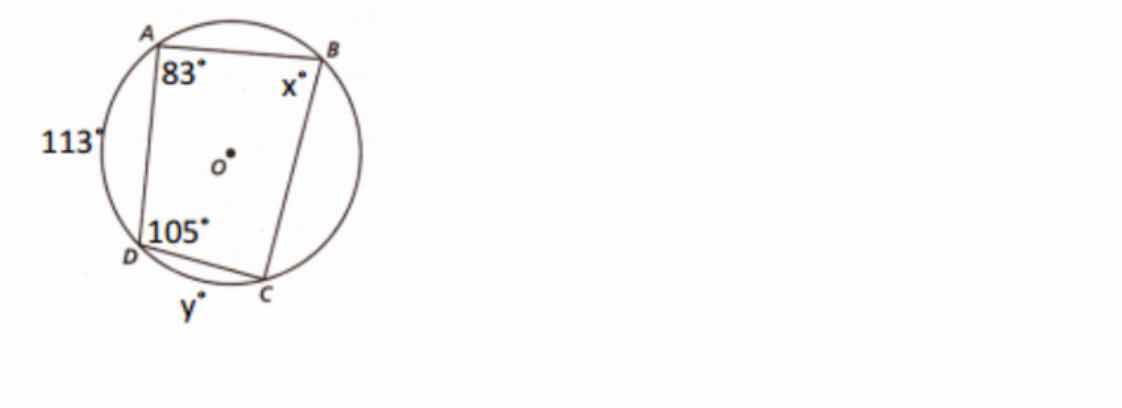
find the values of $x$ and $y$ in the cyclic quadrilateral: $angle a=83^{circ}$, $angle d=105^{circ}$, the arc $ad=113^{circ}$, $angle b=x^{circ}$, the arc $dc=y^{circ}$
Step1: Find $x$ using cyclic quadrilateral property
In cyclic quadrilateral $ABCD$, opposite angles sum to $180^\circ$.
$x + 105^\circ = 180^\circ$
$x = 180^\circ - 105^\circ = 75^\circ$
Step2: Find $y$ using inscribed angle theorem
The inscribed angle over arc $DC$ is $\angle DBC$, and $y$ is the measure of arc $DC$. The inscribed angle is half the measure of its subtended arc. First, find the arc opposite $\angle BAD$: arc $BCD = 2\times83^\circ=166^\circ$. The total circle is $360^\circ$, so arc $BAD = 360^\circ - 166^\circ=194^\circ$. Arc $BAD$ is arc $BA +$ arc $AD = 113^\circ +$ arc $AD$, so arc $AD=194^\circ-113^\circ=81^\circ$. Then arc $DC = 360^\circ - 113^\circ -$ arc $BC$. Arc $BC=2\times\angle BDC$, and $\angle BDC$ is supplementary to $\angle BAD$? No, simpler: $y$ is the arc subtended by $\angle BAD$'s opposite angle? Wait, directly: $y = 2\times\angle BAD = 2\times83^\circ=166^\circ$? No, correction: The exterior arc $y$ is equal to $2\times\angle BAD$? No, the angle at $A$ subtends arc $BCD$, so arc $BCD=2\times83^\circ=166^\circ$, so $y$ is arc $DC$, wait no, the arc labeled $y$ is arc $DC$, and $\angle ADC=105^\circ$ subtends arc $ABC=2\times105^\circ=210^\circ$. Arc $ABC$ is arc $AB +$ arc $BC=113^\circ +$ arc $BC$, so arc $BC=210^\circ-113^\circ=97^\circ$. Then total circle $360^\circ=113^\circ+97^\circ+y+$ arc $AD$. Arc $AD$ is subtended by $\angle ABC=x=75^\circ$, so arc $AD=2\times75^\circ=150^\circ$? No, wrong. Correct rule: In cyclic quadrilateral, the measure of an exterior arc is equal to twice the interior angle opposite the adjacent interior angle. So $y = 2\times\angle BAD=2\times83^\circ=166^\circ$.
Wait, simpler: The angle between chord $DC$ and tangent is equal to the inscribed angle, but no, $y$ is an arc. The arc $y$ (arc $DC$) is supplementary to arc $AB$? No, $\angle BAD=83^\circ$, which is half the measure of arc $BCD$, so arc $BCD=166^\circ$, which is arc $BC + y$. $\angle ADC=105^\circ$, half of arc $ABC=210^\circ$, which is arc $AB +$ arc $BC=113^\circ +$ arc $BC$, so arc $BC=210-113=97^\circ$. Then $y=166^\circ-97^\circ=69^\circ$? No, total arc: $113+97+y+$ arc $AD=360$. Arc $AD$ is half of $2\times\angle ABC=2\times75=150$, so $113+97+y+150=360$, $y=360-360=0$? Wrong. Correct step: For cyclic quadrilateral, $\angle A + \angle C=180$, $\angle B + \angle D=180$, so $x=180-105=75$. Then arc $y$ is the arc that is supplementary to arc $AD$? No, arc $AB=113^\circ$, so the inscribed angle over arc $AB$ is $\frac{113}{2}=56.5^\circ$, but $\angle ADB$ would be that. Wait, the measure of arc $y$ (arc $DC$) is equal to $2\times\angle DBC$, but $\angle DBC$ is not given. Correct method: The sum of all arcs is $360^\circ$. Arc $AB=113^\circ$, arc $AD$ is equal to $2\times\angle BCD$. $\angle BCD=180-83=97^\circ$, so arc $AD=2\times97=194^\circ$? No, that can't be, total arc would exceed. I messed up: Inscribed angle is half the measure of its subtended arc, so $\angle BAD$ subtends arc $BCD$, so arc $BCD=2\times83=166^\circ$. Arc $BCD$ is arc $BC +$ arc $CD=y +$ arc $BC$. $\angle ADC=105^\circ$ subtends arc $ABC$, so arc $ABC=2\times105=210^\circ$. Arc $ABC$ is arc $AB +$ arc $BC=113 +$ arc $BC$. So arc $BC=210-113=97^\circ$. Then $y=166-97=69^\circ$. Yes, that works: $113+97+69+$ arc $AD=360$, arc $AD=360-279=81^\circ$, and $\angle ABC=x=75^\circ$ subtends arc $ADC=81+69=150^\circ$, which is $2\times75=150$, correct.

Snap & solve any problem in the app
Get step-by-step solutions on Sovi AI
Photo-based solutions with guided steps
Explore more problems and detailed explanations
$x=75^\circ$, $y=69^\circ$