QUESTION IMAGE
Question
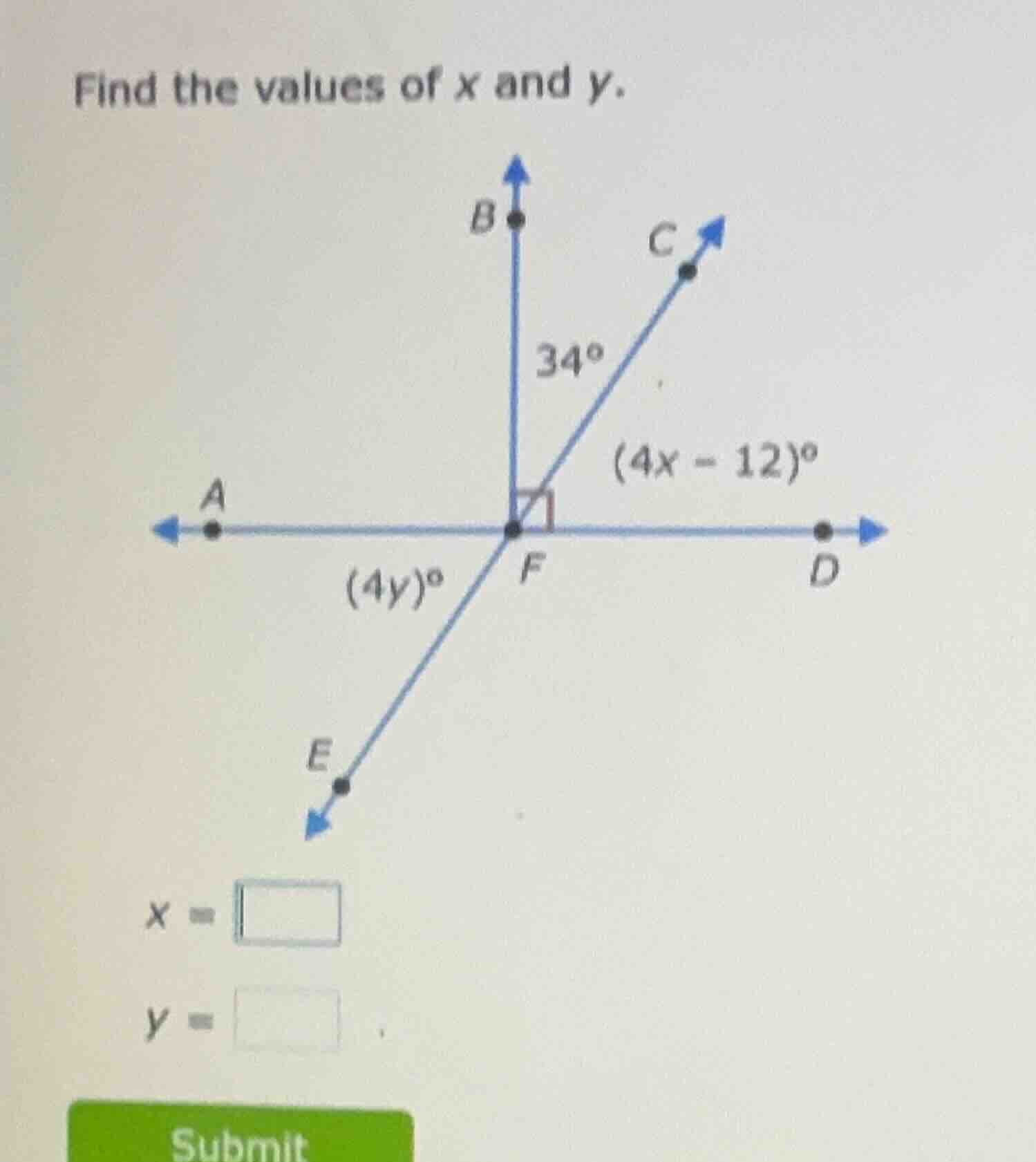
find the values of x and y.
(the image shows a coordinate - like diagram with lines intersecting at point f. there is a right angle at f between the horizontal line ad and the vertical line fb. the angle between fb and fc is 34 degrees, the angle between fc and fd is (4x - 12) degrees, and the angle between fa and fe is (4y) degrees.)
x =
y =
submit
Step1: Solve for x
The angles \(34^\circ\) and \((4x - 12)^\circ\) are complementary (they add up to \(90^\circ\) because \( \angle BFD\) is a right angle). So we set up the equation:
\(34 + (4x - 12) = 90\)
Simplify the left side:
\(34 - 12 + 4x = 90\)
\(22 + 4x = 90\)
Subtract 22 from both sides:
\(4x = 90 - 22\)
\(4x = 68\)
Divide both sides by 4:
\(x = \frac{68}{4}\)
\(x = 17\)
Step2: Solve for y
The angle \((4y)^\circ\) and the angle \(34^\circ\) are equal because they are vertical angles (or we can also see that \((4y)^\circ\) and the angle between \(BF\) and \(CF\) (which is \(34^\circ\)) are related through vertical angles or alternate interior angles, but more simply, since \( \angle AFE\) and \( \angle DFC\) are vertical angles, and \( \angle DFC = 4x - 12 = 4*17 - 12 = 68 - 12 = 56^\circ\)? Wait, no, actually, looking at the diagram, the angle \((4y)^\circ\) and the angle \((4x - 12)^\circ\) are equal? Wait, no, let's re-examine. The angle \((4y)^\circ\) and the angle between \(BF\) and \(CF\) (which is \(34^\circ\))? Wait, no, the right angle is at \(F\) between \(AF\) and \(FD\), so \(AF\) is perpendicular to \(FD\). Then, the angle \((4y)^\circ\) and the angle \((4x - 12)^\circ\) are equal? Wait, no, actually, the angle \((4y)^\circ\) and the angle \(34^\circ\) plus \((4x - 12)^\circ\)? Wait, no, let's use vertical angles. The angle \((4y)^\circ\) and the angle \((4x - 12)^\circ\) are vertical angles? Wait, no, the lines \(AE\) and \(CD\) intersect at \(F\), so the vertical angles: \(\angle AFE\) and \(\angle DFC\), and \(\angle AFD\) and \(\angle EFC\). Wait, maybe a better approach: since \(AF\) is horizontal and \(BF\) is vertical (because there's a right angle at \(F\) between \(AF\) and \(FD\), so \(BF\) is vertical). Therefore, the angle between \(BF\) and \(CF\) is \(34^\circ\), and the angle between \(AF\) and \(EF\) is \((4y)^\circ\). Since \(BF\) is vertical and \(AF\) is horizontal, the angle between \(BF\) and \(AF\) is \(90^\circ\), so the angle between \(EF\) and \(AF\) (which is \((4y)^\circ\)) and the angle between \(CF\) and \(BF\) (which is \(34^\circ\)) should be equal because \(EF\) and \(CF\) are a straight line? Wait, no, \(AE\) and \(CD\) are straight lines intersecting at \(F\), so \(\angle AFE = \angle DFC\). We found \(4x - 12 = 4*17 - 12 = 56^\circ\)? Wait, no, earlier we had \(34 + (4x - 12) = 90\), so \(4x - 12 = 56\)? Wait, 34 + 56 = 90, yes. So \(\angle DFC = 56^\circ\), and \(\angle AFE = \angle DFC = 56^\circ\), so \(4y = 56\)? Wait, no, that contradicts. Wait, maybe I made a mistake. Let's start over.
Wait, the right angle is between \(AF\) and \(FD\), so \(AF \perp FD\). Then, \(BF\) is a vertical line (since \(AF\) is horizontal), so \(BF \perp AF\). Therefore, the angle between \(BF\) and \(CF\) is \(34^\circ\), and the angle between \(CF\) and \(FD\) is \((4x - 12)^\circ\), and since \(BF \perp FD\) (because \(BF\) is vertical and \(FD\) is horizontal), then \(34 + (4x - 12) = 90\), which we solved to get \(x = 17\), so \(4x - 12 = 56^\circ\). Now, the angle \((4y)^\circ\) is equal to the angle \((4x - 12)^\circ\) because they are vertical angles (since \(AE\) and \(CD\) intersect at \(F\), so \(\angle AFE = \angle DFC\)). Therefore, \(4y = 56\)? Wait, no, \(4x - 12 = 56\), so \(4y = 56\)? Then \(y = 14\)? Wait, but let's check: if \(x = 17\), then \(4x - 12 = 56\), and \(4y = 56\), so \(y = 14\). Wait, but earlier I thought maybe \(4y = 34\), but that was wrong. Let's confirm with the diagram: the angle \((4y)^\circ\) is at \(F\) between \(AF\) and \(EF\), and the angle \((…

Snap & solve any problem in the app
Get step-by-step solutions on Sovi AI
Photo-based solutions with guided steps
Explore more problems and detailed explanations
\(x = 17\)
\(y = 14\)