QUESTION IMAGE
Question
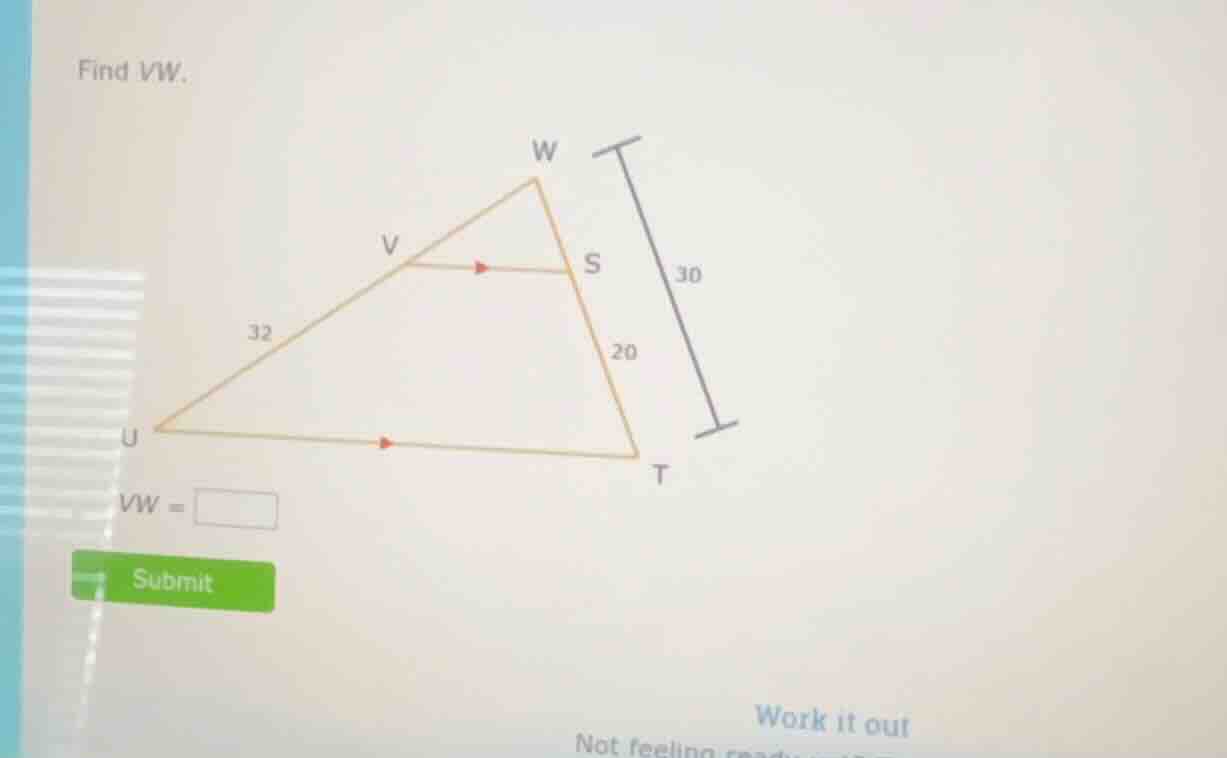
find vw.
vw =
submit
work it out
not feeling
Step1: Identify Similar Triangles
Since \( VS \parallel UT \) (by the midline or proportional segments theorem), triangles \( \triangle WVS \) and \( \triangle WUT \) are similar. So, the ratios of corresponding sides are equal. Let \( VW = x \), then \( WU = VW + VU = x + 32 \). The ratio of \( WS \) to \( WT \) is \( \frac{WS}{WT}=\frac{30 - 20}{30}=\frac{10}{30}=\frac{1}{3} \)? Wait, no, wait. Wait, the segments: \( WT \) is 30? Wait, no, the diagram: \( WT \) has a segment of 20 and the total is 30? Wait, no, maybe \( WT = 30 \), \( ST = 20 \), so \( WS = WT - ST = 30 - 20 = 10 \)? Wait, no, maybe the other way. Wait, the sides: \( VU = 32 \), \( UT \) is a base, \( VS \) is parallel to \( UT \), so by the Basic Proportionality Theorem (Thales' theorem), \( \frac{WV}{WU}=\frac{WS}{WT} \). Wait, let's re-express. Let \( WV = x \), so \( WU = WV + VU = x + 32 \). The sides \( WS \) and \( WT \): \( WT = 30 \), \( ST = 20 \), so \( WS = WT - ST = 30 - 20 = 10 \)? No, that can't be. Wait, maybe \( WT = 30 \), \( WS = 20 \)? Wait, the diagram: the right side has a segment of 20 (from S to T) and the total from W to T is 30? No, maybe the labels: \( W \) at top, \( T \) at bottom right, \( S \) on \( WT \), \( V \) on \( WU \), \( U \) at bottom left. So \( WU = 32 + x \) (where \( x = WV \)), \( WT = 30 \), \( WS = 20 \), \( ST = 10 \)? No, that doesn't make sense. Wait, maybe the ratio is \( \frac{WV}{WU}=\frac{WS}{WT} \). Wait, if \( VS \parallel UT \), then \( \triangle WVS \sim \triangle WUT \), so \( \frac{WV}{WU}=\frac{WS}{WT} \). Let's assume \( WS = 20 \), \( WT = 30 \), so \( \frac{WV}{WV + 32}=\frac{20}{30}=\frac{2}{3} \). Then solve for \( WV \):
Step2: Set Up Proportion
Let \( WV = x \). Then \( WU = x + 32 \). Since \( \triangle WVS \sim \triangle WUT \), \( \frac{x}{x + 32}=\frac{20}{30}=\frac{2}{3} \). Cross-multiplying: \( 3x = 2(x + 32) \)
Step3: Solve for \( x \)
\( 3x = 2x + 64 \)
Subtract \( 2x \) from both sides: \( x = 64 \)? Wait, no, that can't be. Wait, maybe I got the ratio reversed. Maybe \( \frac{WV}{VU}=\frac{WS}{ST} \). Wait, no, Thales' theorem: if a line is drawn parallel to one side of a triangle, intersecting the other two sides, then it divides those sides proportionally. So \( \frac{WV}{VU}=\frac{WS}{ST} \). Let's check: \( VU = 32 \), \( ST = 30 - 20 = 10 \)? No, the diagram has a segment of 30 (the total) and 20 (from S to T), so \( WS = 30 - 20 = 10 \), \( ST = 20 \)? No, that's 10 and 20, sum 30. Then \( \frac{WV}{32}=\frac{10}{20}=\frac{1}{2} \), so \( WV = 16 \). Wait, that makes more sense. Let's re-express:
By Thales' theorem (Basic Proportionality Theorem), since \( VS \parallel UT \), \( \frac{WV}{VU}=\frac{WS}{ST} \). Here, \( WS = 30 - 20 = 10 \), \( ST = 20 \), \( VU = 32 \). So \( \frac{WV}{32}=\frac{10}{20}=\frac{1}{2} \). Therefore, \( WV = 32 \times \frac{1}{2} = 16 \). Wait, but then \( WU = WV + VU = 16 + 32 = 48 \), and \( \frac{WS}{WT}=\frac{10}{30}=\frac{1}{3} \), \( \frac{WV}{WU}=\frac{16}{48}=\frac{1}{3} \), which matches. So that's correct.
Step1: Apply Thales' Theorem
Since \( VS \parallel UT \), \( \frac{WV}{VU}=\frac{WS}{ST} \). \( WS = 30 - 20 = 10 \), \( ST = 20 \), \( VU = 32 \).
Step2: Solve for \( WV \)
\( \frac{WV}{32}=\frac{10}{20} \)
\( WV = 32 \times \frac{10}{20} = 32 \times \frac{1}{2} = 16 \)
Wait, but the question is \( VW \), which is \( WV \), so \( VW = 16 \)? Wait, no, maybe I mixed up \( WV \) and \( VW \). \( VW \) is \( WV \), so yes. Wait, but let's check again. If \( VW = 16 \), then \( WU = 16 + 32 = 48 \), and \( \frac{VW}{WU…

Snap & solve any problem in the app
Get step-by-step solutions on Sovi AI
Photo-based solutions with guided steps
Explore more problems and detailed explanations
\( \boxed{16} \)