QUESTION IMAGE
Question
finding an angle measure
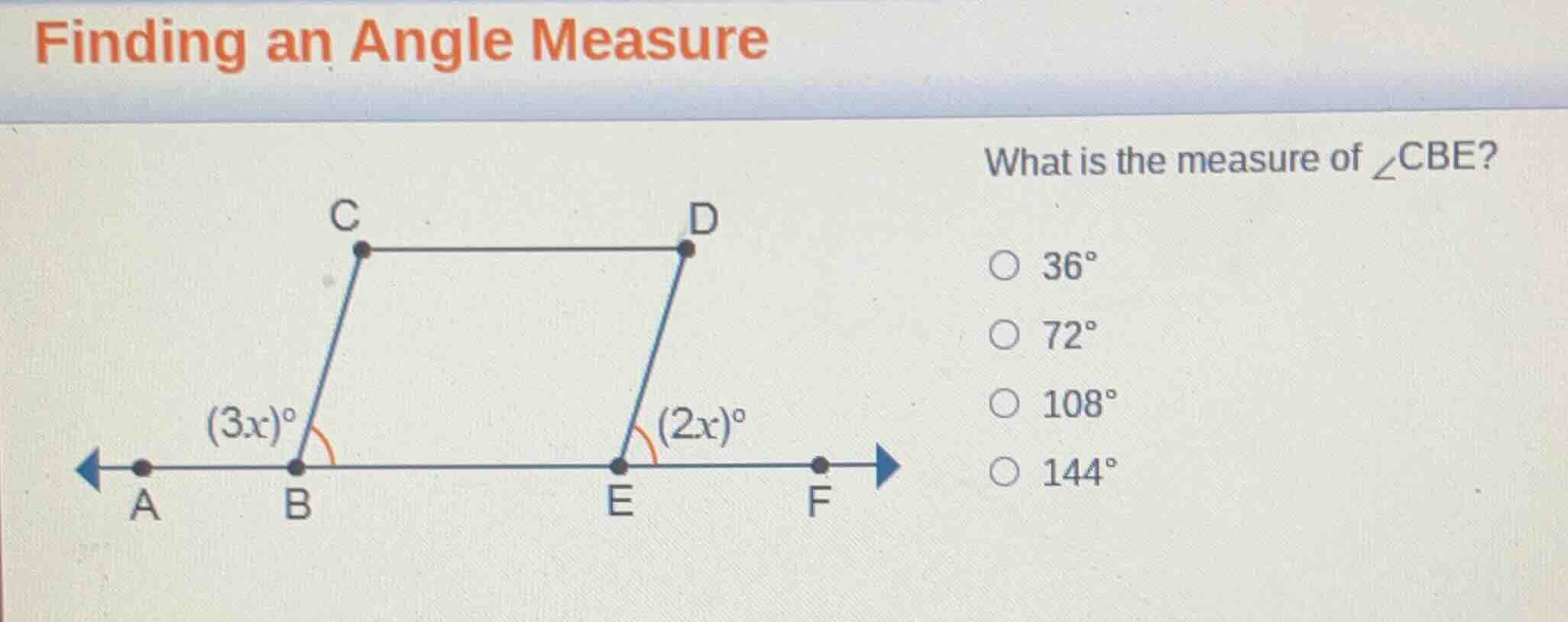
what is the measure of ∠cbe?
options: 36°, 72°, 108°, 144°
(diagram: a, b, e, f on a straight line. quadrilateral bcde with bc and de as sides. at b, angle (3x)° with ab, and at e, angle (2x)° with ef.)
Step1: Identify the relationship
Since \(BCDE\) is a parallelogram, \(BC \parallel DE\), so \(\angle CBE\) and \(\angle DEF\) are supplementary? Wait, no, actually, the consecutive angles on the same side of the transversal for parallel lines: Wait, \(ABEF\) is a straight line, and \(BC \parallel DE\), so the sum of \(\angle CBE\) and \(\angle DEB\)? Wait, no, looking at the angles at \(B\) and \(E\): the angles \((3x)^\circ\) and \(\angle CBE\) are supplementary (since \(A\), \(B\), \(E\), \(F\) are colinear? Wait, \(A\), \(B\), \(E\), \(F\) are on a straight line, so \(\angle ABC + \angle CBE = 180^\circ\), but also, since \(BCDE\) is a parallelogram, \(BC \parallel DE\), so the alternate interior angles? Wait, actually, the angles at \(B\) and \(E\): \(\angle CBE\) and \(\angle DEB\) are same - side interior angles? Wait, no, let's think again. In a parallelogram, consecutive angles are supplementary? Wait, no, in a parallelogram, opposite sides are parallel, so \(BC \parallel DE\) and \(CD \parallel BE\). So, the transversal \(BE\) cuts \(BC\) and \(DE\), so the same - side interior angles should be supplementary? Wait, no, actually, the angles \((3x)^\circ\) and \((2x)^\circ\): since \(BC \parallel DE\) and \(BE\) is a transversal? Wait, no, \(ABEF\) is a straight line, so the sum of \(\angle CBE\) and \((3x)^\circ\) is \(180^\circ\), and also, since \(BCDE\) is a parallelogram, \(BC \parallel DE\), so \(\angle CBE=\angle DEB\)? Wait, no, maybe the angles \((3x)^\circ\) and \((2x)^\circ\) are related because \(BC \parallel DE\) and \(BE\) is a transversal, so the consecutive interior angles? Wait, I think I made a mistake. Let's start over.
Since \(BCDE\) is a parallelogram, \(BC \parallel DE\). So, the transversal \(BE\) creates same - side interior angles? Wait, no, the line \(ABEF\) is a straight line, so \(\angle ABE\) (which is \((3x)^\circ\)) and \(\angle CBE\) are supplementary, and \(\angle DEF\) (which is \((2x)^\circ\)) and \(\angle DEB\) are supplementary. But in a parallelogram, \(BC \parallel DE\), so \(\angle CBE + \angle DEB=180^\circ\)? Wait, no, that's not right. Wait, actually, in a parallelogram, \(BC \parallel DE\) and \(BE\) is a side, so \(CD \parallel BE\). So, the angles at \(B\) and \(E\): \(\angle CBE\) and \(\angle DEB\) are equal? No, that's alternate interior angles. Wait, I think the key is that \(ABEF\) is a straight line, so the sum of \((3x)^\circ\) and \(\angle CBE\) is \(180^\circ\), and also, since \(BCDE\) is a parallelogram, \(BC \parallel DE\), so the angle \(\angle CBE\) and the angle adjacent to \((2x)^\circ\) (i.e., \(\angle DEB\)) are supplementary? Wait, no, maybe the angles \((3x)^\circ\) and \((2x)^\circ\) are such that \(3x + 2x=180\)? Wait, why? Because \(BC \parallel DE\) and \(ABEF\) is a straight line, so the same - side interior angles sum to \(180^\circ\). So, \(3x+2x = 180\).
Step2: Solve for \(x\)
\(3x + 2x=180\)
\(5x = 180\)
\(x=\frac{180}{5}=36\)
Step3: Find \(\angle CBE\)
We know that \(\angle CBE\) and \((3x)^\circ\) are supplementary (since \(A\), \(B\), \(E\), \(F\) are colinear), so \(\angle CBE = 180^\circ-(3x)^\circ\). Substitute \(x = 36\) into \(3x\): \(3x=3\times36 = 108\). Then \(\angle CBE=180 - 108=72^\circ\)? Wait, no, that's not right. Wait, maybe I mixed up the angles. Wait, actually, in the parallelogram \(BCDE\), \(BC \parallel DE\), so the alternate interior angles: \(\angle CBE=(2x)^\circ\)? No, wait, let's re - examine the diagram. The angle at \(B\) is \((3x)^\circ\) (adjacent to \(\angle CBE\)) and the angle at \(E\) is \((2x)^\circ\) (ad…

Snap & solve any problem in the app
Get step-by-step solutions on Sovi AI
Photo-based solutions with guided steps
Explore more problems and detailed explanations
\(72^\circ\) (corresponding to the option \(72^\circ\))