QUESTION IMAGE
Question
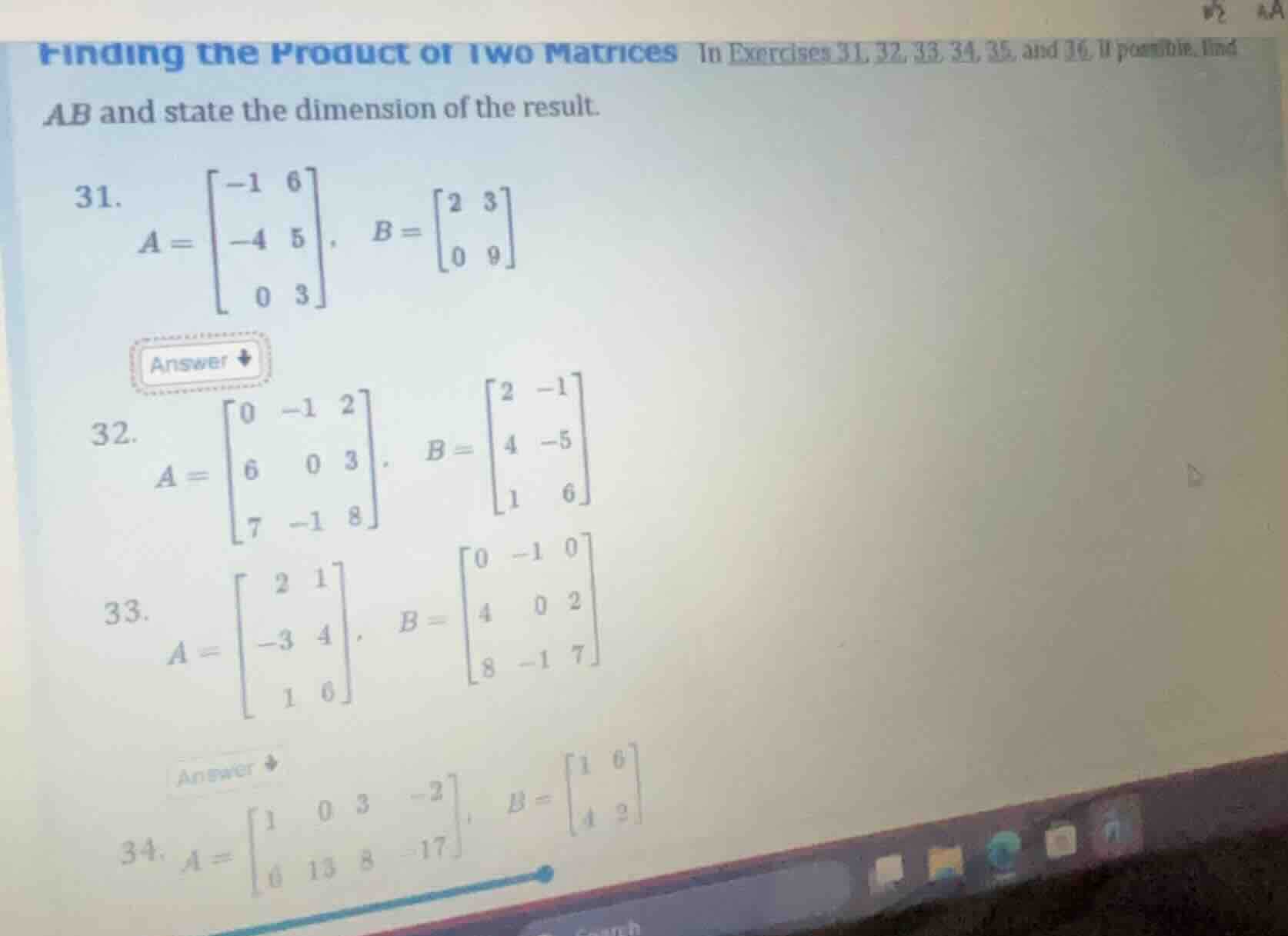
finding the product of two matrices in exercises 31, 32, 33, 34, 35, and 36, if possible, find ab and state the dimension of the result. 31. $a = \
$, $b = \
$ 32. $a = \
$, $b = \
$ 33. $a = \
$, $b = \
$ 34. $a = \
$, $b = \
$
Problem 31
Step1: Recall matrix multiplication rule
To multiply two matrices \( A \) (with dimensions \( m \times n \)) and \( B \) (with dimensions \( n \times p \)), the element in the \( i \)-th row and \( j \)-th column of the product \( AB \) is given by the dot product of the \( i \)-th row of \( A \) and the \( j \)-th column of \( B \). Here, \( A \) is a \( 3 \times 2 \) matrix and \( B \) is a \( 2 \times 2 \) matrix, so the product \( AB \) will be a \( 3 \times 2 \) matrix.
Step2: Calculate the first row of \( AB \)
First row of \( A \): \([-1, 6]\), first column of \( B \): \([2, 0]^T\), second column of \( B \): \([3, 9]^T\)
- First element (row 1, column 1): \((-1)(2)+(6)(0) = -2 + 0 = -2\)
- Second element (row 1, column 2): \((-1)(3)+(6)(9) = -3 + 54 = 51\)
Step3: Calculate the second row of \( AB \)
Second row of \( A \): \([-4, 5]\)
- First element (row 2, column 1): \((-4)(2)+(5)(0) = -8 + 0 = -8\)
- Second element (row 2, column 2): \((-4)(3)+(5)(9) = -12 + 45 = 33\)
Step4: Calculate the third row of \( AB \)
Third row of \( A \): \([0, 3]\)
- First element (row 3, column 1): \((0)(2)+(3)(0) = 0 + 0 = 0\)
- Second element (row 3, column 2): \((0)(3)+(3)(9) = 0 + 27 = 27\)
Step1: Recall matrix multiplication rule
\( A \) is a \( 3 \times 3 \) matrix and \( B \) is a \( 3 \times 2 \) matrix, so the product \( AB \) will be a \( 3 \times 2 \) matrix. The element in the \( i \)-th row and \( j \)-th column of \( AB \) is the dot product of the \( i \)-th row of \( A \) and the \( j \)-th column of \( B \).
Step2: Calculate the first row of \( AB \)
First row of \( A \): \([0, -1, 2]\)
- Column 1 of \( B \): \([2, 4, 1]^T\): \( (0)(2)+(-1)(4)+(2)(1) = 0 - 4 + 2 = -2\)
- Column 2 of \( B \): \([-1, -5, 6]^T\): \( (0)(-1)+(-1)(-5)+(2)(6) = 0 + 5 + 12 = 17\)
Step3: Calculate the second row of \( AB \)
Second row of \( A \): \([6, 0, 3]\)
- Column 1 of \( B \): \( (6)(2)+(0)(4)+(3)(1) = 12 + 0 + 3 = 15\)
- Column 2 of \( B \): \( (6)(-1)+(0)(-5)+(3)(6) = -6 + 0 + 18 = 12\)
Step4: Calculate the third row of \( AB \)
Third row of \( A \): \([7, -1, 8]\)
- Column 1 of \( B \): \( (7)(2)+(-1)(4)+(8)(1) = 14 - 4 + 8 = 18\)
- Column 2 of \( B \): \( (7)(-1)+(-1)(-5)+(8)(6) = -7 + 5 + 48 = 46\)
Step1: Recall matrix multiplication rule
\( A \) is a \( 3 \times 2 \) matrix and \( B \) is a \( 3 \times 3 \) matrix. Wait, no! Wait, the number of columns of \( A \) (which is 2) must equal the number of rows of \( B \) (which is 3) for matrix multiplication to be defined. Wait, no, in the problem, \( A=
\) (dimension \( 3 \times 2 \)) and \( B=
\) (dimension \( 3 \times 3 \)). Wait, the number of columns of \( A \) (2) is not equal to the number of rows of \( B \) (3). Wait, this is a mistake? Wait, no, maybe I misread the matrices. Wait, no, the user's problem 33: \( A=
\), \( B=
\). Wait, matrix multiplication \( AB \) is not defined because the number of columns of \( A \) (2) is not equal to the number of rows of \( B \) (3). Wait, maybe it's \( BA \)? But the problem says "find \( AB \)". Wait, maybe there is a typo, but assuming the matrices are as given, \( AB \) is not defined. But maybe I misread the matrices. Wait, let's check again. Wait, maybe \( B \) is a \( 2 \times 3 \) matrix? No, the user wrote \( B=
\), which is \( 3 \times 3 \). So \( AB \) is not defined. But maybe the user made a typo. Alternatively, maybe I misread \( A \) or \( B \).
Wait, perhaps the original problem has a different \( B \). But based on the given matrices, \( A \) is \( 3 \times 2 \), \( B \) is \( 3 \times 3 \), so \( AB \) is not defined.
Problem 34

Snap & solve any problem in the app
Get step-by-step solutions on Sovi AI
Photo-based solutions with guided steps
Explore more problems and detailed explanations
The product \( AB \) is \(
\) and the dimension is \( 3 \times 2 \).