QUESTION IMAGE
18,366 Learners found this answer helpful
Question
the first five presidents
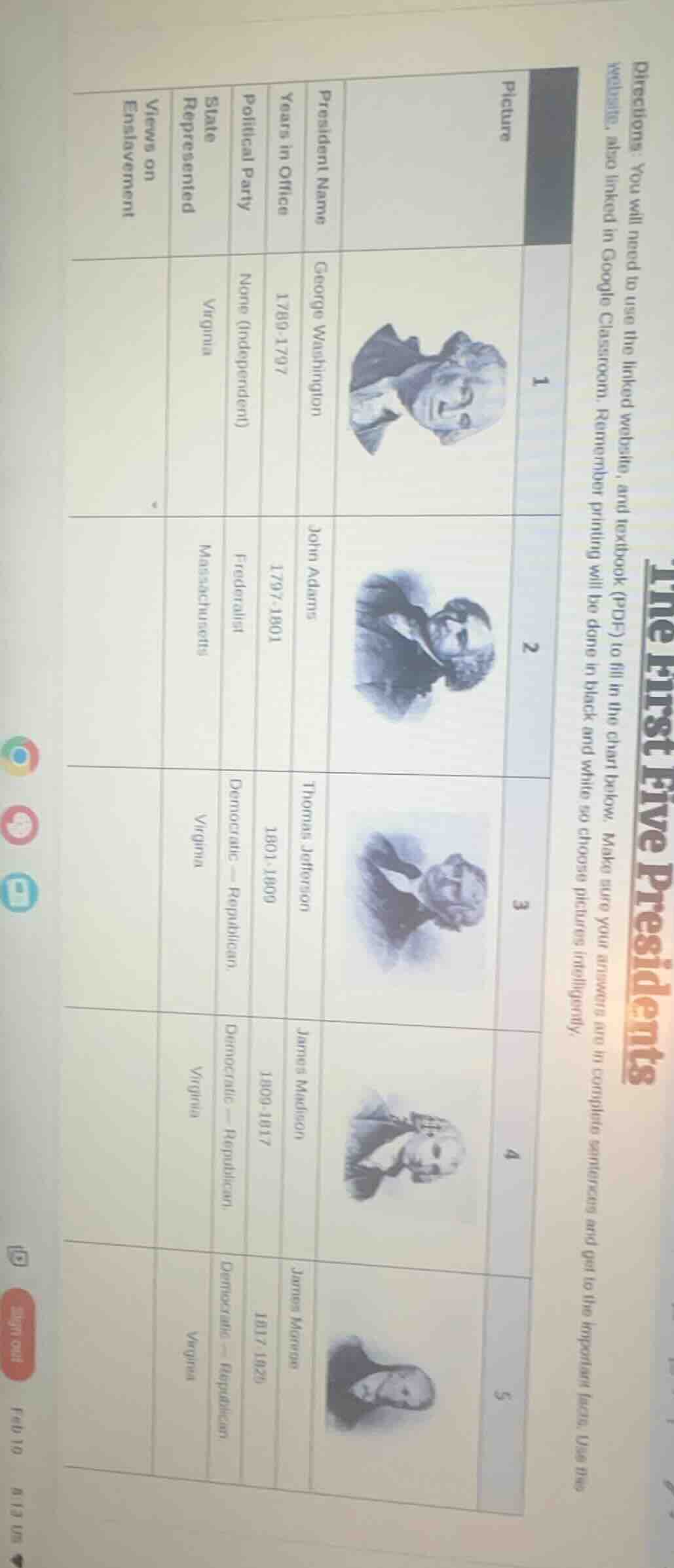
directions: you will need to use the linked website, and textbook (pdf) to fill in the chart below. make sure your answers are in complete sentences and get to the important facts. use the website, also linked in google classroom. remember printing will be done in black and white so choose pictures intelligently.
| picture | president name | years in office | political party | state represented | views on enslavement | ---- | ---- | ---- | ---- | ---- | ---- | 1 <br> portrait of george washington | george washington | 1789-1797 | none (independent) | virginia | 2 <br> portrait of john adams | john adams | 1797-1801 | federalist | massachusetts | 3 <br> portrait of thomas jefferson | thomas jefferson | 1801-1809 | democratic — republican | virginia | 4 <br> portrait of james madison | james madison | 1809-1817 | democratic — republican | virginia | 5 <br> portrait of james monroe | james monroe | 1817-1825 | democratic — republican | virginia |
Brief Explanations
The chart requires filling in the "Views on Enslavement" column for the first five U.S. presidents, using historical records:
- George Washington: He owned enslaved people, privately expressed moral concerns about enslavement, and freed his enslaved individuals in his will.
- John Adams: He never owned enslaved people, publicly opposed enslavement, and advocated for its abolition in early U.S. debates.
- Thomas Jefferson: He owned hundreds of enslaved people, wrote anti-enslavement rhetoric in the Declaration of Independence, but never took major public action to end the institution and even profited from enslaved labor.
- James Madison: He owned enslaved people, recognized enslavement as a moral and political problem for the nation, but did not push for large-scale abolition during his presidency.
- James Monroe: He owned enslaved people, supported the American Colonization Society (which advocated sending freed enslaved people to Africa) rather than immediate abolition in the U.S.

Snap & solve any problem in the app
Get step-by-step solutions on Sovi AI
Photo-based solutions with guided steps
Explore more problems and detailed explanations
| Picture | President Name | Years in Office | Political Party | State Represented | Views on Enslavement |
|---|---|---|---|---|---|
| 2 | John Adams | 1797-1801 | Federalist | Massachusetts | He never owned enslaved people, publicly opposed enslavement, and argued for its abolition in early national political discussions. |
| 3 | Thomas Jefferson | 1801-1809 | Democratic – Republican | Virginia | He owned hundreds of enslaved people, wrote anti-enslavement language in the Declaration of Independence, but took no major public action to end enslavement and benefited from enslaved labor throughout his life. |
| 4 | James Madison | 1809-1817 | Democratic – Republican | Virginia | He owned enslaved people, acknowledged enslavement as a moral and political crisis for the U.S., but did not advance large-scale abolition efforts during his presidency. |
| 5 | James Monroe | 1817-1825 | Democratic – Republican | Virginia | He owned enslaved people, supported the American Colonization Society (which promoted relocating freed enslaved people to Africa) instead of advocating for immediate, full abolition within the United States. |