QUESTION IMAGE
Question
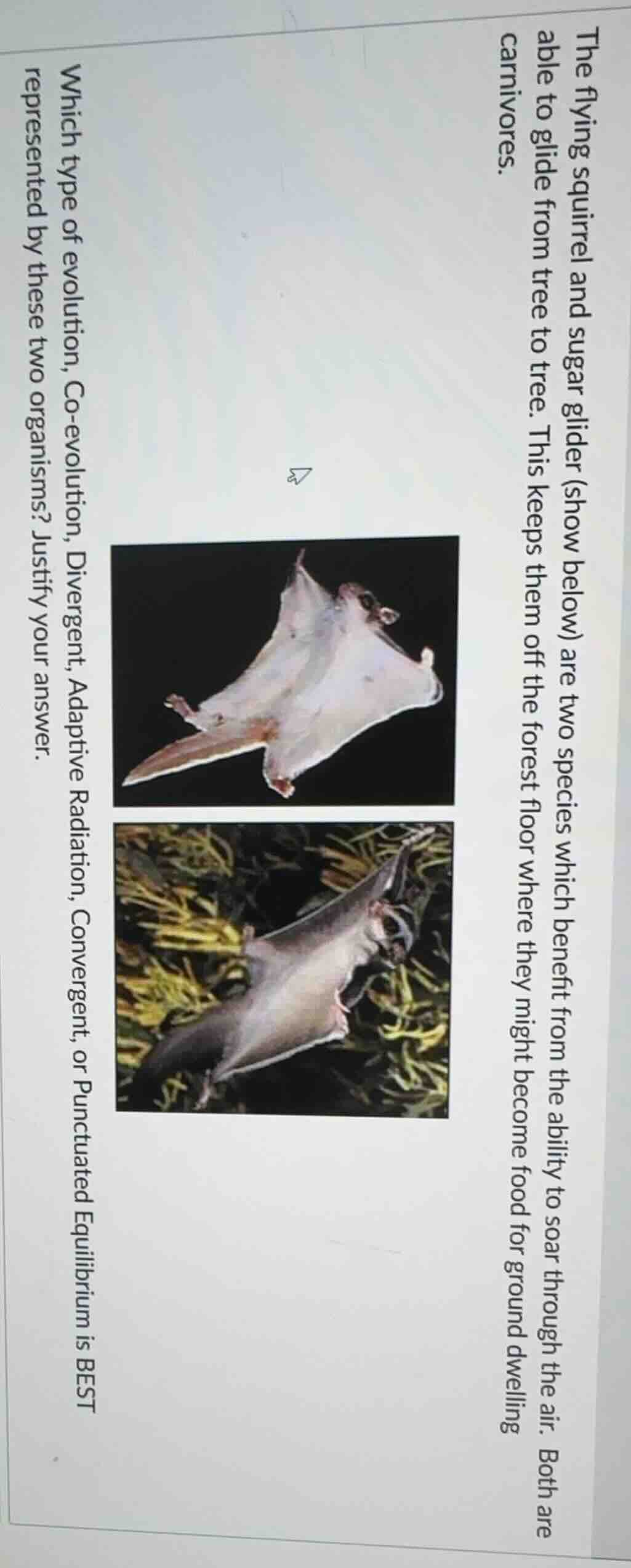
the flying squirrel and sugar glider (show below) are two species which benefit from the ability to soar through the air. both are able to glide from tree to tree. this keeps them off the forest floor where they might become food for ground dwelling carnivores.
which type of evolution, co - evolution, divergent, adaptive radiation, convergent, or punctuated equilibrium is best represented by these two organisms? justify your answer.
Flying squirrels and sugar gliders are different species (squirrels are rodents, sugar gliders are marsupials) but have evolved similar gliding adaptations (like the gliding membrane) to live in tree - dwelling, gliding - based lifestyles. Convergent evolution is when unrelated organisms independently evolve similar traits due to similar environmental pressures. Here, the similar gliding ability in these unrelated organisms fits convergent evolution. Co - evolution involves two or more species evolving in response to each other, divergent is from a common ancestor to different traits, adaptive radiation is rapid diversification from a common ancestor into many forms, and punctuated equilibrium is long periods of stasis with short bursts of change. So convergent evolution is the best fit.

Snap & solve any problem in the app
Get step-by-step solutions on Sovi AI
Photo-based solutions with guided steps
Explore more problems and detailed explanations
Convergent evolution. Justification: The flying squirrel (a rodent) and sugar glider (a marsupial) are not closely related but have independently evolved the similar adaptation of gliding (to avoid ground - dwelling predators) due to similar environmental selection pressures, which is the definition of convergent evolution.