QUESTION IMAGE
Question
follow the step - by - step process to solve the rational equation
a) list all restricted values.
b) determine the lcd of all denominators in the given rational equation
c) write the new linear equation obtained after multiplying both sides of the rational equation by the lcd
d) solve the equation or state that there is no solution
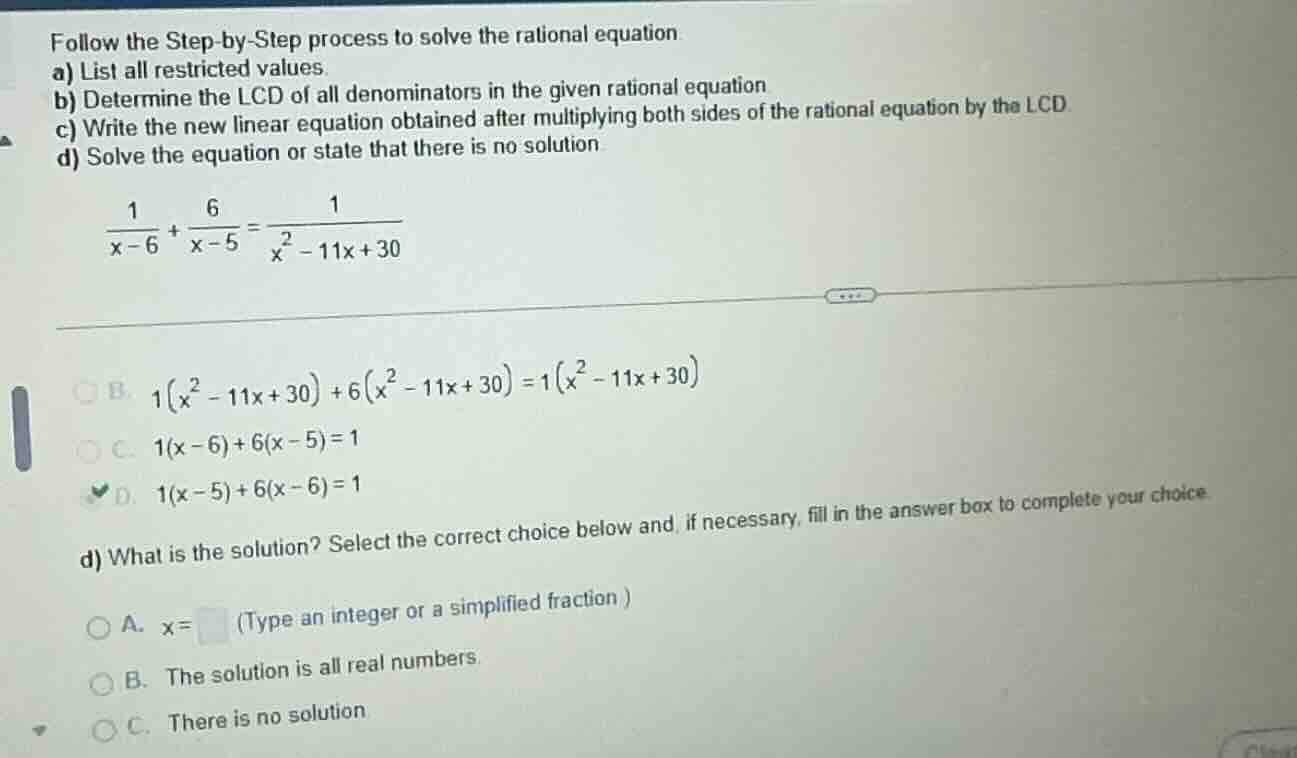
\\(\frac{1}{x - 6}+\frac{6}{x - 5}=\frac{1}{x^{2}-11x + 30}\\)
b. \\(1(x^{2}-11x + 30)+6(x^{2}-11x + 30)=1(x^{2}-11x + 30)\\)
c. \\(1(x - 6)+6(x - 5)=1\\)
d. \\(1(x - 5)+6(x - 6)=1\\)
d) what is the solution? select the correct choice below and, if necessary, fill in the answer box to complete your choice.
a. \\(x = \\) (type an integer or a simplified fraction)
b. the solution is all real numbers.
c. there is no solution
Part a) List all restricted values
Step1: Factor the denominator
First, factor the quadratic denominator \(x^2 - 11x + 30\). We need two numbers that multiply to \(30\) and add up to \(-11\). Those numbers are \(-5\) and \(-6\), so \(x^2 - 11x + 30=(x - 5)(x - 6)\).
Step2: Find values that make denominators zero
For the denominator \(x - 6\), setting \(x - 6 = 0\) gives \(x = 6\). For the denominator \(x - 5\), setting \(x - 5 = 0\) gives \(x = 5\). For the denominator \((x - 5)(x - 6)\), the values \(x = 5\) and \(x = 6\) also make it zero. So the restricted values are \(x = 5\) and \(x = 6\).
Step1: Identify the denominators
The denominators are \(x - 6\), \(x - 5\), and \(x^2 - 11x + 30=(x - 5)(x - 6)\).
Step2: Find the least common denominator (LCD)
The LCD is the product of the unique factors with the highest power. Here, the factors are \((x - 5)\) and \((x - 6)\), so the LCD is \((x - 5)(x - 6)\) (or \(x^2 - 11x + 30\)).
Step1: Multiply each term by the LCD
Multiply each term \(\frac{1}{x - 6}\), \(\frac{6}{x - 5}\), and \(\frac{1}{(x - 5)(x - 6)}\) by the LCD \((x - 5)(x - 6)\).
For \(\frac{1}{x - 6}\times(x - 5)(x - 6)=1\times(x - 5)\)
For \(\frac{6}{x - 5}\times(x - 5)(x - 6)=6\times(x - 6)\)
For \(\frac{1}{(x - 5)(x - 6)}\times(x - 5)(x - 6)=1\)
So the new linear equation is \(1\times(x - 5)+6\times(x - 6)=1\), which matches option D.

Snap & solve any problem in the app
Get step-by-step solutions on Sovi AI
Photo-based solutions with guided steps
Explore more problems and detailed explanations
\(x = 5\), \(x = 6\)