QUESTION IMAGE
Question
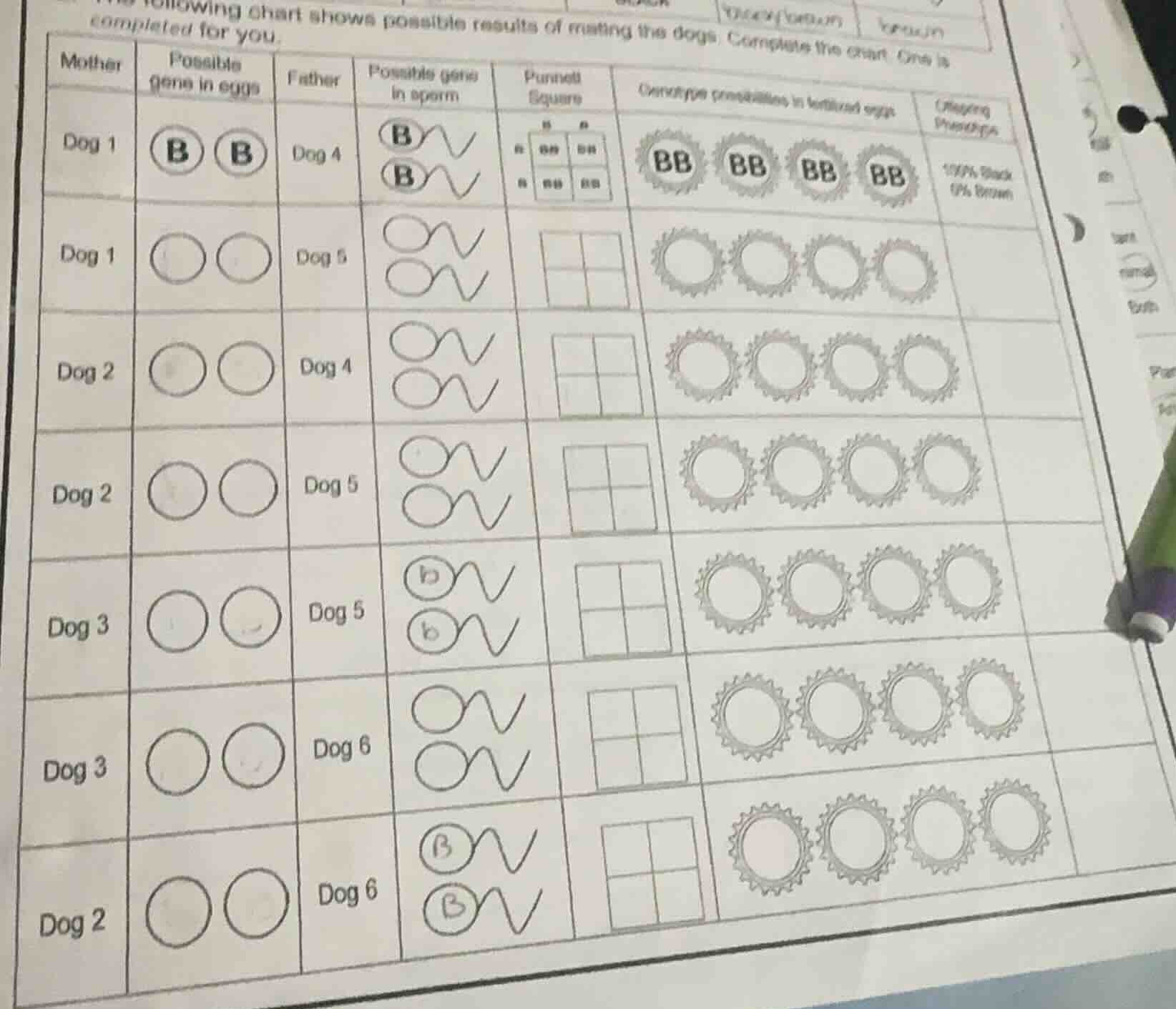
following chart shows possible results of mating the dogs. complete the chart. one is completed for you.
mother\tpossible genes in eggs\tfather\tpossible genes in sperm\tpunnett square\tgenotype probabilities in fertilized eggs\toffspring phenotypes
dog 1\tb b\tdog 4\tb b\t\tbb bb bb bb\t100% black (0% brown)
dog 1\t\tdog 5\t\t\t\t
dog 2\t\tdog 4\t\t\t\t
dog 2\t\tdog 5\t\t\t\t
dog 3\t\tdog 5\tb b\t\t\t\t
dog 3\t\tdog 6\t\t\t\t
dog 2\t\tdog 6\tb b\t\t\t\t
To solve the Punnett square problems for dog breeding, we analyze each cross:
Cross 1: Dog 1 (Mother, \( BB \)) × Dog 5 (Father, \( bb \))
Step 1: Determine gametes
- Dog 1 (mother) has genotype \( BB \), so all eggs carry \( B \).
- Dog 5 (father) has genotype \( bb \), so all sperm carry \( b \).
Step 2: Complete Punnett square
| \( B \) | \( B \) | |
|---|---|---|
| \( b \) | \( Bb \) | \( Bb \) |
Step 3: Genotype & Phenotype probabilities
- Genotypes: All \( Bb \) (4/4).
- Phenotype: If \( B \) is dominant (black), 100% black, 0% brown.
Cross 2: Dog 2 (Mother, \( Bb \)) × Dog 4 (Father, \( BB \))
Step 1: Determine gametes
- Dog 2 (mother) has \( Bb \), so eggs: \( B \) or \( b \).
- Dog 4 (father) has \( BB \), so sperm: \( B \) only.
Step 2: Complete Punnett square
| \( B \) | \( b \) | |
|---|---|---|
| \( B \) | \( BB \) | \( Bb \) |
Step 3: Genotype & Phenotype probabilities
- Genotypes: \( BB \) (2/4) and \( Bb \) (2/4) (50% each).
- Phenotype: If \( B \) is dominant, 100% black (since \( BB \) and \( Bb \) both show black).
Cross 3: Dog 2 (Mother, \( Bb \)) × Dog 5 (Father, \( bb \))
Step 1: Determine gametes
- Dog 2 (mother): \( B \) or \( b \) (eggs).
- Dog 5 (father): \( b \) only (sperm).
Step 2: Complete Punnett square
| \( B \) | \( b \) | |
|---|---|---|
| \( b \) | \( Bb \) | \( bb \) |
Step 3: Genotype & Phenotype probabilities
- Genotypes: \( Bb \) (2/4) and \( bb \) (2/4) (50% each).
- Phenotype: If \( B \) = black, \( Bb \) = black (2/4), \( bb \) = brown (2/4) → 50% black, 50% brown.
Cross 4: Dog 3 (Mother, \( bb \)) × Dog 5 (Father, \( bb \))
Step 1: Determine gametes
- Both parents: \( bb \), so gametes: \( b \) only.
Step 2: Complete Punnett square
| \( b \) | \( b \) | |
|---|---|---|
| \( b \) | \( bb \) | \( bb \) |
Step 3: Genotype & Phenotype probabilities
- Genotypes: All \( bb \) (4/4).
- Phenotype: If \( b \) = brown, 100% brown, 0% black.
Cross 5: Dog 3 (Mother, \( bb \)) × Dog 6 (Father, \( Bb \))
Step 1: Determine gametes
- Dog 3 (mother): \( b \) only (eggs).
- Dog 6 (father): \( B \) or \( b \) (sperm).
Step 2: Complete Punnett square
| \( b \) | \( b \) | |
|---|---|---|
| \( b \) | \( bb \) | \( bb \) |
Step 3: Genotype & Phenotype probabilities
- Genotypes: \( Bb \) (2/4) and \( bb \) (2/4) (50% each).
- Phenotype: \( Bb \) = black (2/4), \( bb \) = brown (2/4) → 50% black, 50% brown.
Cross 6: Dog 2 (Mother, \( Bb \)) × Dog 6 (Father, \( BB \))
Step 1: Determine gametes
- Dog 2 (mother): \( B \) or \( b \) (eggs).
- Dog 6 (father): \( B \) only (sperm).
Step 2: Complete Punnett square
| \( B \) | \( b \) | |
|---|---|---|
| \( B \) | \( BB \) | \( Bb \) |
Step 3: Genotype & Phenotype probabilities
- Genotypes: \( BB \) (2/4) and \( Bb \) (2/4) (50% each).
- Phenotype: 100% black (since \( BB \) and \( Bb \) = black).
Final Answers (Example for Cross 1):
- Genotypes: \( Bb, Bb, Bb, Bb \)
- Phenotype: 100% Black, 0% Brown
(Repeat similar steps for other crosses based on dominant/recessive inheritance of \( B \) and \( b \).)

Snap & solve any problem in the app
Get step-by-step solutions on Sovi AI
Photo-based solutions with guided steps
Explore more problems and detailed explanations
To solve the Punnett square problems for dog breeding, we analyze each cross:
Cross 1: Dog 1 (Mother, \( BB \)) × Dog 5 (Father, \( bb \))
Step 1: Determine gametes
- Dog 1 (mother) has genotype \( BB \), so all eggs carry \( B \).
- Dog 5 (father) has genotype \( bb \), so all sperm carry \( b \).
Step 2: Complete Punnett square
| \( B \) | \( B \) | |
|---|---|---|
| \( b \) | \( Bb \) | \( Bb \) |
Step 3: Genotype & Phenotype probabilities
- Genotypes: All \( Bb \) (4/4).
- Phenotype: If \( B \) is dominant (black), 100% black, 0% brown.
Cross 2: Dog 2 (Mother, \( Bb \)) × Dog 4 (Father, \( BB \))
Step 1: Determine gametes
- Dog 2 (mother) has \( Bb \), so eggs: \( B \) or \( b \).
- Dog 4 (father) has \( BB \), so sperm: \( B \) only.
Step 2: Complete Punnett square
| \( B \) | \( b \) | |
|---|---|---|
| \( B \) | \( BB \) | \( Bb \) |
Step 3: Genotype & Phenotype probabilities
- Genotypes: \( BB \) (2/4) and \( Bb \) (2/4) (50% each).
- Phenotype: If \( B \) is dominant, 100% black (since \( BB \) and \( Bb \) both show black).
Cross 3: Dog 2 (Mother, \( Bb \)) × Dog 5 (Father, \( bb \))
Step 1: Determine gametes
- Dog 2 (mother): \( B \) or \( b \) (eggs).
- Dog 5 (father): \( b \) only (sperm).
Step 2: Complete Punnett square
| \( B \) | \( b \) | |
|---|---|---|
| \( b \) | \( Bb \) | \( bb \) |
Step 3: Genotype & Phenotype probabilities
- Genotypes: \( Bb \) (2/4) and \( bb \) (2/4) (50% each).
- Phenotype: If \( B \) = black, \( Bb \) = black (2/4), \( bb \) = brown (2/4) → 50% black, 50% brown.
Cross 4: Dog 3 (Mother, \( bb \)) × Dog 5 (Father, \( bb \))
Step 1: Determine gametes
- Both parents: \( bb \), so gametes: \( b \) only.
Step 2: Complete Punnett square
| \( b \) | \( b \) | |
|---|---|---|
| \( b \) | \( bb \) | \( bb \) |
Step 3: Genotype & Phenotype probabilities
- Genotypes: All \( bb \) (4/4).
- Phenotype: If \( b \) = brown, 100% brown, 0% black.
Cross 5: Dog 3 (Mother, \( bb \)) × Dog 6 (Father, \( Bb \))
Step 1: Determine gametes
- Dog 3 (mother): \( b \) only (eggs).
- Dog 6 (father): \( B \) or \( b \) (sperm).
Step 2: Complete Punnett square
| \( b \) | \( b \) | |
|---|---|---|
| \( b \) | \( bb \) | \( bb \) |
Step 3: Genotype & Phenotype probabilities
- Genotypes: \( Bb \) (2/4) and \( bb \) (2/4) (50% each).
- Phenotype: \( Bb \) = black (2/4), \( bb \) = brown (2/4) → 50% black, 50% brown.
Cross 6: Dog 2 (Mother, \( Bb \)) × Dog 6 (Father, \( BB \))
Step 1: Determine gametes
- Dog 2 (mother): \( B \) or \( b \) (eggs).
- Dog 6 (father): \( B \) only (sperm).
Step 2: Complete Punnett square
| \( B \) | \( b \) | |
|---|---|---|
| \( B \) | \( BB \) | \( Bb \) |
Step 3: Genotype & Phenotype probabilities
- Genotypes: \( BB \) (2/4) and \( Bb \) (2/4) (50% each).
- Phenotype: 100% black (since \( BB \) and \( Bb \) = black).
Final Answers (Example for Cross 1):
- Genotypes: \( Bb, Bb, Bb, Bb \)
- Phenotype: 100% Black, 0% Brown
(Repeat similar steps for other crosses based on dominant/recessive inheritance of \( B \) and \( b \).)