QUESTION IMAGE
Question
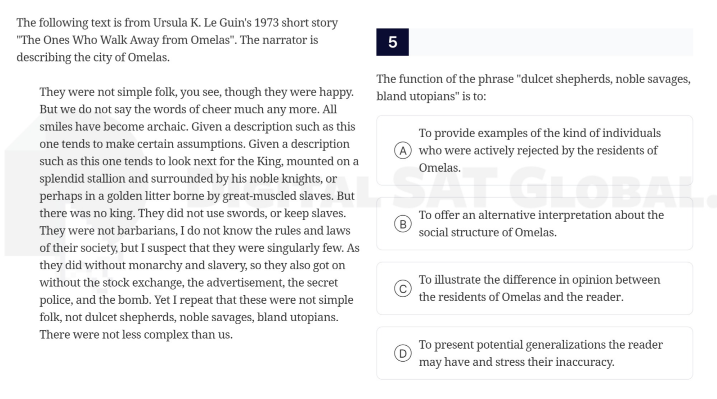
the following text is from ursula k. le guins 1973 short story the ones who walk away from omelas. the narrator is describing the city of omelas.
they were not simple folk, you see, though they were happy. but we do not say the words of cheer much any more. all smiles have become archaic. given a description such as this one tends to make certain assumptions. given a description such as this one tends to look next for the king, mounted on a splendid stallion and surrounded by his noble knights, or perhaps in a golden litter borne by great-muscled slaves. but there was no king. they did not use swords, or keep slaves. they were not barbarians. i do not know the rules and laws of their society, but i suspect that they were singularly few. as they did without monarchy, and slavery, so they also got on without the stock exchange, the advertisement, the secret police, and the bomb. yet i repeat that these were not simple folk, not dulcet shepherds, noble savages, bland utopians. there were no less complex than us.
5
the function of the phrase \dulcet shepherds, noble savages, bland utopians\ is to:
a to provide examples of the kind of individuals who were actively rejected by the residents of omelas.
b to offer an alternative interpretation about the social structure of omelas.
c to illustrate the difference in opinion between the residents of omelas and the reader.
d to present potential generalizations the reader may have and stress their inaccuracy.
The narrator first mentions the people of Omelas are happy but not "simple folk", then lists the phrases "dulcet shepherds, noble savages, bland utopians" as clichéd, oversimplified generalizations readers might apply to Omelas. By explicitly stating the people are not these things, the narrator rejects these inaccurate stereotypes and emphasizes Omelas's complexity, matching the purpose described in option D.

Snap & solve any problem in the app
Get step-by-step solutions on Sovi AI
Photo-based solutions with guided steps
Explore more problems and detailed explanations
D. To present potential generalizations the reader may have and stress their inaccuracy.