QUESTION IMAGE
Question
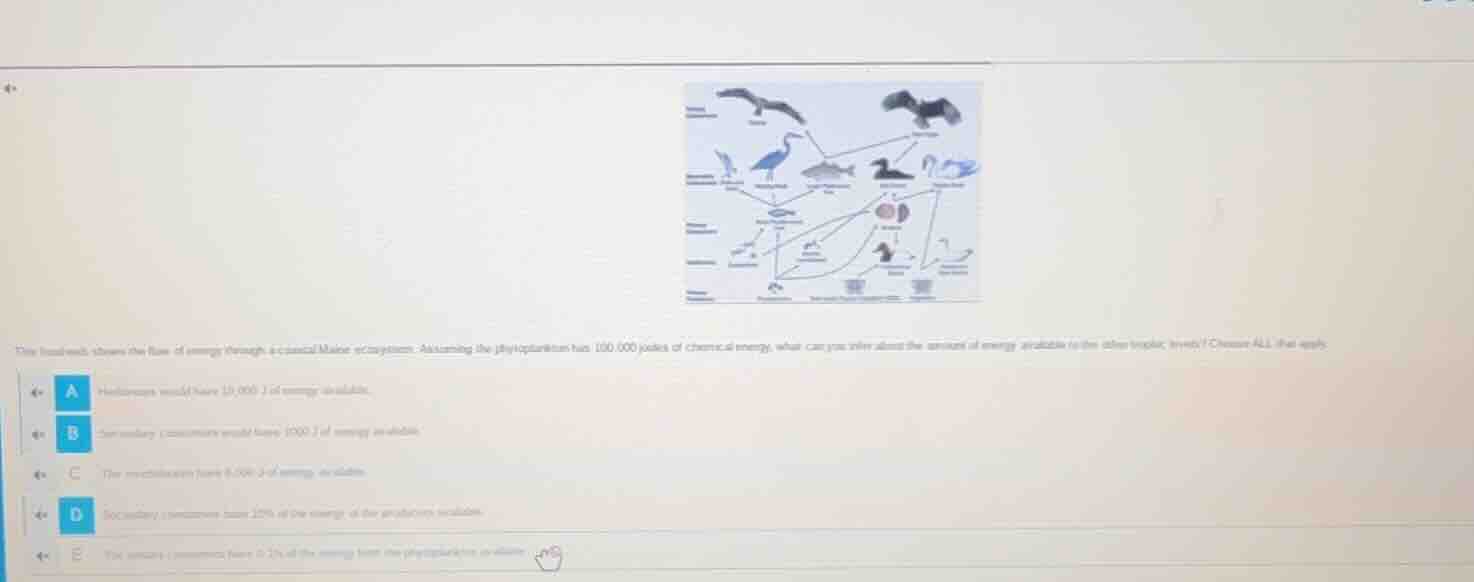
the foodweb shows the flow of energy through a coastal marine ecosystem. assuming the phytoplankton has 100,000 joules of chemical energy, what can you infer about the amount of energy available to the other trophic levels? choose all that apply. a herbivores would have 10,000 j of energy available. b secondary consumers would have 1000 j of energy available. c the microorganisms have 6,000 j of energy available. d secondary consumers have 20% of the energy of the producers available. e the tertiary consumers have 1% of the energy from the phytoplankton available.
- Rule of Energy Transfer in Food Chains: In a food chain, energy is transferred from one trophic level to the next with about 10% of the energy being passed on (the 10% rule). Producers (phytoplankton here) are at the first trophic level. Primary consumers (herbivores) eat producers, secondary consumers eat primary consumers, and tertiary consumers eat secondary consumers. Decomposers break down all levels and receive energy from all, but the 10% rule applies to the main trophic levels (producer → primary → secondary → tertiary).
- Analyzing Each Option:
- Option A: Herbivores are primary consumers. If producers (phytoplankton) have 100,000 J, primary consumers should get ~10% (10,000 J). This matches the 10% rule.
- Option B: Secondary consumers eat primary consumers. Primary consumers have ~10,000 J, so secondary consumers should get ~10% of that (1,000 J). This matches the 10% rule (10% of 10,000 is 1,000).
- Option C: Decomposers receive energy from all trophic levels (producers, primary, secondary, tertiary), not just 10% of producers. Their energy isn’t limited to 10% of producers’ energy (which would be 10,000 J, not 6,000 J anyway). So this is incorrect.
- Option D: Secondary consumers get ~10% of primary consumers’ energy. Primary consumers have ~10% of producers’ energy. So secondary consumers have ~10% of 10% = 1% of producers’ energy? Wait, no—wait, the option says “secondary consumers have 20% of the energy of the primary consumers”. The 10% rule is an average; sometimes it can be 5 - 20%, so 20% is possible (though 10% is typical). But let's check the math: If primary consumers have 10,000 J, 20% of that is 2,000 J. But the 10% rule is a general guideline—some ecosystems might have slightly more efficient transfer. However, let's check other options first. Wait, no—wait, the 10% rule is about the amount passed to the next trophic level (i.e., secondary consumers get ~10% of primary consumers’ energy, so if primary has 10,000 J, secondary has ~1,000 J). But the option says “secondary consumers have 20% of the energy of the primary consumers”—so 20% of 10,000 is 2,000 J. Is that possible? The 10% rule is an average; actual transfer can vary (5 - 20%), so 20% is within the possible range? Wait, no—wait, the key is the question is about a “coastal Maine ecosystem” and the 10% rule is a general rule, but maybe the question is using the 10% rule strictly? Wait, no—let's re - evaluate. Wait, the 10% rule is the amount of energy available to the next trophic level (i.e., the energy that is assimilated and available for growth/reproduction, not the total energy consumed). So primary consumers get ~10% of producers’ energy, secondary get ~10% of primary’s, etc. So secondary consumers should have ~10% of primary’s energy (1,000 J if primary has 10,000 J). But the option says 20%—so is that wrong? Wait, maybe I misread. Wait, the option says “secondary consumers have 20% of the energy of the primary consumers”. Let's check the numbers: If primary has 10,000 J, 20% is 2,000 J. But according to the 10% rule, it's 1,000 J. But maybe the question is considering that the 10% is a rough estimate and 20% is possible? Wait, no—let's check the other options. Wait, option E: “Tertiary consumers have 1% of the energy from the phytoplankton available”. Tertiary consumers are three levels above producers: producer (100%), primary (10%), secondary (1%), tertiary (0.1%)? Wait, no—wait, producer → primary (10%), primary → secondary (10% of 10% = 1%), secondary → tertiary (10% of 1% = 0.1%). Wait, the option…

Snap & solve any problem in the app
Get step-by-step solutions on Sovi AI
Photo-based solutions with guided steps
Explore more problems and detailed explanations
A. Herbivores would have 10,000 J of energy available.
B. Secondary consumers would have 1000 J of energy available.