QUESTION IMAGE
Question
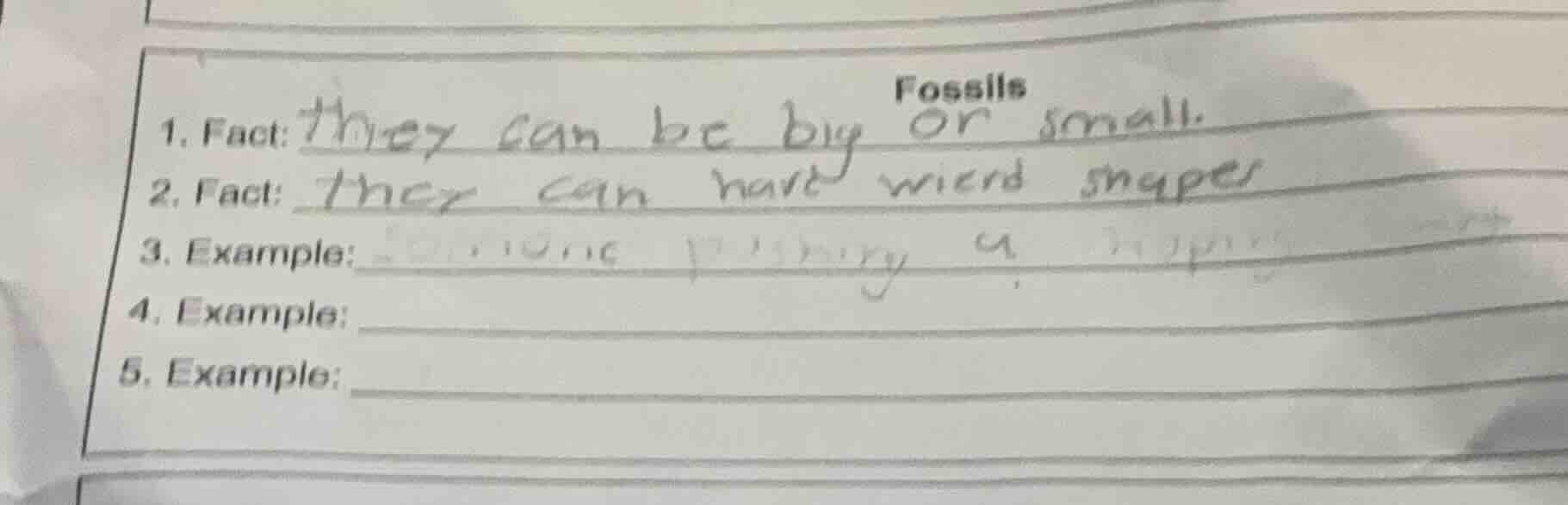
fossils
- fact: they can be big or small.
- fact: they can have weird shapes
- example:
- example:
- example:
To complete the worksheet about fossils, we can use scientific facts and common examples of fossils:
Fact 2 (corrected for clarity):
Fossils form from once - living organisms. (Or, if we follow the “weird shapes” idea more closely: They can have unusual shapes due to the organism’s form or preservation process.)
Example 3:
Dinosaur bone (A classic fossil, as dinosaur bones are often preserved and found as fossils.)
Example 4:
Ammonite (Ammonites are extinct marine mollusks, and their fossils are very common and have distinct spiral shapes.)
Example 5:
Leaf imprint (Fossilized leaf imprints are common, showing the shape of ancient plants.)
If we need to fill in the blanks with the appropriate content:
- Fact: They form from once - living things. (or “They can have strange shapes from the organism’s structure”)
- Example: Dinosaur bone
- Example: Ammonite
- Example: Leaf imprint
These answers are based on the scientific understanding of fossils (from the Natural Science subfield of Biology, specifically paleontology, which studies fossils). Fossils are the preserved remains or traces of organisms, and examples include body fossils (like bones, shells) and trace fossils (like imprints, burrows).

Snap & solve any problem in the app
Get step-by-step solutions on Sovi AI
Photo-based solutions with guided steps
Explore more problems and detailed explanations
To complete the worksheet about fossils, we can use scientific facts and common examples of fossils:
Fact 2 (corrected for clarity):
Fossils form from once - living organisms. (Or, if we follow the “weird shapes” idea more closely: They can have unusual shapes due to the organism’s form or preservation process.)
Example 3:
Dinosaur bone (A classic fossil, as dinosaur bones are often preserved and found as fossils.)
Example 4:
Ammonite (Ammonites are extinct marine mollusks, and their fossils are very common and have distinct spiral shapes.)
Example 5:
Leaf imprint (Fossilized leaf imprints are common, showing the shape of ancient plants.)
If we need to fill in the blanks with the appropriate content:
- Fact: They form from once - living things. (or “They can have strange shapes from the organism’s structure”)
- Example: Dinosaur bone
- Example: Ammonite
- Example: Leaf imprint
These answers are based on the scientific understanding of fossils (from the Natural Science subfield of Biology, specifically paleontology, which studies fossils). Fossils are the preserved remains or traces of organisms, and examples include body fossils (like bones, shells) and trace fossils (like imprints, burrows).