QUESTION IMAGE
Question
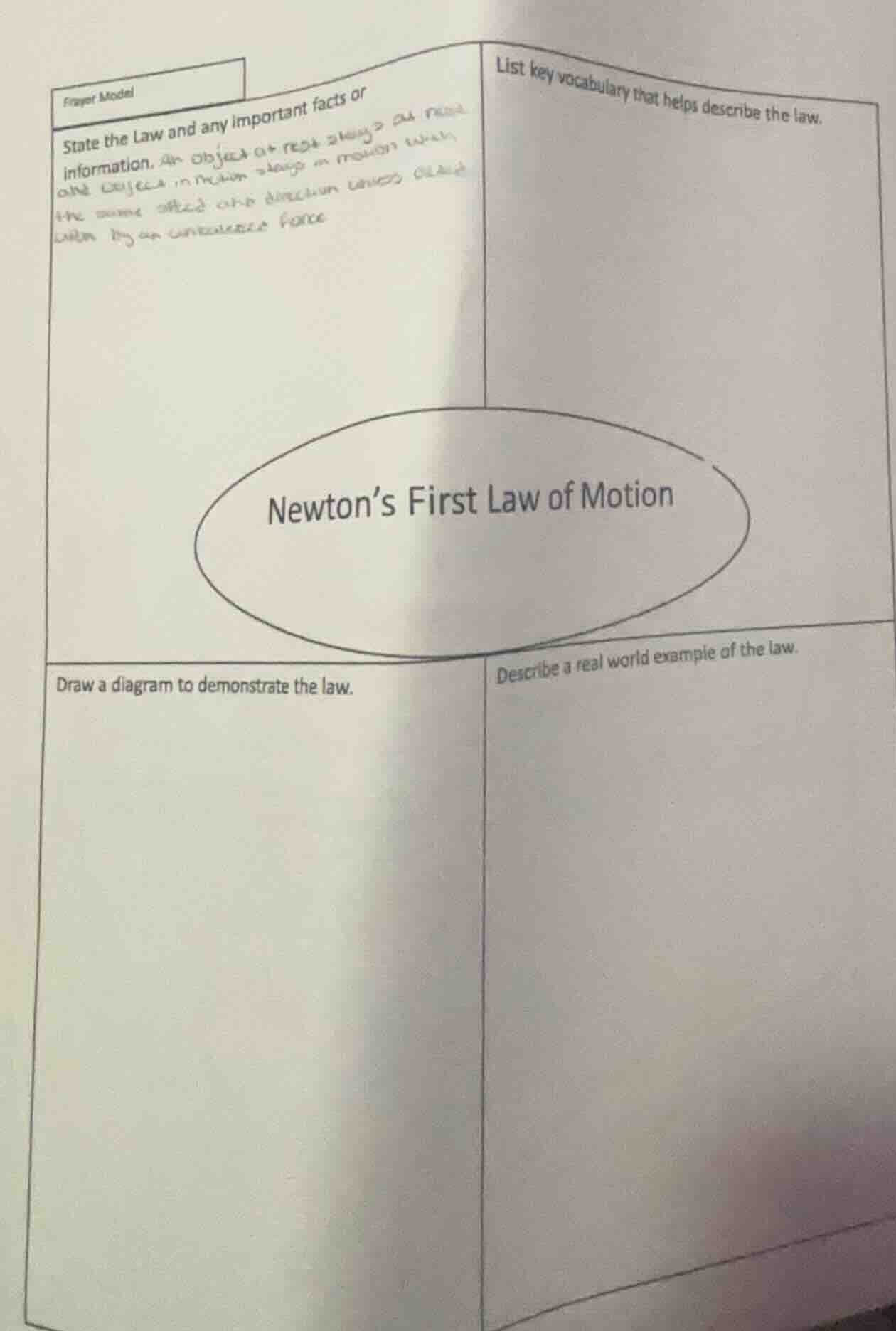
frayer model
state the law and any important facts or information. an object at rest stays at rest and object in motion stays in motion with the same speed and direction unless acted upon by an unbalanced force
list key vocabulary that helps describe the law.
newton’s first law of motion
draw a diagram to demonstrate the law.
describe a real world example of the law.
Brief Explanations
- State the Law: Newton's First Law (Law of Inertia) formalizes the handwritten text: an object at rest stays at rest, and an object in uniform motion stays in motion with constant speed and direction, unless acted upon by an unbalanced external force. Key facts: this law describes inertia, the tendency of objects to resist changes in motion.
- Key Vocabulary: Terms directly tied to defining and explaining the law include inertia, unbalanced force, uniform motion, rest, external force, and velocity.
- Diagram Description: A simple diagram would show a book at rest on a table (no unbalanced forces, so it stays at rest) and a sliding hockey puck on ice (low friction, so it moves uniformly until a force like friction or a stick acts on it).
- Real-World Example: When a car suddenly stops, passengers lurch forward. The passengers were in motion with the car; when the car is stopped by an unbalanced force (brakes), the passengers' bodies tend to stay in motion due to inertia until a seatbelt provides an unbalanced force to stop them.

Snap & solve any problem in the app
Get step-by-step solutions on Sovi AI
Photo-based solutions with guided steps
Explore more problems and detailed explanations
- State the Law and Facts: Newton's First Law of Motion (Law of Inertia): An object at rest remains at rest, and an object in uniform linear motion remains in motion at constant speed and direction, unless acted upon by an unbalanced external force. This law describes inertia, the natural tendency of objects to resist changes in their state of motion.
- Key Vocabulary: Inertia, unbalanced force, uniform motion, rest, external force, velocity
- Diagram Explanation:
- Top panel: A stationary book on a flat table, with arrows for upward normal force and downward gravitational force (balanced, so no motion change).
- Bottom panel: A hockey puck sliding on ice, with a small arrow for friction (weak unbalanced force) slowing it, and a large arrow showing its initial uniform motion direction.
- Real-World Example: When a moving car abruptly brakes, the passengers inside lurch forward. The passengers were moving at the car's speed; when the car is stopped by brake force, the passengers' bodies resist the change in motion (inertia) and continue moving forward until the seatbelt applies an unbalanced force to bring them to a stop.