QUESTION IMAGE
Question
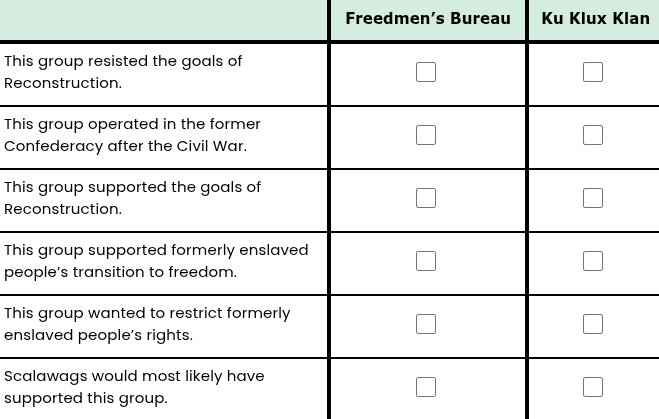
| freedmen’s bureau | ku klux klan |
this group resisted the goals of reconstruction. | |
this group operated in the former confederacy after the civil war. | |
this group supported the goals of reconstruction. | |
this group supported formerly enslaved people’s transition to freedom. | |
this group wanted to restrict formerly enslaved people’s rights. | |
scalawags would most likely have supported this group. | |
To solve this, we analyze each group's role during Reconstruction:
1. “This group resisted the goals of Reconstruction.”
- Freedmen’s Bureau supported Reconstruction.
- Ku Klux Klan (KKK) opposed Reconstruction (e.g., through violence against Black people and Republicans).
→ Check: Ku Klux Klan.
2. “This group operated in the former Confederacy after the Civil War.”
- Freedmen’s Bureau worked in the South (former Confederacy) to aid freedpeople.
- KKK also operated in the former Confederacy to enforce white supremacy.
→ Check: Both (Freedmen’s Bureau, Ku Klux Klan).
3. “This group supported the goals of Reconstruction.”
- Freedmen’s Bureau’s goals (aid freedpeople, promote equality) aligned with Reconstruction.
- KKK opposed Reconstruction.
→ Check: Freedmen’s Bureau.
4. “This group supported formerly enslaved people’s transition to freedom.”
- Freedmen’s Bureau provided resources (food, education, legal help) for freedpeople’s transition.
- KKK sought to limit freedpeople’s rights.
→ Check: Freedmen’s Bureau.
5. “This group wanted to restrict formerly enslaved people’s rights.”
- KKK used terror to restrict Black rights (e.g., voting, employment, mobility).
- Freedmen’s Bureau worked to expand freedpeople’s rights.
→ Check: Ku Klux Klan.
6. “Scalawags would most likely have supported this group.”
- Scalawags (Southern white Republicans) supported Reconstruction.
- Freedmen’s Bureau supported Reconstruction; KKK opposed it.
→ Check: Freedmen’s Bureau.
Final Checkboxes (rows 1–6, columns 1=Freedmen’s Bureau, 2=Ku Klux Klan):
- $\boldsymbol{\square}$ (col1), $\boldsymbol{\checkmark}$ (col2)
- $\boldsymbol{\checkmark}$ (col1), $\boldsymbol{\checkmark}$ (col2)
- $\boldsymbol{\checkmark}$ (col1), $\boldsymbol{\square}$ (col2)
- $\boldsymbol{\checkmark}$ (col1), $\boldsymbol{\square}$ (col2)
- $\boldsymbol{\square}$ (col1), $\boldsymbol{\checkmark}$ (col2)
- $\boldsymbol{\checkmark}$ (col1), $\boldsymbol{\square}$ (col2)
(Note: For each row, mark $\checkmark$ in the appropriate column based on the analysis above.)

Snap & solve any problem in the app
Get step-by-step solutions on Sovi AI
Photo-based solutions with guided steps
Explore more problems and detailed explanations
To solve this, we analyze each group's role during Reconstruction:
1. “This group resisted the goals of Reconstruction.”
- Freedmen’s Bureau supported Reconstruction.
- Ku Klux Klan (KKK) opposed Reconstruction (e.g., through violence against Black people and Republicans).
→ Check: Ku Klux Klan.
2. “This group operated in the former Confederacy after the Civil War.”
- Freedmen’s Bureau worked in the South (former Confederacy) to aid freedpeople.
- KKK also operated in the former Confederacy to enforce white supremacy.
→ Check: Both (Freedmen’s Bureau, Ku Klux Klan).
3. “This group supported the goals of Reconstruction.”
- Freedmen’s Bureau’s goals (aid freedpeople, promote equality) aligned with Reconstruction.
- KKK opposed Reconstruction.
→ Check: Freedmen’s Bureau.
4. “This group supported formerly enslaved people’s transition to freedom.”
- Freedmen’s Bureau provided resources (food, education, legal help) for freedpeople’s transition.
- KKK sought to limit freedpeople’s rights.
→ Check: Freedmen’s Bureau.
5. “This group wanted to restrict formerly enslaved people’s rights.”
- KKK used terror to restrict Black rights (e.g., voting, employment, mobility).
- Freedmen’s Bureau worked to expand freedpeople’s rights.
→ Check: Ku Klux Klan.
6. “Scalawags would most likely have supported this group.”
- Scalawags (Southern white Republicans) supported Reconstruction.
- Freedmen’s Bureau supported Reconstruction; KKK opposed it.
→ Check: Freedmen’s Bureau.
Final Checkboxes (rows 1–6, columns 1=Freedmen’s Bureau, 2=Ku Klux Klan):
- $\boldsymbol{\square}$ (col1), $\boldsymbol{\checkmark}$ (col2)
- $\boldsymbol{\checkmark}$ (col1), $\boldsymbol{\checkmark}$ (col2)
- $\boldsymbol{\checkmark}$ (col1), $\boldsymbol{\square}$ (col2)
- $\boldsymbol{\checkmark}$ (col1), $\boldsymbol{\square}$ (col2)
- $\boldsymbol{\square}$ (col1), $\boldsymbol{\checkmark}$ (col2)
- $\boldsymbol{\checkmark}$ (col1), $\boldsymbol{\square}$ (col2)
(Note: For each row, mark $\checkmark$ in the appropriate column based on the analysis above.)