QUESTION IMAGE
Question
5
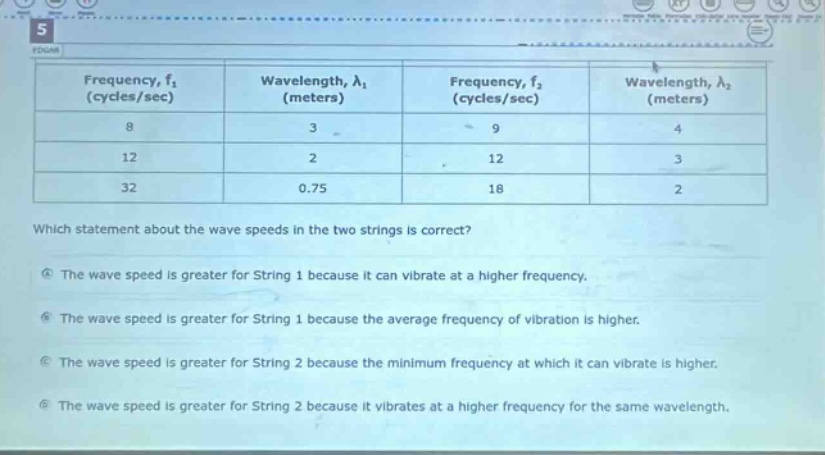
| frequency, ( f_1 ) (cycles/sec) | wavelength, ( lambda_1 ) (meters) | frequency, ( f_2 ) (cycles/sec) | wavelength, ( lambda_2 ) (meters) |
|---|---|---|---|
| 12 | 2 | 12 | 3 |
| 32 | 0.75 | 18 | 2 |
which statement about the wave speeds in the two strings is correct?
a the wave speed is greater for string 1 because it can vibrate at a higher frequency.
b the wave speed is greater for string 1 because the average frequency of vibration is higher.
c the wave speed is greater for string 2 because the minimum frequency at which it can vibrate is higher.
d the wave speed is greater for string 2 because it vibrates at a higher frequency for the same wavelength.
To solve this, we use the wave speed formula \( v = f \lambda \), where \( v \) is wave speed, \( f \) is frequency, and \( \lambda \) is wavelength. We calculate the wave speed for each string using their respective \( f \) and \( \lambda \) values.
Step 1: Calculate wave speed for String 1
For String 1, we have three pairs of \( (f_1, \lambda_1) \):
- When \( f_1 = 8 \) cycles/sec and \( \lambda_1 = 3 \) meters:
\( v_1 = 8 \times 3 = 24 \) m/s.
- When \( f_1 = 12 \) cycles/sec and \( \lambda_1 = 2 \) meters:
\( v_1 = 12 \times 2 = 24 \) m/s.
- When \( f_1 = 32 \) cycles/sec and \( \lambda_1 = 0.75 \) meters:
\( v_1 = 32 \times 0.75 = 24 \) m/s.
Step 2: Calculate wave speed for String 2
For String 2, we have three pairs of \( (f_2, \lambda_2) \):
- When \( f_2 = 9 \) cycles/sec and \( \lambda_2 = 4 \) meters:
\( v_2 = 9 \times 4 = 36 \) m/s.
- When \( f_2 = 12 \) cycles/sec and \( \lambda_2 = 3 \) meters:
\( v_2 = 12 \times 3 = 36 \) m/s.
- When \( f_2 = 18 \) cycles/sec and \( \lambda_2 = 2 \) meters:
\( v_2 = 18 \times 2 = 36 \) m/s.
Step 3: Analyze the options
- Option 1: Incorrect. String 1’s speed is 24 m/s, not greater than String 2’s 36 m/s.
- Option 2: Incorrect. String 1’s average frequency is not higher in a way that increases speed (speed depends on \( f\lambda \), not just \( f \)).
- Option 3: Incorrect. Minimum frequency does not determine speed; speed is \( f\lambda \).
- Option 4: Let’s check “same wavelength” (e.g., \( \lambda = 2 \) m). For String 1: \( f = 12 \) Hz, \( v = 24 \) m/s. For String 2: \( f = 18 \) Hz, \( v = 36 \) m/s. String 2 has a higher \( f \) for the same \( \lambda \), so higher speed.

Snap & solve any problem in the app
Get step-by-step solutions on Sovi AI
Photo-based solutions with guided steps
Explore more problems and detailed explanations
The wave speed is greater for String 2 because it vibrates at a higher frequency for the same wavelength. (The correct option, e.g., if it’s labeled as the last option, state the identifier and text.)