QUESTION IMAGE
Question
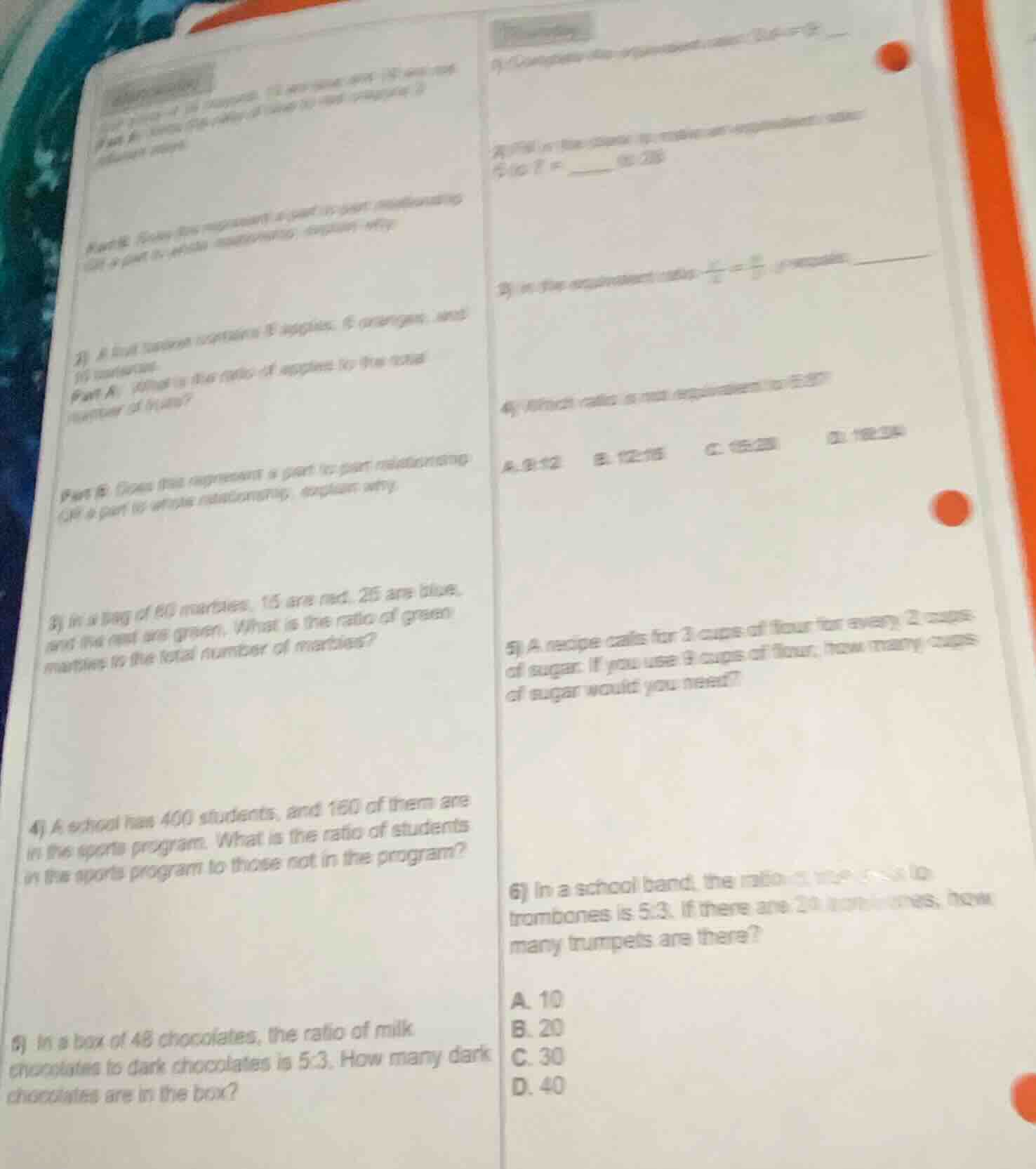
- a fruit basket contains 8 apples, 6 oranges, and 10 bananas.
part a: what is the ratio of apples to the total number of fruits?
part b: does this represent a part to part relationship or a part to whole relationship; explain why.
- in a bag of 80 marbles, 15 are red, 25 are blue, and the rest are green. what is the ratio of green marbles to the total number of marbles?
- a school has 400 students, and 160 of them are in the sports program. what is the ratio of students in the sports program to those not in the program?
- in a box of 48 chocolates, the ratio of milk chocolates to dark chocolates is 5:3. how many dark chocolates are in the box?
- (compare two of given, (2) are equal and (2) are not
part a: write the letter of each to their proper ?
(choose ways)
part b: draw the response a part to part relationship or a part to whole relationship; explain why
- (fill in the blank to make an equivalent ratio)
5 to 7 = ______ to 28
- in the equivalent ratio \\(\frac{15}{4}=\frac{45}{y}\\), y equals ______
- which ratio is not equivalent to 5:3?
a. 9:12 b. 12:15 c. 15:20 d. 18:24
- a recipe calls for 3 cups of flour for every 2 cups of sugar. if you use 9 cups of flour, how many cups of sugar would you need?
- in a school band, the ratio of trumpets to trombones is 5:3. if there are 20 trombones, how many trumpets are there?
a. 10
b. 20
c. 30
d. 40
Let's solve the problem about the box of chocolates (problem 5 on the left, maybe? Wait, the last problem on the left: "In a box of 48 chocolates, the ratio of milk chocolates to dark chocolates is 5:3. How many dark chocolates are in the box?"). Let's solve that.
Step1: Find total parts of the ratio
The ratio of milk to dark is \( 5:3 \), so total parts \( = 5 + 3 = 8 \).
Step2: Find value of one part
Total chocolates are 48, so one part \( = \frac{48}{8} = 6 \).
Step3: Calculate dark chocolates
Dark chocolates are 3 parts, so \( 3 \times 6 = 18 \)? Wait, no, wait: ratio milk:dark is 5:3, so dark is 3 parts. Wait, 5+3=8 parts. 48 divided by 8 is 6. So dark chocolates: 36=18? Wait, maybe I misread. Wait, the problem says "milk chocolates to dark chocolates is 5:3". So milk is 5 parts, dark is 3 parts. Total parts 8. 48/8=6. So dark is 36=18. Wait, but maybe the problem is different. Wait, let's check again.
Wait, maybe the problem is the one with school band: "In a school band, the ratio of trumpets to trombones is 5:3. If there are 20 trombones, how many trumpets are there?" Wait, no, the options are 10,20,30,40. Wait, maybe I mixed up. Let's take the chocolate problem first.
Wait, the chocolate problem: box of 48 chocolates, ratio milk to dark is 5:3. How many dark?
Total parts: 5 + 3 = 8.
Each part: 48 / 8 = 6.
Dark chocolates: 3 * 6 = 18.
But maybe the school band problem: ratio trumpets to trombones is 5:3. If trombones are 20? Wait, no, the options are 10,20,30,40. Wait, maybe the trombones are 12? No, the problem says "If there are 20 trombones" – wait, no, maybe the trombones are 12? Wait, no, the options are A.10, B.20, C.30, D.40. Let's solve that.
Ratio trumpets (T) to trombones (Tr) is 5:3. So T/Tr = 5/3.
If Tr = 20? No, that would give T = (5/3)*20 ≈ 33.33, not in options. Wait, maybe Tr is 12? No, the problem says "If there are 20 trombones" – wait, maybe a typo. Wait, maybe the trombones are 12? No, the options are 10,20,30,40. Wait, maybe the ratio is 5:3, and trombones are 12? No, let's check the chocolate problem again.
Wait, the chocolate problem: 48 chocolates, ratio 5:3. So milk is 5x, dark is 3x. 5x + 3x = 48 → 8x=48 → x=6. So dark is 3*6=18. So answer is 18.
But let's take the recipe problem: "A recipe calls for 3 cups of flour for every 2 cups of sugar. If you use 9 cups of flour, how many cups of sugar would you need?"
Step1: Set up proportion
Flour : Sugar = 3 : 2. Let sugar be \( x \). So \( \frac{3}{2} = \frac{9}{x} \).
Step2: Cross-multiply
\( 3x = 2 \times 9 \) → \( 3x = 18 \) → \( x = 6 \).
So sugar needed is 6 cups.
But let's choose one problem. Let's take the recipe problem.
Step1: Define the ratio
Flour to sugar ratio is \( 3:2 \), meaning \( \frac{\text{Flour}}{\text{Sugar}} = \frac{3}{2} \).
Step2: Set up proportion for 9 cups flour
Let \( x \) be sugar cups. Then \( \frac{3}{2} = \frac{9}{x} \).
Step3: Solve for \( x \)
Cross-multiply: \( 3x = 2 \times 9 \) → \( 3x = 18 \) → \( x = \frac{18}{3} = 6 \).

Snap & solve any problem in the app
Get step-by-step solutions on Sovi AI
Photo-based solutions with guided steps
Explore more problems and detailed explanations
6