QUESTION IMAGE
Question
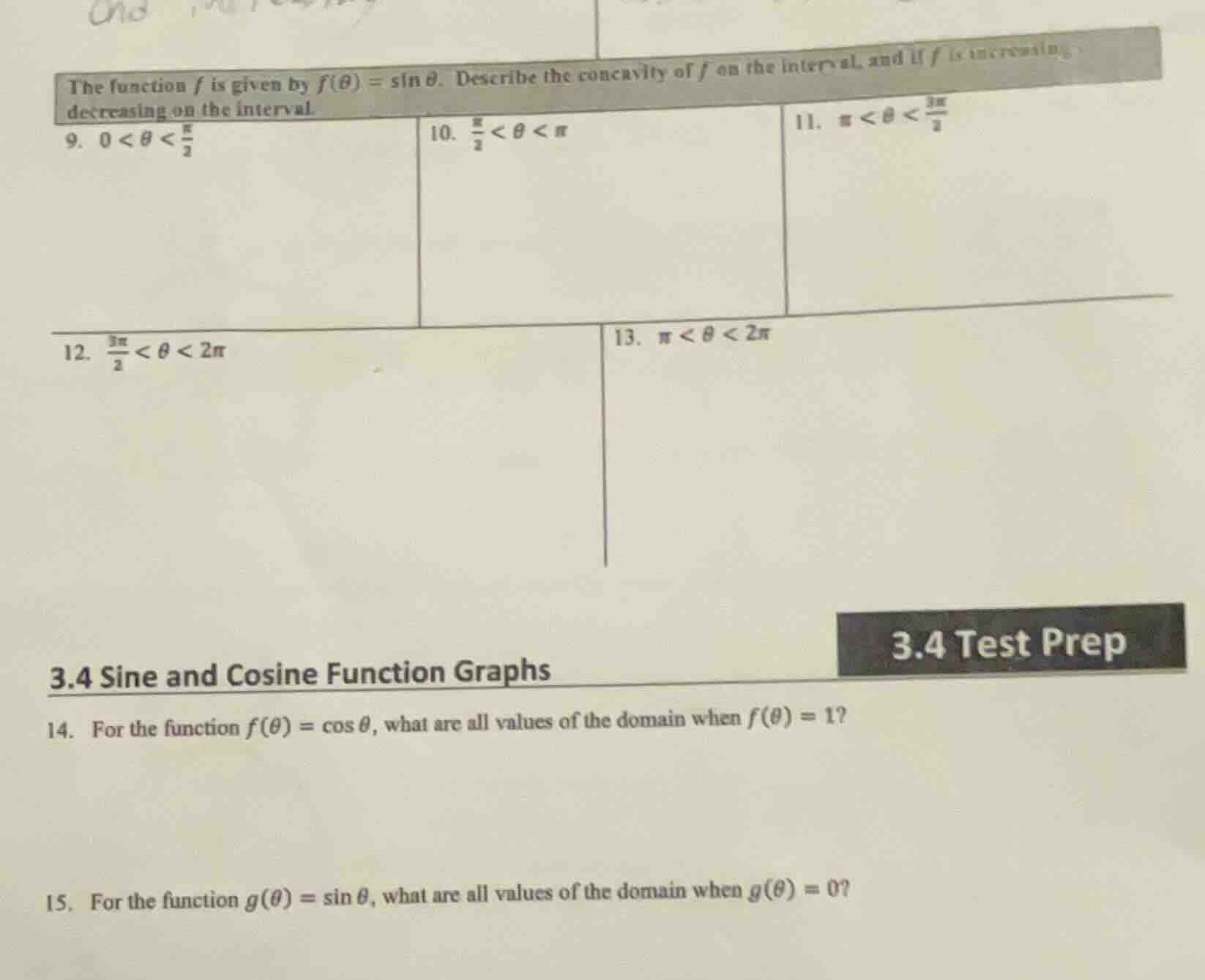
the function ( f ) is given by ( f(\theta) = sin \theta ). describe the concavity of ( f ) on the interval, and if ( f ) is increasing or decreasing on the interval.
- ( 0 < \theta < \frac{pi}{2} )
- ( \frac{pi}{2} < \theta < pi )
- ( pi < \theta < \frac{3pi}{2} )
- ( \frac{3pi}{2} < \theta < 2pi )
- ( pi < \theta < 2pi )
3.4 sine and cosine function graphs
3.4 test prep
- for the function ( f(\theta) = cos \theta ), what are all values of the domain when ( f(\theta) = 1 )?
- for the function ( g(\theta) = sin \theta ), what are all values of the domain when ( g(\theta) = 0 )?
Question 14
Step 1: Recall the cosine function property
The cosine function \( f(\theta) = \cos\theta \) has a value of 1 at specific angles. We know from the unit circle and the properties of the cosine function that \( \cos\theta = 1 \) when \( \theta = 2k\pi \), where \( k \) is any integer (positive, negative, or zero). This is because the cosine of an angle represents the x - coordinate on the unit circle, and when the x - coordinate is 1, the angle is a multiple of \( 2\pi \) (a full rotation around the unit circle).
Step 1: Recall the sine function property
The sine function \( g(\theta)=\sin\theta \) has a value of 0 at specific angles. From the unit circle and the properties of the sine function, we know that \( \sin\theta = 0 \) when \( \theta = k\pi \), where \( k \) is any integer (positive, negative, or zero). This is because the sine of an angle represents the y - coordinate on the unit circle, and when the y - coordinate is 0, the angle is a multiple of \( \pi \) (half - rotations around the unit circle, at angles like \( 0,\pi,2\pi, - \pi,- 2\pi,\cdots \)).

Snap & solve any problem in the app
Get step-by-step solutions on Sovi AI
Photo-based solutions with guided steps
Explore more problems and detailed explanations
All values of the domain (where \( f(\theta)=\cos\theta = 1 \)) are \( \theta = 2k\pi \), for any integer \( k \) (or \( \theta=2k\pi,k\in\mathbb{Z} \))