QUESTION IMAGE
Question
function operations
for use with exploration 5.5
essential question how can you use the graphs of two functions to sketch the graph of an arithmetic combination of the two functions?
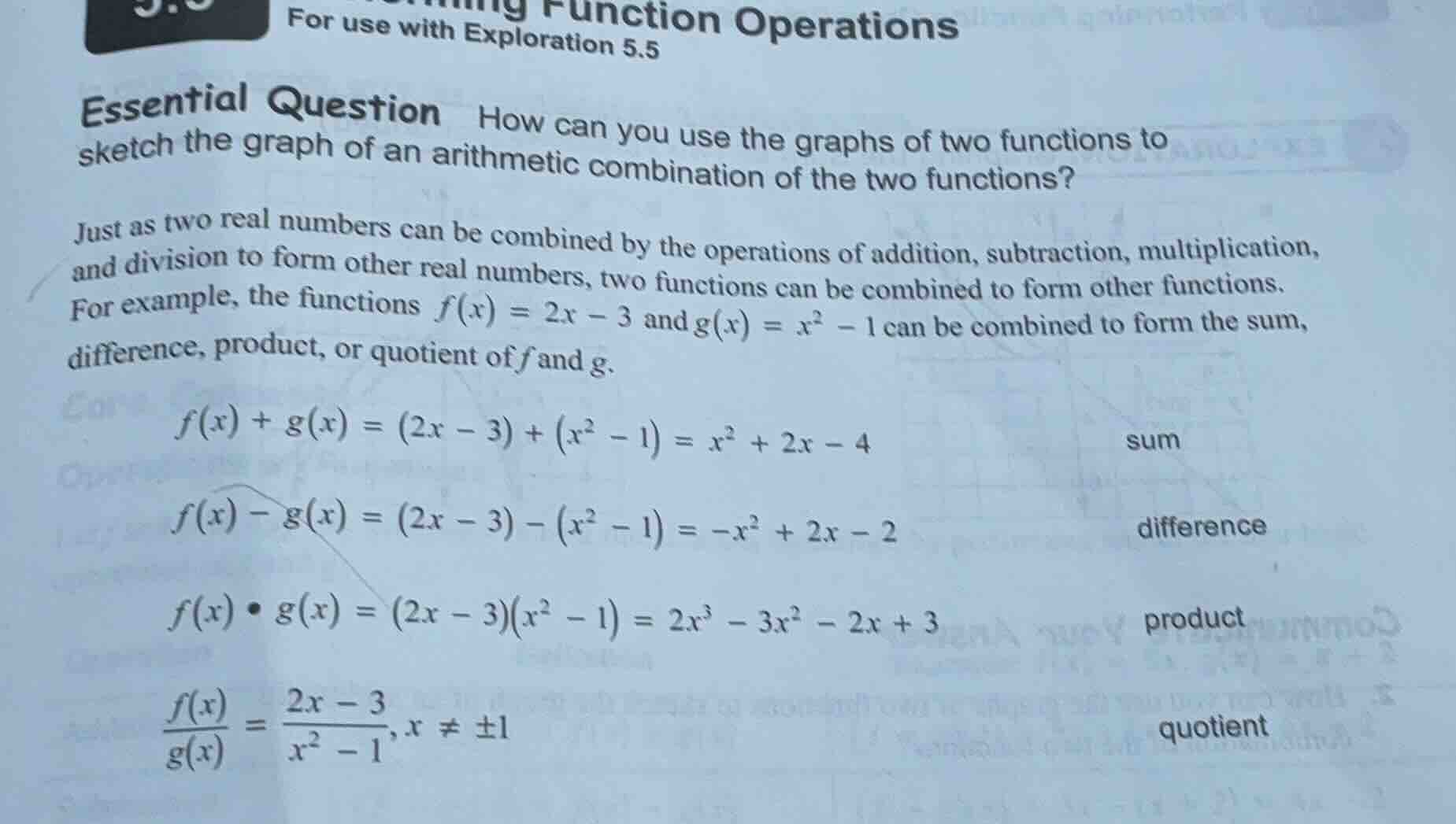
just as two real numbers can be combined by the operations of addition, subtraction, multiplication, and division to form other real numbers, two functions can be combined to form other functions. for example, the functions $f(x) = 2x - 3$ and $g(x) = x^2 - 1$ can be combined to form the sum, difference, product, or quotient of $f$ and $g$.
$f(x) + g(x) = (2x - 3) + (x^2 - 1) = x^2 + 2x - 4$ sum
$f(x) - g(x) = (2x - 3) - (x^2 - 1) = -x^2 + 2x - 2$ difference
$f(x) \bullet g(x) = (2x - 3)(x^2 - 1) = 2x^3 - 3x^2 - 2x + 3$ product
$\frac{f(x)}{g(x)} = \frac{2x - 3}{x^2 - 1}, x \
eq \pm1$ quotient
Since the problem here is about understanding how to use graphs of two functions to sketch the graph of their arithmetic combination (sum, difference, product, quotient), and also involves function operations (algebraic manipulations of functions), the subfield from Mathematics that applies is Algebra (specifically, it's about function operations which is a topic in Algebra, and also relates to the graphical aspects which could tie to Algebra and potentially Calculus/Graphing, but the core operation here is algebraic combination of functions).
To answer the essential question:
Step-by-Step Explanation (for the process of sketching the graph of arithmetic combination using two function graphs):
Step 1: Understand the Arithmetic Operation
First, identify the arithmetic operation (sum, difference, product, or quotient) for the two functions \( f(x) \) and \( g(x) \). For example, if it's a sum \( h(x) = f(x) + g(x) \), difference \( h(x) = f(x) - g(x) \), product \( h(x) = f(x) \cdot g(x) \), or quotient \( h(x) = \frac{f(x)}{g(x)} \) (with \( g(x)
eq 0 \)).
Step 2: Analyze Key Points on \( f(x) \) and \( g(x) \)
For a set of \( x \)-values (e.g., critical points, intercepts, vertices, asymptotes if applicable), find the corresponding \( y \)-values (outputs) of \( f(x) \) and \( g(x) \) from their graphs. For example, if \( x = a \) is an \( x \)-intercept of \( f(x) \) (so \( f(a) = 0 \)) and \( x = b \) is an \( x \)-intercept of \( g(x) \) (so \( g(b) = 0 \)), these points will help in determining the behavior of the combined function.
Step 3: Compute the Combined Function's Value at Key Points
For each arithmetic operation:
- Sum: At a point \( x = c \), \( h(c) = f(c) + g(c) \). So, add the \( y \)-values of \( f(x) \) and \( g(x) \) at \( x = c \).
- Difference: At \( x = c \), \( h(c) = f(c) - g(c) \). Subtract the \( y \)-value of \( g(x) \) from \( f(x) \) at \( x = c \).
- Product: At \( x = c \), \( h(c) = f(c) \cdot g(c) \). Multiply the \( y \)-values of \( f(x) \) and \( g(x) \) at \( x = c \).
- Quotient: At \( x = c \) (where \( g(c)
eq 0 \)), \( h(c) = \frac{f(c)}{g(c)} \). Divide the \( y \)-value of \( f(x) \) by \( g(x) \) at \( x = c \).
Step 4: Analyze Asymptotes (for Quotient)
If the operation is a quotient \( \frac{f(x)}{g(x)} \), find the vertical asymptotes by identifying \( x \)-values where \( g(x) = 0 \) (and \( f(x)
eq 0 \) at those points). Horizontal or slant asymptotes can be determined by analyzing the end - behavior of \( f(x) \) and \( g(x) \) (e.g., if \( f(x) \) and \( g(x) \) are polynomials, use the degrees of the polynomials to find the horizontal asymptote of the quotient).
Step 5: Sketch the Combined Function
Plot the key points (from Step 3) on the coordinate plane. For the sum and difference, the graph will have a shape that is related to the sum/difference of the two original graphs' behaviors. For the product, the sign of the product (positive or negative) will depend on the signs of \( f(x) \) and \( g(x) \) in different intervals. For the quotient, use the asymptotes and the key points to sketch the graph, being careful with the behavior near asymptotes and the sign of the quotient in different intervals.

Snap & solve any problem in the app
Get step-by-step solutions on Sovi AI
Photo-based solutions with guided steps
Explore more problems and detailed explanations
(to the Essential Question):
To sketch the graph of an arithmetic combination (sum, difference, product, or quotient) of two functions \( f(x) \) and \( g(x) \) using their graphs:
- Identify the Arithmetic Operation: Determine if you are finding the sum (\( f + g \)), difference (\( f - g \)), product (\( f\cdot g \)), or quotient (\( \frac{f}{g} \)) of the two functions.
- Find Key Points on \( f(x) \) and \( g(x) \): Locate important points (e.g., intercepts, vertices, asymptotes) on the graphs of \( f(x) \) and \( g(x) \).
- Compute Combined Function Values at Key Points: For each key \( x \)-value, calculate the value of the combined function using the arithmetic operation. For sum, add the \( y \)-values of \( f(x) \) and \( g(x) \); for difference, subtract; for product, multiply; for quotient, divide (ensuring the denominator is non - zero).
- Analyze Asymptotes (for Quotient): For a quotient function, determine vertical, horizontal, or slant asymptotes.
- Sketch the Graph: Plot the calculated key points and use the behavior of the original functions (e.g., increasing/decreasing, concavity for more advanced cases, sign of the function) to sketch the graph of the combined function, connecting the points in a way that is consistent with the arithmetic operation's effect on the original functions' graphs.