QUESTION IMAGE
Question
functions
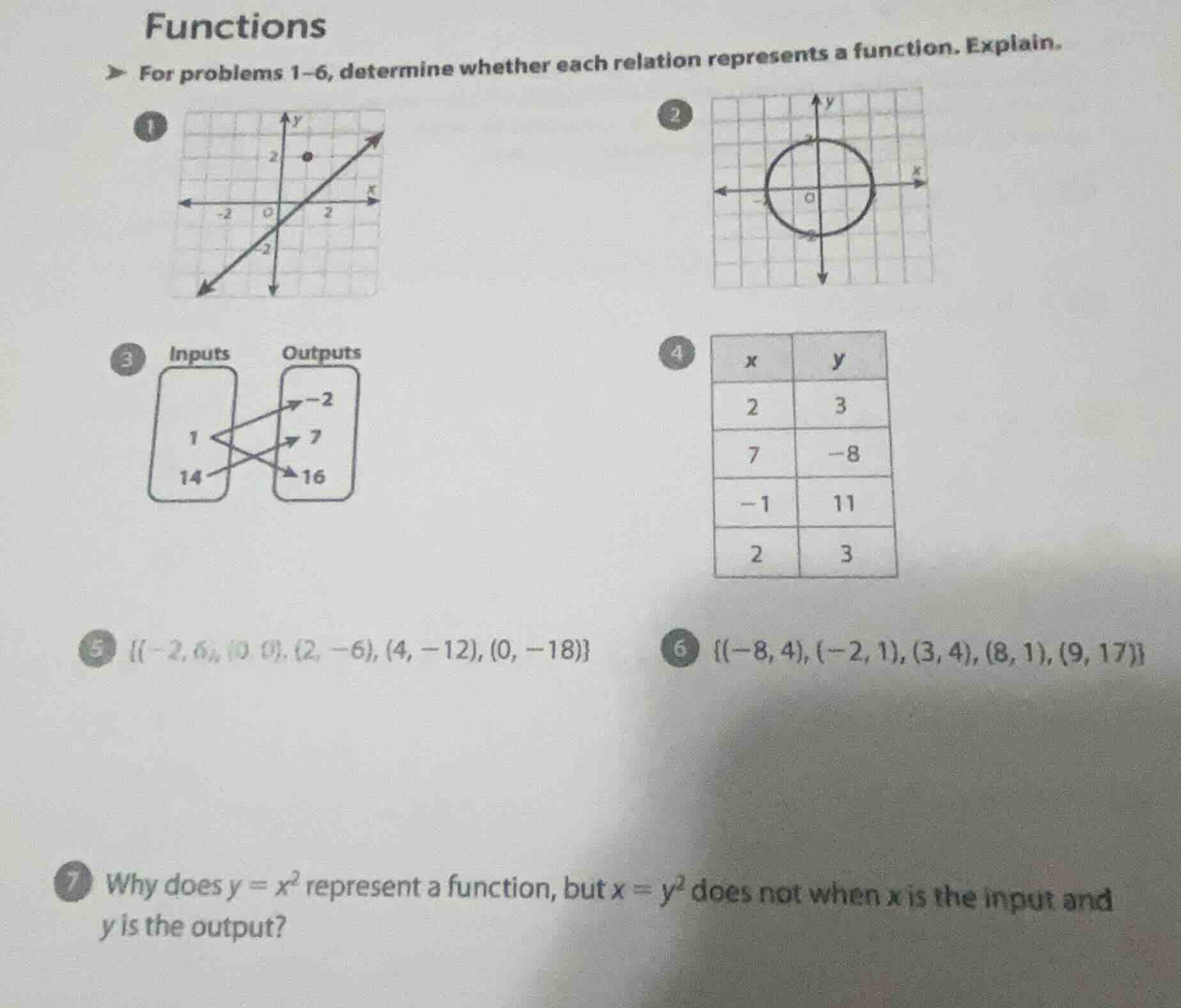
for problems 1–6, determine whether each relation represents a function. explain.
1
2
3 inputs outputs
-2
1 7
14 16
4
x y
2 3
7 -8
-1 11
2 3
5 {(-2,6), (0, 0), (2, -6), (4, -12), (0, -18)}
6 {(-8, 4), (-2, 1), (3, 4), (8, 1), (9, 17)}
7 why does $y = x^2$ represent a function, but $x = y^2$ does not when $x$ is the input and $y$ is the output?
Problem 1:
Step 1: Recall the definition of a function.
A relation is a function if every input (x - value) has exactly one output (y - value). For a graph, we can use the vertical line test: if any vertical line intersects the graph at more than one point, it is not a function.
Step 2: Apply the vertical line test to the graph.
Looking at the first graph, if we draw a vertical line at any x - value, it will intersect the graph (the line and the point) at most once. The point and the line do not violate the vertical line test because the point is above the line, and for each x, there is only one y.
Step 1: Recall the vertical line test.
A graph represents a function if no vertical line intersects the graph more than once.
Step 2: Apply the vertical line test to the circle graph.
For a circle centered at the origin, if we draw a vertical line (for example, \(x = 0\) or \(x = 1\) or \(x=- 1\)), the vertical line will intersect the circle at two points. So, it fails the vertical line test.
Step 1: Recall the function definition for mappings.
A mapping from inputs (domain) to outputs (range) is a function if each input is mapped to exactly one output.
Step 2: Analyze the mapping.
The input \(1\) is mapped to \(- 2\), \(7\), and \(16\). So, the input \(1\) has more than one output.

Snap & solve any problem in the app
Get step-by-step solutions on Sovi AI
Photo-based solutions with guided steps
Explore more problems and detailed explanations
This relation is a function. Because for every x - value, there is exactly one y - value (passes the vertical line test).