QUESTION IMAGE
Question
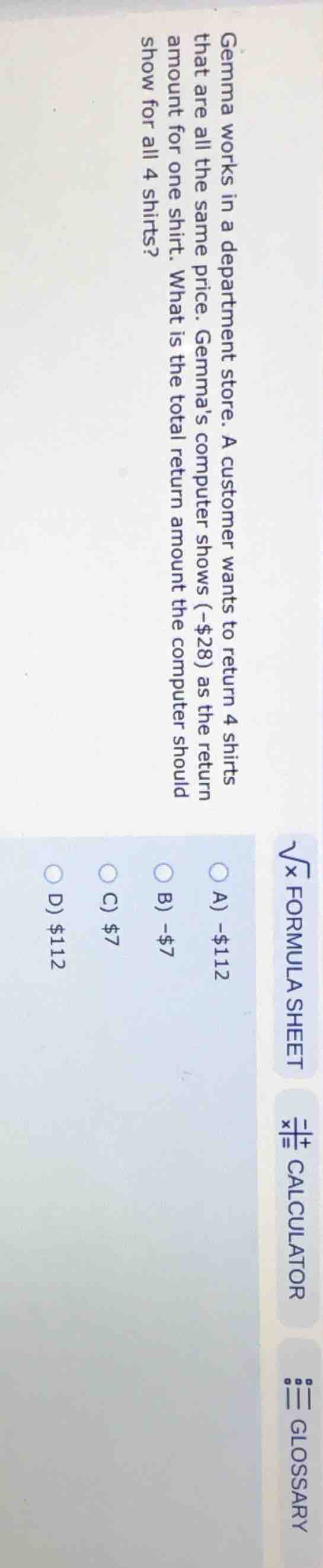
gemma works in a department store. a customer wants to return 4 shirts that are all the same price. gemma’s computer shows (-$28) as the return amount for one shirt. what is the total return amount the computer should show for all 4 shirts? a) -$112 b) -$7 c) $7 d) $112
Step1: Identify the return per shirt
The return amount for one shirt is $-\$28$ (negative because it's a return, representing money given back).
Step2: Calculate total return for 4 shirts
To find the total return for 4 shirts, we multiply the return per shirt by the number of shirts. So we calculate $4\times(-28)$? Wait, no. Wait, if one shirt has a return amount of $-\$28$ (meaning the store gives back $28$ dollars for one shirt), then for 4 shirts, we need to find the total amount given back. Wait, actually, the return amount for one shirt is $-\$28$ (maybe in the system, negative means return). So to find the total for 4 shirts, we do $4\times(-28)$? Wait, no, that would be negative, but actually, when you return an item, the total return should be the sum of each return. Since each shirt has a return of $-\$28$ (so the store owes the customer $28$ per shirt), for 4 shirts, it's $4\times28$ but with the sign. Wait, the problem says the computer shows $(-\$28)$ as the return amount for one shirt. So for 4 shirts, we multiply the per - shirt return by 4. So the calculation is $4\times(-28)$? Wait, no, that would be $- 112$, but let's think again. If returning one shirt gives the customer back $\$28$ (so the store's account has a decrease of $\$28$, which is represented as $-\$28$ in the store's system). Then for 4 shirts, the total return (the total amount the store gives back to the customer) is $4\times28=\$112$, but in the store's system, since it's a return (money going out), it would be $-\$112$? Wait, no, the question is "What is the total return amount the computer should show for all 4 shirts?". If one shirt is $-\$28$ (return), then 4 shirts would be $4\times(-28)=- 112$? Wait, but let's check the options. Option A is $-\$112$, option D is $\$112$. Wait, maybe the sign is different. Let's re - read the problem: "Gemma's computer shows $(-\$28)$ as the return amount for one shirt". So "return amount" here: when you return a shirt, the store gives you money, so from the store's perspective, a return is a negative (because it's a decrease in revenue, or an expense). So if one shirt has a return of $-\$28$ (the store's account: they have to give back $28$, so their cash outflow is $28$, which is a negative in their income statement). Then for 4 shirts, the total return (the total amount the store has to give back) is $4\times28 = 112$, but in the store's system, since it's a return (outflow), it's $-\$112$? Wait, no, maybe I got the sign wrong. Let's think of it as: the return amount for one shirt is $-\$28$ (so the customer gets back $\$28$ per shirt). So for 4 shirts, the customer gets back $4\times28=\$112$, but in the computer system, if the return is represented as a negative (because it's a credit to the customer, debit to the store), then the total return amount (from the store's perspective) is $-\$112$. So the calculation is $4\times(-28)=-112$.

Snap & solve any problem in the app
Get step-by-step solutions on Sovi AI
Photo-based solutions with guided steps
Explore more problems and detailed explanations
A) $-\$112$